


A half-empty ice bin before the lunch rush is an operational warning, not a minor inconvenience. Waiting for a complete shutdown can raise repair costs, complicate food-service operations, and leave customers waiting.
Schedule commercial ice machine repair with QRC
Commercial ice machine repair should be scheduled promptly when output drops, ice looks cloudy or misshapen, the machine leaks, or it makes unusual noises. Also call a technician if the unit cycles constantly, runs hot, shows repeated error codes, or still produces no ice after basic checks. Shut down equipment that produces dirty or foul-smelling ice.
Knowing when to call requires separating safe staff checks from faults that need a qualified refrigeration technician. Managers do not need to diagnose the machine themselves. They do need to recognize urgent warnings, document the symptom, protect people and product, and arrange service before a small problem causes a longer interruption.
Signs your commercial ice machine needs repair
Falling production often appears before complete failure. The bin may refill more slowly, batches may stop early, or the unit may run without completing a cycle. Ice can become thin, cloudy, soft, hollow, small, or misshapen when water flow, freezing, harvest, cleaning, or control problems affect operation.
Urgent signs that call for shutdown
Stop the machine if water is pooling near electrical parts, you smell burning, or a component feels unusually hot. Loud grinding, banging, or screeching also calls for a shutdown. These signs may point to a leak, failing motor, blocked fan, damaged moving part, or electrical fault.
Do not remove panels or reach into the unit while it is powered. Turn it off using the approved controls only if staff can do so safely, keep people away from the area, and call a trained technician. Prompt commercial ice machine service can limit added damage.
- Stop for electrical risk: Burning odors, smoke, repeated breaker trips, or water near electrical parts require immediate attention.
- Stop for questionable ice: Do not serve ice with an unusual taste, smell, color, or visible debris.
- Stop for severe leaks: Keep staff and customers away from wet floors and active leaks near the unit.
- Call for repeated faults: Recurring error codes, resets, or shutdowns indicate that the underlying problem remains.
Changes in output, ice quality, and sound
No ice is the clearest warning, but low output can be just as disruptive during peak demand. A technician can test the water supply, condenser, controls, sensors, evaporator, and refrigeration circuit instead of replacing parts by guesswork. Record whether the machine starts, freezes, harvests, or stops at a repeatable point.
New clicking, humming, rattling, buzzing, or fan noise matters even when the machine still makes ice. Frequent resets, fault codes, and cycles that start and stop also need professional diagnosis. QRC’s guide to signs you need commercial refrigeration repair covers related warnings across other cold-storage equipment.
What common ice machine symptoms may mean
Common symptoms identify a likely system to inspect, not a guaranteed failed part. No ice can involve water, airflow, controls, sensors, or refrigeration performance. Leaks can begin at drains, hoses, pumps, fittings, or seals. Record the symptom and operating stage so a technician can test the cause efficiently.
| Symptom | Possible cause area | Useful first check |
|---|---|---|
| No ice | Water supply, inlet valve, condenser, sensor, or refrigeration system | Confirm water and power are on |
| Low output | Filter, scale, airflow, or weak refrigeration performance | Check filter age and blocked vents |
| Thin or hollow ice | Low water flow, scale, or freeze-cycle control | Look for weak or uneven water flow |
| Large ice sheets | Harvest sensor, control, or evaporator condition | Record whether harvest runs late |
| Water leak | Drain, hose, fitting, pump, or bin seal | Shut down and locate the visible source |
| Repeated shutdown | High temperature, sensor, safety control, or board | Record the error code before resetting |
No ice or low ice output
A machine that stops making ice may have a closed water valve, blocked filter, weak inlet valve, dirty evaporator, poor airflow, dirty condenser, or refrigeration fault. First confirm a clear water supply, normal controls, and enough space around air-cooled vents. Do not open sealed refrigeration lines or bypass safety controls.
Misshapen ice, leaks, and slow cycles
Thin, hollow, or uneven cubes can suggest that water is not moving across the evaporator as designed. A clogged filter, mineral scale, weak pump, or inlet problem may reduce flow. Large sheets that fail to release can point toward the harvest cycle, sensor readings, or evaporator condition.
Leaks need quick attention because water may spread beyond the machine or reach nearby equipment. A loose hose, blocked drain, cracked fitting, failed pump, or poor bin seal may be responsible. Stop operation when a leak creates an electrical or slip hazard.
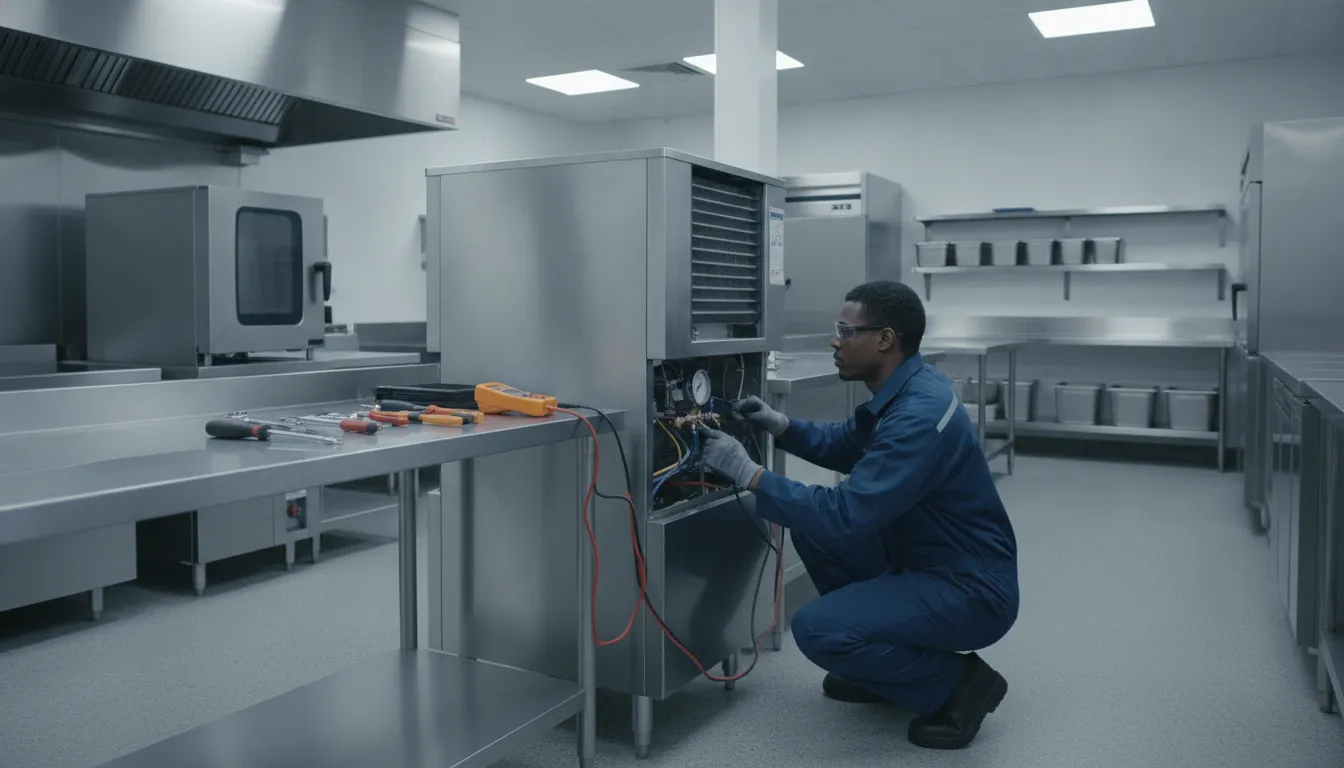
What should you check before calling a technician?
Before calling, confirm the symptom, normal control setting, visible water supply, clear exterior vents, and display code without removing covers. Photograph warning lights and record the model, serial number, last cleaning, and recent service. Stop immediately if checks would expose staff to electricity, moving parts, refrigerant, or contaminated ice.
Safe checks before the call
Do not remove covers, open electrical panels, handle refrigerant lines, or take the machine apart. Instead, check only items staff can reach without entering the equipment. Useful notes can shorten diagnosis time and help the service team arrive prepared.
- Confirm the symptom: Note whether the machine makes no ice, makes too little ice, leaks, or produces poor-quality cubes.
- Check normal controls: Make sure the unit is set to make ice and was not placed in clean or off mode.
- Observe the water supply: From a safe distance, note a closed visible valve, kinked hose, low flow, or nearby leak.
- Inspect exterior airflow: Clear stored items blocking outside vents, but do not reach inside the machine.
- Read the display: Photograph error codes, warning lights, and current settings before anyone resets the unit.
- Record machine details: Capture the brand, model, serial number, cleaning date, recent work, and when the problem began.
What staff should not reset or repair
A manager should not keep restarting a machine that trips a breaker or returns to the same fault. Never bypass a safety switch or attempt electrical work. Leave refrigerant checks, internal cleaning, component testing, and part replacement to a trained technician. A reset may temporarily hide a symptom while the cause continues to worsen.
Keep questionable ice out of service until the cause is clear. The CDC notes that harmful germs can live in ice and on equipment that touches it. Follow the business’s food safety procedures and the manufacturer’s approved cleaning process rather than improvising.
When should you call a commercial ice machine repair technician?
Call immediately for burning odors, smoke, harsh mechanical noise, breaker trips, active leaks, unsafe heat, contaminated-looking ice, or repeated shutdowns. Arrange prompt service for falling output, misshapen cubes, slow cycles, recurring codes, or faults that remain after safe basic checks. Do not wait for complete failure during peak demand.
Safety, sanitation, and control failures
Stop serving ice that smells odd, tastes unusual, looks discolored, or contains visible debris. A cleaning cycle alone may not address buildup in hidden water lines or internal parts. Water leaks, standing water, hot surfaces, smoke, and burning odors also require immediate attention. Shut the machine down only when staff can do so safely.
Why delaying service can cost more
Do not keep resetting a unit that returns to the same fault. Delayed service can lead to more downtime and added strain on connected parts. Leaks, scale, blocked airflow, and dirty heat-transfer surfaces may also reduce performance over time. Early diagnosis gives managers more control over scheduling and repair decisions.
Before calling, record the model, serial number, error code, and when the issue began. Note recent cleaning, changes in ice quality, and unusual sounds. For broader cold-storage issues at the same site, review QRC’s commercial refrigeration repair guide.
What should you expect during professional ice machine service?
Professional service should progress from confirming the reported symptom to testing likely systems, identifying the cause, and presenting a clear repair plan. A technician may observe a complete cycle, inspect water and airflow paths, test controls and refrigeration performance, explain sanitation concerns, and verify operation after approved work is complete.
Diagnosis from symptom to cause
The technician first reviews the model, serial number, controls, service history, error codes, and recent changes. They may observe a freeze and harvest cycle, check ice quality, and note sounds or leaks. Next, they inspect relevant water, drain, filter, condenser, evaporator, sensor, electrical, and refrigeration components.
Testing matters because a failed part can resemble a cleaning, airflow, or water problem. The technician should explain what evidence confirmed the diagnosis, what caused the fault when known, and whether another condition could make it return. They should also separate mechanical repair recommendations from cleaning or maintenance needs.
Questions to ask before work starts
- Diagnosis: What tests confirmed the fault, and what likely caused it?
- Scope: Does the estimate separate parts, labor, cleaning, and follow-up testing?
- Expected result: Will the repair restore suitable ice output and quality?
- Coverage: Is any part or labor covered by a manufacturer or service warranty?
- Long-term fit: Would replacement make more sense based on condition, demand, and repair history?
Keep written findings with the machine’s records. Before the appointment, clear boxes and supplies away from the unit, bin, condenser, and nearby shutoffs. Provide safe access and tell staff not to reset the machine unless the service team requests it. QRC supports commercial and industrial refrigeration needs and provides ice maker sales and service.
How does preventive maintenance help avoid emergency repairs?
Preventive maintenance reduces emergency risk by keeping water flow, filters, airflow, contact surfaces, and operating records under routine review. It can reveal scale, blocked vents, changing cube shape, longer cycles, and falling output before production stops. Maintenance cannot prevent every failure, but it creates earlier opportunities for planned service.
Cleaning, filters, airflow, and water quality
Clean the machine on the schedule in its manual, using products and procedures approved for that model. Keep nearby storage away from condenser vents. Check air and water filters on a set schedule, then replace them according to manufacturer directions, site conditions, and actual wear instead of waiting for poor output.
- Keep airflow clear: Remove dust and grease from accessible intake areas and avoid blocking exterior vents.
- Watch food-contact areas: Check the bin, scoop, and reachable contact surfaces for buildup.
- Track production changes: Note slow harvest cycles, longer run times, and changes in cube shape.
- Maintain a service log: Record cleaning, filter changes, error codes, leaks, and past parts replaced.
Water conditions can affect how quickly scale and residue build up. Note sudden changes in taste, odor, clarity, or cube size, and ask a service professional whether the installed filter and treatment plan fit the site. Assign routine visual checks to a named team member and create a simple way for staff to report concerns.
Should you repair or replace your commercial ice machine?
Repair often makes sense when the machine meets peak demand, has an isolated fault, and has not needed frequent service. Replacement deserves consideration when breakdowns repeat, major parts show wear, sanitation concerns persist, or capacity no longer fits operations. Base the choice on diagnosis, condition, history, demand, and parts availability.
When repair makes sense
Review work orders to see whether the current issue is isolated or part of a pattern. Ask what output to expect after repair and whether the work addresses the cause rather than masking the symptom.
When replacement may fit better
Replacement deserves a closer look when breakdowns return, several major parts show wear, or the machine no longer produces enough ice during peak hours. Menu changes, longer hours, more seats, or a new service model can raise demand. Repairing an undersized machine will not solve that operating gap.
- Repair history: Review the number, frequency, and type of recent repairs.
- Peak capacity: Confirm whether the unit meets actual ice demand during the busiest periods.
- Overall condition: Note corrosion, leaks, scale, hard-to-clean areas, and sanitation concerns.
- Operating fit: Consider water use, energy use, site conditions, and current business needs.
- Future serviceability: Confirm parts availability and qualified service support.
If replacement fits better, size the new unit for real demand and site conditions. QRC’s guide to selecting a commercial ice maker explains factors that shape that choice. A documented comparison helps avoid repeated repairs or buying more machine than the operation needs.
Contact QRC to plan your commercial ice machine repair
Frequently Asked Questions
How much does it cost to fix a commercial ice machine?
Commercial ice machine repair cost depends on the failed part, labor time, machine type, and whether cleaning is also needed. Ask for a written estimate that separates diagnosis, parts, labor, cleaning, and follow-up testing. Compare that total with the machine’s condition, repair history, remaining capacity, and the cost of downtime before approving work.
Is it worth fixing a commercial ice maker?
Repair is often worthwhile when the machine still meets peak demand, has a clear isolated fault, and has not needed frequent service. Replacement may make more sense when breakdowns repeat, major parts show wear, or the unit no longer produces enough ice. A technician should document the fault, overall condition, expected output after repair, and parts availability before you decide.
Does a commercial ice machine warranty cover routine maintenance?
Manufacturer warranties often exclude routine adjustments and maintenance, so review the terms for the exact model before scheduling work. Ask the technician to separate covered repair work from cleaning, filter changes, and other maintenance charges. Keep service records and receipts in case the manufacturer requests documentation when reviewing a warranty claim.
How should staff handle ice while a commercial ice machine awaits repair?
Stop serving ice that looks dirty, smells unusual, tastes odd, or may have contacted contaminated equipment. Keep the machine off if it leaks near electrical parts, smells like burning, or makes harsh mechanical noises. Follow the business’s food safety process for discarding suspect ice, and keep staff away from unsafe equipment until service arrives.
Ready to Schedule Commercial Ice Machine Repair?
A struggling ice machine can disrupt daily service and force difficult workarounds while the underlying problem worsens. Starting now gives your team time to document symptoms, coordinate a technician visit, and restore dependable production with fewer surprises. Share the unit details, error codes, recent service history, and operating symptoms when requesting help.