


In a Lewisville home, comfort can change from room to room. The upstairs may feel warm while the main floor stays comfortable. And an open-plan living area can leave family members adjusting one thermostat from opposite sides of the house. Those problems are common when one HVAC setting is expected to manage spaces with different sun exposure, ceiling heights, occupancy, and airflow needs.
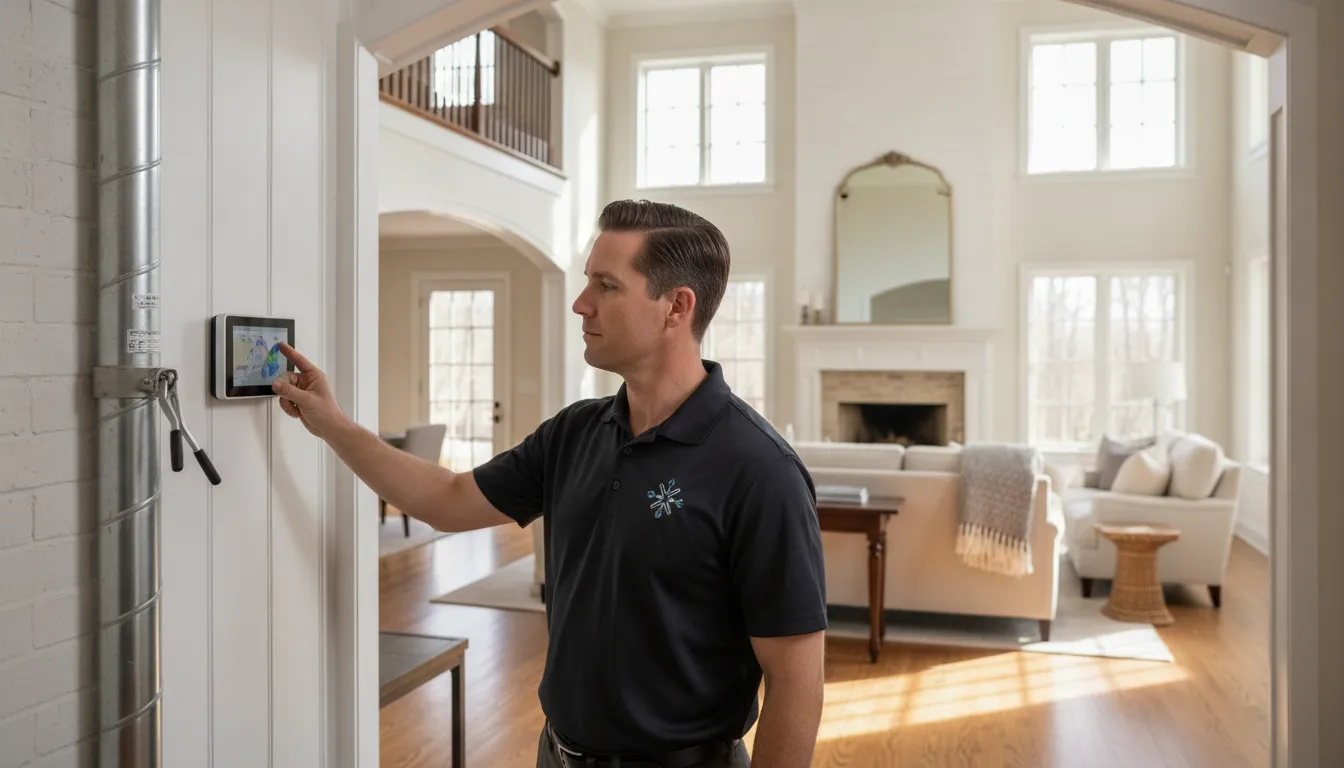
Yes. Should homeowners in Lewisville opt for zoned HVAC control? For most multi-story or open-plan homes with persistent hot and cold spots. Zoning is a practical option because it lets different areas receive heating or cooling according to their own needs. The U.S. Department of Energy reports that zoning can reduce energy bills by up to 30 percent by avoiding heating or cooling unused spaces: Department of Energy guidance.
Zoned control is not a guaranteed fit for every house, and savings depend on system design, ductwork, insulation, and how your household uses each room. A professional evaluation can determine whether separate zones would improve comfort and reduce unnecessary runtime, or whether another HVAC adjustment would address the problem more effectively. It can also identify whether your existing equipment and duct layout can support a zoning upgrade.
The first step is understanding what a zoned system actually changes. Instead of treating the entire home as one temperature area, it uses controls and airflow management to respond to conditions in designated parts of the house. That basic arrangement explains why zoning can help with upstairs heat, open-plan temperature differences, and competing comfort preferences.
Talk to a QRC comfort specialist about zoning for your Lewisville home to get advice tailored to your floor plan, ductwork, and family schedule. Our local team can help you decide whether zoned control is the right upgrade before you invest, and we are happy to answer your questions at (336) 281-5144.
What Is Zoned HVAC Control and How Does It Work?
Zoned HVAC control divides a home into separate comfort areas instead of treating every room as one temperature zone. Each zone has its own thermostat or temperature sensor, allowing the system to respond to conditions in that part of the house. The living area, bedrooms, upstairs rooms, or a finished space can receive different levels of heating or cooling based on how the home is used.
The U.S. Department of Energy describes HVAC zoning as independent temperature control for different areas of a building. That distinction matters in homes where one thermostat cannot accurately represent every room. A thermostat near the main living area may be satisfied while an upstairs bedroom remains too warm. Or it may continue calling for heating while another area is already comfortable. Zoning gives the system more specific information about what each part of the home needs. Learn more about independent HVAC control from the Department of Energy.
Zones direct conditioned air where it is needed
Behind the scenes, motorized dampers installed inside the ductwork regulate airflow to each zone. When a zone thermostat calls for heating or cooling, the control panel adjusts the appropriate damper. Opening it to deliver conditioned air and limiting airflow to areas that do not need as much attention. These dampers can adjust automatically as the temperature and occupancy pattern changes. The Department of Energy identifies dampers as a key part of managing air distribution to specific areas of a building.
This is different from simply closing supply registers by hand. Manual register adjustments can restrict airflow without coordinating with the equipment, duct system, or other rooms. A properly designed zoning system coordinates the thermostats, dampers, blower operation, and HVAC equipment so the system can meet each zone’s demand without leaving other areas unplanned.
Smart thermostats can add scheduling and remote control
Many modern zoning systems integrate with smart thermostats. That combination can allow homeowners to set different temperatures or schedules for sleeping areas, living spaces, and rooms that are used less often. A zone can be adjusted when household routines change, rather than forcing the entire home to follow one setting. Some controls can also use occupancy information to prioritize conditioning in areas that are in use, while automatically adjusting dampers elsewhere.
Zoning does not replace sound HVAC design. Duct sizing, equipment capacity, return-air planning, insulation, and control setup all affect performance. Because the system changes airflow through the ductwork, the design should be evaluated by a qualified HVAC professional before installation or retrofit. The goal is controlled, balanced comfort, not simply more thermostats.
When Should Lewisville Homeowners Opt for Zoned HVAC Control?
Lewisville homes can have very different comfort needs from one area to the next. In a two-story house, warm air naturally rises, so upstairs bedrooms may feel warmer than the main living areas. A large open-plan first floor can create a similar challenge because one thermostat may not accurately represent the temperature across the entire space.
That imbalance can lead to familiar thermostat conflicts. One person lowers the setting to cool an upstairs bedroom, while someone else feels too cold near the downstairs thermostat. Zoned HVAC control addresses this problem by dividing the home into separate areas, or zones, that can receive different amounts of heating or cooling. The U.S. Environmental Protection Agency identifies multi-story temperature imbalances as a situation where zoning can help improve comfort: EPA guidance on HVAC and indoor air quality.
Multi-story homes can need different levels of conditioning
Lewisville homeowners with an upper floor may notice the difference most during warm North Carolina weather. Upper levels can receive more solar heat gain, adding to the heat that already collects upstairs. As a result, the upper floor may need more cooling during the afternoon, while the lower floor remains comparatively comfortable. A zoned design lets the system respond to those distinct loads instead of treating the entire house as one uniform space. The U.S. Department of Energy discusses how targeted airflow control can address these differences: DOE information on modulating air distribution.
Open layouts and larger homes benefit from more precise control
Open-plan homes do not always distribute conditioned air evenly, especially when rooms have different ceiling heights, window exposures, or occupancy patterns. Zoning can make comfort management more practical by giving frequently used living areas and quieter rooms separate control. This is also worth evaluating in homes larger than 2,500 square feet, which research identifies as among those most likely to benefit from zoned HVAC systems: NREL research on residential HVAC controls.
Zoning is not automatically the right answer for every Lewisville home. Duct design, insulation, equipment capacity, and household routines all matter. A professional evaluation can determine whether zoning, duct improvements, equipment replacement, or a combination will deliver the best result. QRC can help assess those factors through residential HVAC service in Lewisville and recommend a comfort plan suited to the home.
The Comfort Benefits of a Zoned System
A single thermostat cannot account for every room’s exposure, use, or preference. In a Lewisville home, one family member may prefer a cooler bedroom while another spends the evening in a warmer living area. With one control point, those differences can lead to thermostat wars, repeated adjustments, and rooms that never feel quite right.
Zoned HVAC control gives separate areas of the home more individualized temperature management. The system can direct conditioned air where it is needed instead of treating the entire house as though every room has the same comfort requirements. Research from the U.S. Department of Energy notes that zoning can accommodate individual temperature preferences, which can improve resident satisfaction.
Fewer hot and cold spots
Even temperatures are one of the most noticeable benefits. Bedrooms, living areas, bonus rooms, and home offices often have different heat loads or schedules. A well-designed zoning arrangement helps condition those areas more independently, reducing the need to overcool one room just to make another tolerable. That can make a sprawling floor plan or an open living space feel more consistent without forcing every occupant to accept the same setting.
Faster comfort when and where you need it
Zoning can also make temperature changes feel more responsive. When conditioning is concentrated in a desired room or zone. That area can reach its comfort setting faster than it would if the system were trying to condition the whole house equally. The National Renewable Energy Laboratory describes this benefit as more rapid temperature adjustment in targeted rooms: NREL research on HVAC controls.
That targeted response is useful when a room becomes occupied unexpectedly. When the sun changes the temperature of one side of the house, or when a household follows different daily schedules. Instead of walking to the thermostat several times a day, occupants can rely on programmed zone settings. The EPA identifies reduced manual thermostat adjustments as another practical comfort benefit of zoning: EPA guidance on ventilation systems and controls.
For homeowners asking whether zoned HVAC control is worthwhile, the comfort case is strongest when rooms have noticeably different needs. A professional evaluation can determine whether zoning will address the underlying distribution problem and how many zones make sense for the home’s layout.
How Zoning Can Lower Your Energy Bills
A zoned HVAC system can reduce wasted heating and cooling by matching system operation to how your Lewisville home is actually used. Instead of conditioning every room to the same setting all day, zoning directs more airflow to occupied areas and less to rooms that are empty or rarely used. The U.S. Department of Energy reports that zoning systems can reduce energy bills by up to 30 percent by avoiding heating or cooling unused spaces. Actual savings depend on your home’s layout, insulation, equipment, schedule, and control settings.
This approach is especially useful when bedrooms sit empty during the day, a guest room is used only occasionally, or different areas of the home need different temperatures. Automated dampers can adjust airflow to each zone, helping the system prioritize the spaces that need conditioning. You may be able to keep an unused bedroom from receiving the same cooling as a busy living area without making the rest of the home uncomfortable.
Reduce cooling demand during partial-load conditions
Central air conditioners do not always need to cool the entire home at full demand. On mild summer days, or when only one part of the house needs relief, zoning can concentrate cooling where it matters. Research summarized by the U.S. Environmental Protection Agency indicates that concentrating cooling in occupied areas can reduce the load on a central air conditioning system during partial-load conditions. That can limit unnecessary runtime and help the equipment meet comfort needs more efficiently.
However, zoning is not a substitute for properly sized equipment, sealed ductwork, or adequate insulation. If your air conditioner runs continuously, struggles to reach the thermostat setting, or leaves some rooms uncomfortable, review the underlying problem before adding controls. QRC’s guide to improve your home comfort and efficiency can help you understand why an undersized or poorly performing system may need attention.
Use the system around your household schedule
The strongest savings opportunity comes from aligning zone settings with real routines. A daytime schedule might reduce conditioning in sleeping areas while keeping the kitchen and living room comfortable. At night, the settings can shift toward the bedrooms. This avoids paying to condition spaces simply because they are connected to the same duct system.
For a zoning upgrade to deliver its potential, the controls, dampers, ductwork, and equipment must work together. A professional evaluation can identify whether zoning is appropriate for your home and how to set it up without creating airflow or comfort problems.
Zoning vs. a Single Thermostat: Weighing the Trade-Offs
A single thermostat is often the simplest choice. It measures conditions in one location and generally asks the entire HVAC system to heat or cool according to that reading. That approach can work well in a compact home with a consistent layout, similar schedules, and few comfort differences between rooms.
Zoning adds separate controls for distinct areas, allowing the system to respond to how each part of the home is used. The added flexibility can be valuable in a Lewisville home with multiple floors, closed-off bedrooms, or rooms that are occupied at different times. It is not automatically the best investment for every house, however. The value depends on the home’s size and the household’s usage patterns, as NREL notes in its discussion of residential heating and cooling controls.
| Consideration | Zoned HVAC | Single thermostat |
|---|---|---|
| Comfort | Separate areas can receive different temperature settings, helping address hot or cold rooms and different household preferences. | One setting governs the home, so rooms farther from the thermostat may feel warmer or cooler than the measured area. |
| Energy efficiency | Controls can reduce conditioning in lightly used areas and direct airflow where it is needed. Results depend on design, equipment, and how the zones are operated. | The system may condition the whole home even when only part of it is occupied, which can create avoidable energy use. |
| Installation cost | Usually higher because the design may require multiple controls, ductwork dampers, wiring, and commissioning. | Typically lower when the existing system and ductwork are suitable and no additional controls are needed. |
| Best fit | Large, multi-story, or irregular homes with persistent temperature differences and rooms used on different schedules. | Smaller or consistently occupied homes where one temperature setting provides acceptable comfort throughout. |
Homes larger than 2,500 square feet may receive especially meaningful benefits from zoning, but square footage alone should not decide the project. A professional assessment should examine duct layout, equipment capacity, insulation, room use, and airflow. Zoning can be retrofitted into an existing HVAC system, although the work is feasible only with careful design and can be complex. That is also why comparing choosing the right HVAC system involves more than comparing equipment labels. The best choice balances comfort goals, operating habits, installation conditions, and long-term service needs.
For many Lewisville homeowners, a single thermostat remains a sound solution when comfort is already consistent. Zoned control is more compelling when recurring hot and cold spots, thermostat conflicts, or unused areas make whole-home conditioning inefficient.
When Does Zoned HVAC Control Pay Off? Cost and Payback
Zoned HVAC control is most likely to pay off when your home’s layout and daily routines create a problem that a single thermostat cannot solve. In Lewisville, that may mean a warm upstairs, unused bedrooms that are conditioned all day, or family members using different parts of the home at different times. The investment is easier to justify when zoning addresses an ongoing comfort or energy problem, rather than being added simply as a feature.
A typical professionally installed zoning project may cost about $2,000 to $5,000, depending on the home’s size, ductwork, number of zones, controls, and installation requirements. That range is a planning estimate, not a quote. Home size and usage patterns strongly influence cost-effectiveness, so the same system can make financial sense in one home and provide a slower payback in another. A homeowner who regularly conditions several floors or has large areas that sit empty may have more opportunity to benefit than someone in a compact home with consistent occupancy.
Larger homes often have a stronger case
Homes larger than 2,500 square feet are generally more likely to derive significant benefits from zoning. More square footage often means longer duct runs, more pronounced temperature differences, and rooms with different schedules. A zoned system can direct conditioning toward occupied areas instead of treating the entire home as one space. That does not guarantee a specific percentage of savings, but it can reduce wasted heating or cooling when the system is designed and operated correctly.
Retrofitting zoning into an existing HVAC system is possible, although the work can be complex. Existing duct layout, equipment capacity, bypass requirements, and control compatibility all need to be evaluated before installation. Adding dampers and thermostats without addressing those details can create airflow or comfort problems instead of solving them.
Start with an audit, not a promise of savings
A professional energy audit is recommended before installation to confirm that zoning is a cost-effective solution for your specific home. The audit can help identify whether uneven temperatures are caused by duct leakage, insulation gaps, equipment sizing, or the layout itself. If those issues are the main problem, correcting them may be a better first investment. If the home has genuine zone-by-zone needs, the audit gives the contractor a stronger basis for designing the system and estimating its likely value.
In practical terms, zoning pays off when it improves comfort, reduces unnecessary conditioning, and fits the home’s long-term use. A careful evaluation is the best way to compare that potential benefit with the upfront cost.
How QRC Can Design a Zoned System for Your Lewisville Home
A zoned HVAC system can solve real comfort problems, but its performance depends on the design behind the controls. QRC begins by looking at your Lewisville home’s layout, insulation, ductwork, equipment, occupancy patterns, and the temperature differences you experience from room to room. A multi-story home, for example, may need a different zoning approach than a single-level home with an open living area.
Before recommending equipment or controls, QRC can evaluate whether zoning is a cost-effective fit for the property. A professional energy audit is recommended before installation so the design addresses the home’s actual heating and cooling needs rather than treating the thermostat as the only problem. Professional audit guidance supports this evaluation step.
Designing the ductwork and damper layout
Effective zoning requires more than installing multiple thermostats. The ductwork must be divided into practical zones, and motorized dampers must be integrated so airflow can respond to each zone’s demand. Professional installation helps ensure the duct design and damper placement work together correctly. Poorly planned zoning can create airflow problems, unnecessary equipment strain, or rooms that still feel uncomfortable. QRC’s approach is to design the system around how your family uses the home. Whether that means separating upstairs bedrooms from the main living area or giving an open-plan space more balanced control.
QRC HVAC & Refrigeration is a family-owned, Winston-Salem-based company founded in 2003. Its team specializes in zoned HVAC systems and high-efficiency climate solutions for homeowners across Forsyth County and the surrounding Triad communities, including Lewisville.
Maintaining reliable zone control
Installation is only the beginning. Dampers, thermostats, wiring, and related controls should be checked during regular professional maintenance. Guidance for zoning systems emphasizes that ongoing maintenance is essential to keep dampers functioning properly. Regular damper maintenance can help the system continue directing conditioned air where it is needed.
When you are ready to discuss a zoned design, QRC can assess your home’s comfort patterns and equipment before outlining the practical options. Connect with QRC for heating services in the Winston-Salem area or air conditioning service in Winston-Salem. Call (336) 281-5144 to schedule an evaluation for your Lewisville home.
Get a professional zoned HVAC design review for your Lewisville home and find out whether separate zones will improve your comfort and efficiency. QRC serves multi-story and open-plan homes across Forsyth County, including Lewisville, with local technicians who know the climate. Call (336) 281-5144 to book your consultation today.
Frequently Asked Questions
Should homeowners in Lewisville opt for zoned HVAC control?
Often, yes, especially in a multi-story Lewisville home, a house with an open-plan layout, or a home where bedrooms and living areas need different temperatures. Zoning gives each area more independent control, which can reduce upstairs heat, hot and cold spots, and thermostat conflicts. It is not automatically the best investment for every property. A professional evaluation should consider the ductwork, insulation, equipment capacity, floor plan, and how your family uses each room. Homes larger than 2,500 square feet may see especially meaningful benefits, according to research from the National Renewable Energy Laboratory: NREL zoning research.
How much does an HVAC zoning system cost?
A typical installed zoning project may cost about $2,000 to $5,000, but the actual price depends on the number of zones. Damper and control requirements, ductwork access, and whether the existing system can support the design. A basic two-zone layout is generally less involved than a multi-level home requiring extensive duct modifications and new controls. Treat any online range as a planning estimate, not a quote. A technician should inspect the system and explain which improvements are necessary before you compare proposals.
Can zoning be added to an existing HVAC system?
In many cases, yes. A retrofit may be possible when the home has a compatible forced-air system and accessible ductwork. The technician may need to add motorized dampers, zone thermostats, control wiring, and a control panel, then confirm that airflow and equipment operation remain safe. Retrofit work can be complex if ducts are difficult to reach, the system is improperly sized, or the existing controls are outdated. Professional design and installation are important for proper damper integration: DOE building controls guidance.
Is zoned HVAC worth it for a smaller home?
It can be, but the answer depends more on comfort problems and room usage than square footage alone. A smaller home may benefit when a finished bonus room, sunny bedroom, addition, or rarely occupied area stays noticeably warmer or cooler than the rest of the house. If temperatures are already even and the floor plan is compact, zoning may add cost and maintenance without solving a meaningful problem. Ask for an evaluation that compares the expected comfort improvement with simpler options such as duct balancing, insulation work, or thermostat changes.
What is zoned HVAC control?
Zoned HVAC control divides a home into separate areas, or zones, with individual thermostats or temperature sensors. Motorized dampers in the ductwork then regulate airflow so the system can prioritize the zones that need heating or cooling. This allows occupied rooms to receive conditioning without treating every area identically. Zoning can work with modern smart thermostats, but the controls must be matched to the equipment and duct design. The U.S. Department of Energy explains the role of dampers and independent control in its air-distribution guidance.
Ready to Improve Comfort With Zoned HVAC Control?
For Lewisville homeowners, zoned HVAC control can make a noticeable difference in multi-story and open-plan homes. Separate temperature control helps address warm upper floors, cooler unused rooms, and the everyday thermostat compromises that can make comfort uneven. It can also help your system focus conditioning where and when your household needs it, supporting more efficient operation without treating every room the same way. A professional design review can determine whether zoning fits your home’s layout, existing equipment, and comfort goals. Schedule a zoned HVAC consultation for your Lewisville home, or call QRC at (336) 281-5144 to discuss the next step.