


A boiler rarely fails without warning. The challenge for a facility manager is deciding whether an abnormal condition can wait for planned maintenance or needs immediate professional diagnosis. A qualified boiler repair service should be called when the system cannot maintain pressure or temperature, repeatedly locks out, leaks water or combustion gases, produces unusual combustion signs, or creates a safety concern. Fast, documented action protects occupants, preserves equipment, and reduces disruption.
Schedule commercial boiler repair service with QRC when an active fault, leak, or loss of heat threatens your North Carolina facility.
This guide gives commercial and industrial facility managers a practical framework for triage. It explains which observations to document, what a technician will test, and when repair should become a capital-planning discussion. QRC HVAC & Refrigeration is a family-owned company based in Winston-Salem, and equipped to serve commercial and industrial HVAC systems across North Carolina.
When does a commercial boiler need repair service?
A commercial boiler needs professional repair when it shows an active safety risk, cannot hold its operating setpoints, or develops a recurring fault that routine operator checks do not resolve. Loss of heat, abnormal pressure, leaks, burner instability, and repeated lockouts are strong reasons to stop troubleshooting and call a qualified technician.
Start with the operating trend, not one isolated reading. Compare current supply temperature, return temperature, pressure, firing behavior, pump status, and fuel use with the facility’s normal baseline. A small deviation that persists across multiple cycles can reveal a developing problem before occupants complain or production is affected.
Conditions that require prompt escalation
- Water, steam, or combustion-gas leakage: isolate the affected area and follow the facility’s emergency procedures.
- Repeated safety lockouts: do not keep resetting a boiler without identifying the initiating fault.
- Unstable flame or unusual soot: stop operation according to site procedure and request combustion diagnosis.
- Pressure or temperature outside the approved range: treat unexplained excursions as a control or mechanical fault.
- Loss of heat during critical operations: coordinate repair, temporary measures, and stakeholder communication immediately.
Operators may safely confirm obvious items allowed by the equipment manual, such as setpoints, visible alarms, and whether a scheduled pump is enabled. Internal burner, gas-train, electrical, pressure-vessel, and combustion work belongs with trained personnel. QRC’s commercial HVAC repair team can evaluate system faults and define the next step.
What warning signs should facility managers document?
The most useful repair call begins with a clear record of what changed, when it changed, and how the system responded. Document alarm codes, trend data, affected zones, recent service, operating conditions, noises, odors, and visible leakage. This evidence helps a technician reproduce an intermittent problem and shortens the diagnostic path.
Build a useful fault record
Record the date and time of each event, outside conditions, occupied or production schedule, active boiler stage, and any change after a reset. Photograph the control display and visible condition without opening guarded or energized equipment. If a building automation system is available, preserve trends from before and during the incident.
| Observed condition | What to record | Likely diagnostic focus |
|---|---|---|
| Repeated lockout | Exact code, run time before trip, reset history | Safety circuit, ignition sequence, sensors, controls |
| Low heat output | Supply and return temperatures, load, valve position | Firing rate, flow, heat transfer, control sequence |
| Pressure instability | Cold and hot pressure, makeup activity, relief events | Expansion control, leakage, fill components, flow |
| Unusual noise | Location, cycle stage, duration, recent changes | Flow, pump condition, air, scale, combustion |
| Fuel-use increase | Comparable periods, runtime, weather, setpoints | Combustion, fouling, controls, distribution losses |
A good fault record also prevents needless parts replacement. It allows the service team to distinguish a recurring sequence problem from a one-time interruption. Facilities with complex HVAC operations can also review QRC’s approach to industrial HVAC performance, efficiency, and compliance.
What happens during a professional boiler diagnosis?
A professional diagnosis connects the symptom to its root cause through a controlled inspection and test sequence. The technician reviews operating history, confirms the complaint, checks safety controls, examines combustion and heat-transfer conditions, evaluates pumps and hydronic components, and verifies performance after the repair.
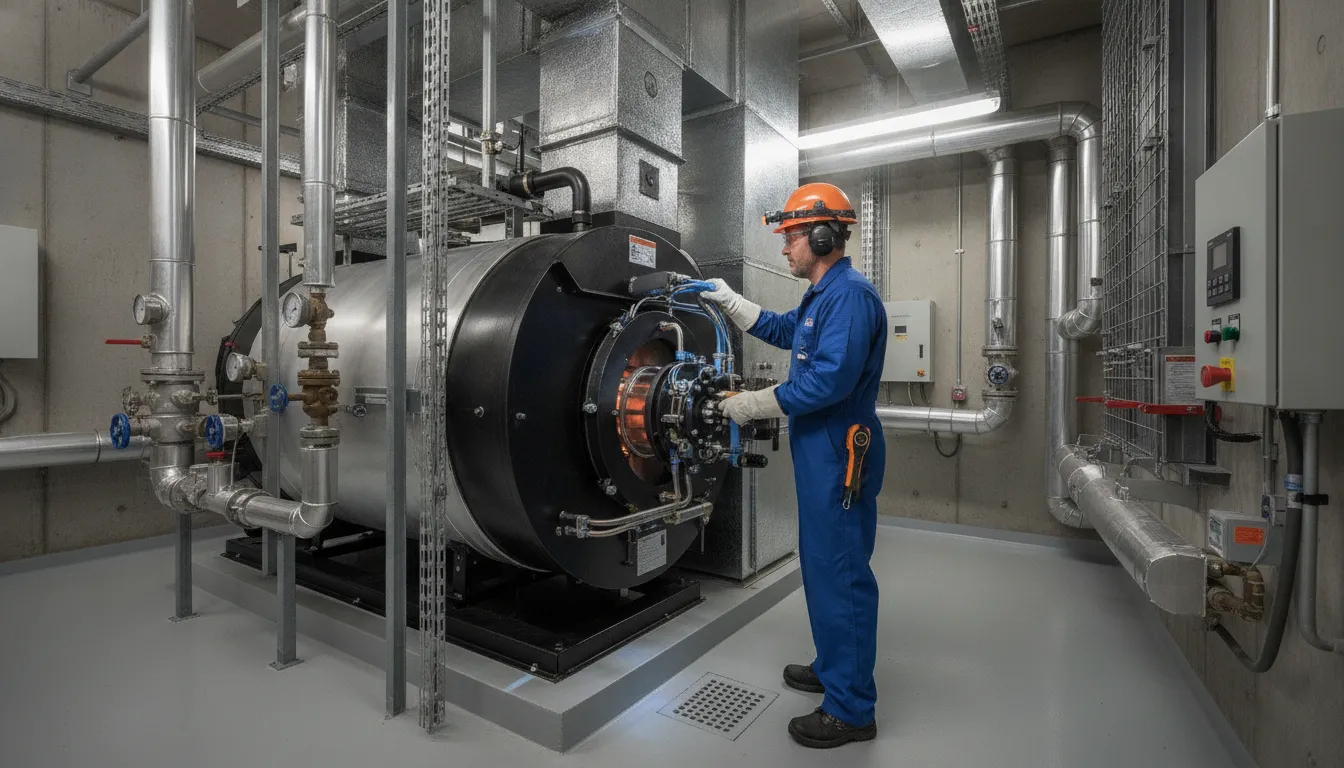
A disciplined diagnostic sequence
- Review the operating history. The technician confirms reported symptoms, recent work, reset attempts, and trend data.
- Inspect the installation. Visible piping, venting, wiring, pumps, valves, controls, and signs of leakage are reviewed.
- Verify the fault safely. When conditions allow, the technician observes the operating sequence and captures relevant readings.
- Test the suspected system. Controls, sensors, flow, ignition, combustion, and related components are evaluated as appropriate.
- Identify cause and consequence. The technician separates the failed component from the condition that caused it to fail.
- Complete an authorized repair. The scope should address the root cause, not simply clear an alarm.
- Commission and document. The repaired boiler is operated through an appropriate cycle, and findings are recorded.
Facility managers should expect a clear explanation of findings, the proposed repair, operational risk, and any follow-up work. If an immediate site visit is not yet practical, QRC’s Virtual Tele-Tech option can help teams discuss visible conditions and determine an appropriate next action.
Is the issue maintenance or an actual repair?
Maintenance preserves normal operation through planned inspection, cleaning, adjustment, and testing. Repair restores operation after a component, control, or system condition has failed or moved outside acceptable performance. A maintenance visit may uncover a repair need, but recurring lockouts, active leaks, and failed safeties should never be treated as routine tune-up items.
Use evidence to classify the work
| Planned maintenance | Corrective repair |
|---|---|
| Scheduled around operating hours | Triggered by a fault, failure, or unacceptable trend |
| Inspects, cleans, tests, and documents | Diagnoses and corrects a confirmed problem |
| Reduces avoidable failure risk | Restores safe, reliable operation |
| Uses a repeatable checklist and baseline | Uses symptom-specific tests and verification |
Deferring corrective work under a maintenance label can increase operating risk. For example, cleaning may improve heat transfer, but it will not correct a leaking seal, defective safety device, unstable control signal, or worn pump component. Conversely, replacing a component without correcting fouling, water-quality, flow, or control issues may only postpone another failure.
A documented maintenance program gives technicians the baseline needed to identify changes early. QRC offers commercial HVAC maintenance for organizations that want a more planned approach to system care.
How should you decide between boiler repair and replacement?
Choose repair when the root cause is isolated, parts are supportable, and the boiler can return to safe and dependable service at a reasonable lifecycle cost. Begin replacement planning when failures recur, critical parts are difficult to source, efficiency or capacity no longer meets the facility’s needs, or vessel condition creates unacceptable risk.
Evaluate the whole operating context
A repair estimate is only one part of the decision. Review downtime exposure, redundancy, repair history, annual maintenance burden, fuel performance, controls compatibility, planned building changes, and how long the system must remain in service. A technically repairable boiler may still be a poor investment if repeated outages threaten critical operations.
- Repair history: Are faults isolated, or is the system requiring repeated corrective visits?
- Supportability: Are approved components and technical information readily available?
- Capacity and control: Does the boiler meet present loads and integrate with current operating sequences?
- Condition: Do inspection findings support continued safe operation?
- Operational exposure: Can the facility tolerate the next unplanned outage?
For a major decision, ask for repair options, identified risks, and recommended next steps in writing. A staged plan may include an immediate repair to stabilize operations followed by a properly scoped capital project. QRC’s commercial HVAC design capabilities can support planning when a system-level change is warranted.
Prioritize the decision with a simple risk screen
Classify each option by safety exposure, operational consequence, probability of another failure, and the time needed to obtain parts or complete replacement. This prevents a low initial repair price from outweighing a serious downtime risk. It also gives finance and operations teams a shared basis for deciding when capital funding should move forward.
Redundancy changes the calculation. A facility with two boilers may be able to schedule a controlled repair while one unit carries a limited load. A site with no standby capacity may need temporary planning, an accelerated response, or a different repair window. Confirm that available backup capacity is truly ready before relying on it.
How can facilities reduce repeat boiler failures?
Facilities reduce repeat failures by correcting root causes, maintaining consistent operating records, testing safeguards, controlling water and flow conditions, and scheduling service around equipment needs rather than waiting for a shutdown. The strongest program connects technician findings with work orders, trend data, and capital planning.
Turn each repair into a reliability improvement
After service, capture the initiating symptom, confirmed cause, parts used, test results, and recommendations. Update the asset record and create follow-up work orders before the issue disappears from attention. If the same symptom returns, the history should make that recurrence obvious.
Operators should also know which conditions require shutdown, which observations to record, and whom to contact. Clear escalation rules reduce unsafe reset cycles and prevent small abnormalities from becoming emergency calls. When multiple boilers serve a facility, periodically verify staging and lead-lag rotation so that one unit is not carrying an unintended share of the load.
Professional maintenance should align with the manufacturer’s requirements and the facility’s duty cycle. It should also account for the entire hydronic and control system, not only the boiler cabinet. Learn more about QRC’s broader commercial services for North Carolina facilities.
Track a small set of reliability indicators
Useful indicators include unplanned lockouts, corrective work orders, repeat faults, makeup-water activity, unusual fuel-use changes, and hours of lost service. Review these measures at a regular operations meeting. Trends help managers direct maintenance resources before the next heating season or production peak.
A closeout review after a significant repair is equally valuable. Confirm that the boiler returned to its normal operating range, that alarms and safeties were verified, and that follow-up recommendations have owners and due dates. The repair is not fully closed until the facility can show that the initiating condition was corrected.
Request a QRC Tele-Tech consultation to review a boiler concern and prepare for the right service response.
Frequently asked questions about boiler repair service
Facility managers often need fast answers about lockouts, service timing, and repair scope. The safest decision is based on the active condition, approved site procedures, and a qualified diagnosis. The answers below provide a practical starting point, but they do not replace the equipment manual or an on-site safety assessment.
Can operators reset a commercial boiler after a lockout?
Follow the equipment manual and the facility’s approved procedures. Do not repeatedly reset an unexplained lockout. Repeated trips indicate that a safety or control condition has not been resolved, and additional reset attempts can obscure the evidence a technician needs.
How quickly should a leaking boiler be inspected?
An active leak should be assessed promptly. Follow the site’s emergency and isolation procedures, protect people and property, and contact a qualified service provider. The response depends on the leak location, system type, pressure, and associated safety conditions.
What information should be ready before calling for service?
Provide the boiler make and model, location, alarm code, timeline, operating readings, affected areas, recent work, and any photos or trends that can be collected safely. Also explain access requirements, operating constraints, and whether the facility has redundant capacity.
Does boiler repair service include preventive maintenance?
Repair and preventive maintenance are different scopes. Repair corrects a confirmed fault. Maintenance follows a planned checklist to inspect, clean, test, and document the system. Ask the service provider to define the proposed scope and any recommended follow-up.
Schedule commercial boiler repair service with QRC
QRC HVAC & Refrigeration helps North Carolina commercial and industrial facilities diagnose HVAC problems, complete authorized repairs, and plan practical next steps. Facility managers can expect a service conversation focused on the observed condition, operational priorities, and a clear path back to dependable performance.
Do not wait through repeated lockouts, unstable readings, or an active leak. Gather the available fault history, follow your facility’s safety procedure, and arrange a professional assessment.
Contact QRC to schedule boiler repair service or request a quote.