


If your Yadkinville home is taking too long to warm up, making a new sound, or cycling more than usual, it may be time to schedule furnace repair. Small changes in heating performance often show up before a complete breakdown. Paying attention early can help you address a correctable problem before a cold morning turns it into an emergency.
A Yadkinville furnace needs professional repair when it cannot provide steady heat, repeatedly turns on and off, makes unusual sounds, produces unusual odors, or shows a safety warning. Start with simple observations, but do not open combustion equipment or attempt gas, electrical, venting, or heat-exchanger repairs yourself.
Talk with QRC about furnace repair in Yadkinville at (336) 281-5144.
This guide explains which symptoms deserve a service call, what you can safely check first, and when a furnace problem should be treated as urgent. A qualified technician can identify whether the issue involves airflow, controls, ignition, combustion, ductwork, or another component.
What are the clearest signs a Yadkinville furnace needs repair?
The clearest signs are weak or uneven heat, a furnace that will not start, frequent cycling, unusual noises, unfamiliar odors, rising energy use without a change in habits, water around the equipment, and repeated thermostat problems. One symptom may have several possible causes, so a diagnosis is more reliable than replacing a part based on a guess.
Watch for a change from the furnace’s normal behavior. A system that used to heat the home evenly but now leaves cold rooms may have an airflow, duct, thermostat, or equipment problem. If the blower runs but the air feels cool, the furnace may not be completing its heating cycle correctly. If the system stops before the thermostat is satisfied, it may be overheating, sensing a fault, or struggling with restricted airflow.
Keep a short record of what you notice. Note the room temperature, time of day, operating sound, thermostat setting, and whether the symptom happens every cycle or only occasionally. This information gives the technician a useful starting point and helps distinguish a one-time event from a developing pattern.
- Weak heat: The system runs, but supply air is not warming the home as expected.
- Uneven temperatures: Some rooms remain cold while others receive adequate heat.
- Short cycling: The furnace starts and stops repeatedly instead of completing a normal cycle.
- New noises: Banging, scraping, squealing, rattling, or humming appears during startup or operation.
- Unusual odors: A persistent burning, fuel-like, or musty smell does not go away after a brief startup period.
- Repeated shutdowns: The furnace needs to be reset or fails to start reliably.
Why is my furnace running but the house still feels cold?
A furnace can run without adequately heating the home because of a dirty or restricted filter, blocked registers, duct leakage, a thermostat problem, inadequate airflow, or a fault inside the heating equipment. Check the thermostat setting and visible airflow first. If the problem continues, schedule a professional inspection instead of repeatedly resetting the furnace.
Begin with checks that do not require opening the furnace. Confirm that the thermostat is set to heat and that its displayed temperature is reasonable. Make sure supply registers and return grilles are open and not covered by furniture, rugs, or stored items. If your system uses a replaceable filter, inspect it and replace it with the correct size when it is visibly dirty or overdue for replacement. Do not force a filter into place or operate the system without one.
A clean filter does not rule out an airflow problem. Duct restrictions, disconnected duct sections, blower issues, closed dampers, and problems within the furnace can all reduce delivered heat. Energy STAR notes that filters, annual tune-ups, duct sealing, and correct installation all affect heating performance and comfort. Its heating and cooling guidance is a useful maintenance reference, but it cannot replace a site-specific diagnosis.
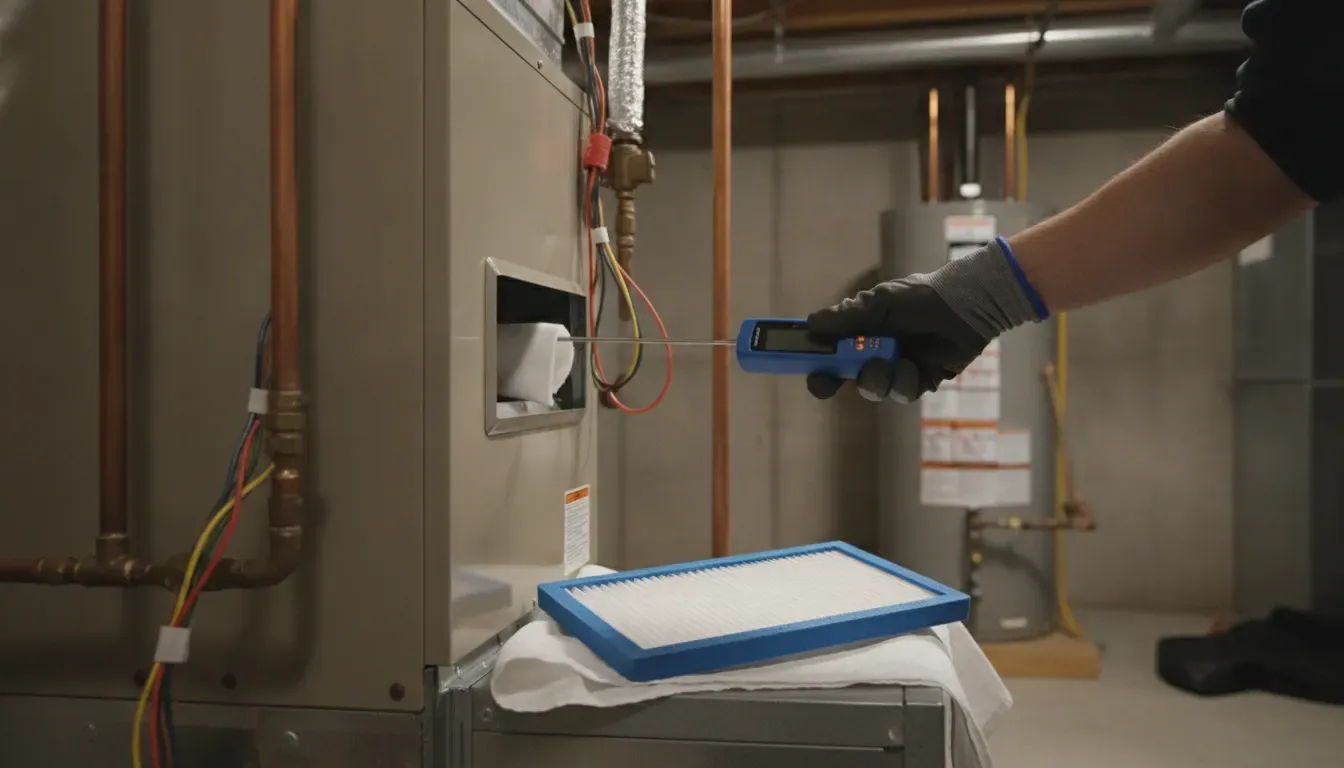
If the furnace still runs without warming the home, avoid turning the thermostat higher and higher. That may keep the system running without fixing the cause. A technician should evaluate the heating sequence, airflow, controls, and equipment condition together.
Which furnace noises mean I should schedule service?
Schedule service for a new, persistent, or worsening furnace noise, especially banging, scraping, grinding, squealing, rattling, or repeated booming at startup. A brief, mild expansion sound can have a different cause, but homeowners should not assume every noise is harmless. Turn the system off and request urgent guidance if the sound is severe, accompanied by an odor, or followed by a shutdown.
Sound can help describe the symptom, but it cannot identify the failed component by itself. A rattling sound may come from a loose panel or another mechanical issue. Squealing can be associated with a moving component or belt on some systems. Scraping or grinding deserves prompt attention because continued operation may worsen damage. A booming ignition sound should not be treated as normal household noise.
Record a short audio or video clip only if you can do so safely from a normal standing position. Do not remove access panels, reach into the cabinet, bypass a safety control, or relight equipment unless the manufacturer’s instructions and a qualified professional specifically direct you. Share when the noise occurs, such as at startup, during the blower cycle, or when the system shuts down.
When is a furnace odor or carbon monoxide concern an emergency?
Leave the home and call 911 if anyone has symptoms that could indicate carbon monoxide exposure or if a carbon monoxide alarm sounds. Do not stay inside to troubleshoot the furnace. For a strong fuel odor, leave the area, avoid flames and electrical switches, and contact the appropriate emergency service. A qualified HVAC professional can inspect the furnace after the immediate safety concern is addressed.
Carbon monoxide is colorless and odorless, and fuel-burning appliances can produce it when something is wrong with combustion or venting. The Centers for Disease Control and Prevention lists headache, dizziness, weakness, nausea, chest pain, and confusion among possible symptoms. Review the CDC’s carbon monoxide safety information and make sure your home has working carbon monoxide alarms according to the manufacturer’s instructions.
A brief dusty smell at the start of a heating season can have a different explanation, but a persistent burning, electrical, fuel-like, or exhaust odor should not be ignored. Turn the furnace off if doing so is safe, move away from the area, and ask for professional advice. Never use smell alone to decide that a furnace is safe.
Do not attempt to inspect a heat exchanger, combustion chamber, flue, gas connection, or electrical control yourself. These components require appropriate training and testing equipment. Safety concerns take priority over deciding whether a repair is cheaper than replacement.
What can a homeowner check before calling for furnace repair?
Before calling, a homeowner can check the thermostat mode, visible filter condition, open registers, electrical breaker position, and whether the furnace has power. Stop and request professional service if a breaker trips again, an odor persists, a carbon monoxide alarm sounds, water is leaking, or the equipment shows a combustion or electrical problem.
Use this limited checklist only for visible, low-risk observations:
- Confirm the thermostat is set to heat and the desired temperature is above the current room temperature.
- Check that the furnace switch has not been turned off accidentally and that the relevant breaker appears in the normal position.
- Look at the filter and replace it if it is dirty, using the correct replacement size.
- Make sure supply registers and return grilles are open and unobstructed.
- Write down any error code or flashing light pattern without removing panels or touching wiring.
If the breaker trips again, do not keep resetting it. If the furnace has standing-pilot instructions, follow the manufacturer’s safety directions rather than improvising. When in doubt, leave the equipment off and arrange an evaluation. QRC’s residential heating and cooling service information explains the broader repair, maintenance, and replacement support available to homeowners.
How does regular maintenance help prevent furnace repairs?
Regular maintenance can identify restricted airflow, dirty components, loose connections, control problems, and other developing issues before they become a no-heat call. It cannot prevent every failure, but seasonal professional service gives the furnace a better chance of operating safely and consistently.
Maintenance is especially useful before the heating season, when a hidden problem can become urgent during the first cold spell. A professional visit may include inspection of accessible components, airflow, operation, safety controls, and other system-specific items. The exact work depends on the furnace and the condition found during service.
QRC’s service maintenance program information describes seasonal visits and preventive HVAC care. Homeowners should still respond to new symptoms between visits. A maintenance appointment is not a substitute for prompt repair when the furnace is producing unusual noises, odors, weak heat, or repeated shutdowns.
For a Yadkinville homeowner, the practical goal is not to wait for a total failure. Schedule an evaluation when performance changes, document the symptom, and ask what the technician found, which repair is recommended, and what signs would require follow-up.
Request furnace service from QRC in Yadkinville at (336) 281-5144.
Frequently Asked Questions
How do I know if my furnace needs repair?
Look for weak or uneven heat, short cycling, unusual noises, persistent odors, repeated shutdowns, or a furnace that will not start. A professional diagnosis is needed to identify the cause and confirm whether repair is safe.
Should I replace my furnace if it is not heating evenly?
Not necessarily. Uneven heating can involve airflow, ductwork, thermostat settings, insulation, or the furnace itself. Have the complete system evaluated before deciding on repair or replacement. However, just like a vehicle, furnaces have a limited life span and do not last forever and do need replacing when they are past their ability to perform correctly, have parts that are outdated, or are inefficiently operating.
Can I troubleshoot a furnace myself?
You can check the thermostat, visible filter, open registers, power switch, and breaker position without opening the equipment. Do not work on gas, combustion, electrical, venting, or heat-exchanger components yourself.
When should I turn my furnace off?
Turn it off when there is a strong fuel, exhaust, or electrical odor, a severe unusual noise, a carbon monoxide alarm, visible smoke, repeated breaker trips, or another condition that seems unsafe. Leave the area when appropriate and seek emergency or professional guidance.
Get help with a Yadkinville furnace problem
Early furnace repair can address a developing problem before it becomes a no-heat emergency. If your system is making a new sound, heating unevenly, cycling repeatedly, or showing an odor or safety warning, contact QRC HVAC & Refrigeration for the next safe step.
Describe the symptom, when it started, and anything you have already checked. A qualified evaluation can help you understand the repair options for your home and get your heating system back to dependable operation. Learn more about QRC furnace repair and heating service at (336) 281-5144.