


Commercial HVAC systems in manufacturing plants often fail faster because they work in a harsher, more changeable environment than a typical office or retail building. Airborne dust, process heat, exhaust air, vibration, humidity, shifting production loads, and maintenance plans built for ordinary commercial spaces can all increase wear. The system may still be running while its filters load, coils foul, fans become unbalanced, controls drift, or components operate outside their intended conditions.
Why do commercial HVAC systems in manufacturing plants fail faster? Manufacturing plants place heavier and more variable demands on HVAC equipment. Dust and fumes can restrict airflow or foul fans and coils, process equipment can add heat beyond the original design, vibration can loosen or wear mechanical parts, and ventilation changes can upset pressure and humidity. A maintenance plan matched to the process, equipment, and operating schedule helps identify these stresses before they become disruptive failures.
For plant managers in Winston-Salem, Greensboro, High Point, and the surrounding Piedmont Triad, the practical question is not whether every failure can be prevented. It is whether the facility can identify the conditions accelerating wear, prioritize the equipment that protects production, and schedule qualified service before an avoidable problem becomes an emergency.
Schedule a manufacturing-plant HVAC assessment with QRC HVAC & Refrigeration to discuss process-specific service needs.
Why Do Commercial HVAC Systems in Manufacturing Plants Fail Faster?
Manufacturing HVAC systems fail faster when contaminants, heat, moisture, vibration, airflow resistance, and changing production conditions add stress that the original equipment selection or maintenance plan did not fully address. The underlying issue is usually cumulative. Several moderate stresses can combine until a fan, motor, compressor, control, coil, or safety device can no longer operate reliably.
A plant HVAC system supports more than occupant comfort. It may help control temperature and humidity around production equipment, remove heat from process areas, provide make-up air, support air cleanliness, protect materials, or maintain acceptable conditions for employees. That broader role means a small performance change can affect both equipment reliability and the operation it serves.
The word commercial also does not always describe the actual operating environment. An office unit may run on a relatively predictable schedule with a low contaminant load. A manufacturing system may serve a large open space, multiple production zones, a process exhaust system, and equipment that changes the heat balance from shift to shift. Even when the HVAC nameplate is similar, the conditions around it can be very different.
The U.S. Department of Energy’s fan system sourcebook for industry explains that particulate and moisture content affect fan-system performance. It also describes how contaminant buildup can degrade fan performance, create imbalance, and increase drivetrain wear. Those principles apply to the air-moving side of a plant HVAC system, not just to a standalone process fan.
That is why the right response is a site-specific review rather than a generic promise that a seasonal tune-up will solve every problem. Start by connecting HVAC symptoms to the production conditions present when they occur.
How Do Dust, Fumes, and Process Heat Damage Plant HVAC Equipment?
Dust, fumes, oil mist, and process heat can make HVAC equipment work harder by loading filters, fouling coils and fan blades, increasing airflow resistance, and raising the cooling or ventilation load. The appropriate response depends on what the process releases, where it travels, how the system is filtered, and whether local exhaust captures the contaminant before it reaches the comfort HVAC system.
Manufacturing environments are not all alike. Cutting, grinding, welding, molding, finishing, packaging, food production, and chemical processes create different combinations of particles, vapors, heat, and moisture. A facility does not need visibly dirty air for those conditions to matter. Fine particles can accumulate inside equipment or on heat-transfer surfaces long before a manager sees a dramatic change in the room.
- Loaded filters increase resistance. As a filter collects particles, the system may need more fan effort to move the required air. The resulting airflow reduction can affect temperature control and increase stress on fans and motors.
- Fouled coils transfer heat less effectively. Dust, oil, moisture, or debris on a coil surface can reduce heat transfer and make the system run longer to reach its target condition.
- Contaminated fan blades can become unbalanced. Uneven buildup adds vibration and can accelerate wear in bearings, belts, shafts, mounts, and connected ductwork.
- Process heat raises the cooling demand. Ovens, furnaces, motors, compressors, lighting, and production lines can add heat that was not present when the system was designed or last evaluated.
- Exhaust changes can alter the air balance. A new hood, exhaust fan, enclosure, or production line can change pressure relationships and increase the amount of make-up air the HVAC system must condition.
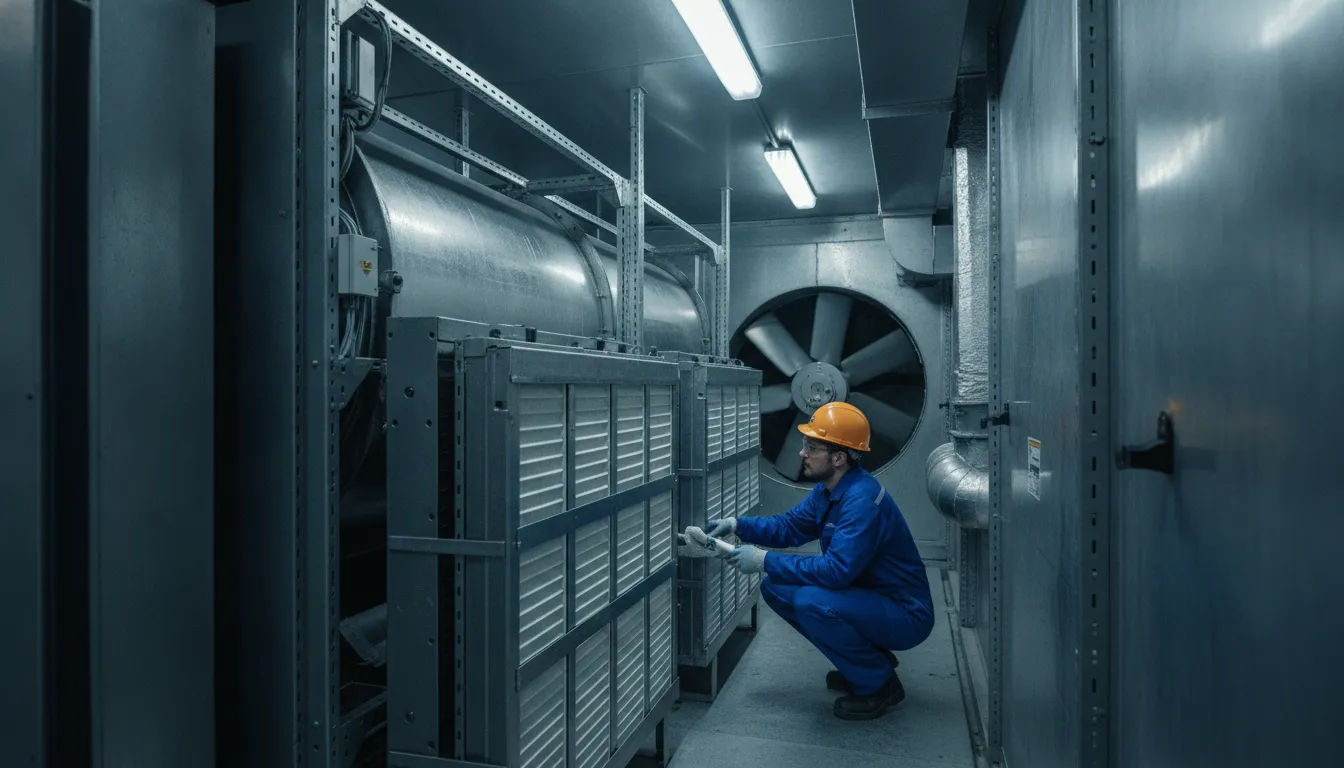
OSHA’s industrial ventilation standard addresses exhaust ventilation for dust, dirt, fumes, and gases in specific work processes. It is not a substitute for a facility engineering review, and its requirements vary by operation. It does reinforce an important principle: process contaminants should be evaluated as part of the ventilation system, not treated as an ordinary comfort-maintenance issue.
Plant managers should also avoid assuming that a thicker filter or more frequent filter change is automatically the answer. Filter selection affects pressure drop, capture performance, access, and the design of the air-moving system. A qualified HVAC professional can evaluate the filter arrangement, coil condition, fan capacity, duct restrictions, and the process conditions together.
Can Ventilation and Building Loads Overload a Plant HVAC System?
Yes. A plant HVAC system can be overloaded when production heat, outside-air requirements, exhaust, occupancy, humidity, or facility changes exceed the assumptions used for design and controls. The equipment may run continuously, miss setpoints, short-cycle in some zones, or show repeated alarms. These symptoms call for diagnosis, not a larger unit chosen without a load and airflow review.
Manufacturing plants change over time. A line may be moved, a new oven or machine may be installed, a shift schedule may expand, or an exhaust system may be modified. Each change can alter the sensible heat, moisture, pressure, and ventilation requirements of the building. If the HVAC system is not reassessed, it may be asked to compensate for a process it was never sized to serve.
Oversizing and undersizing can both create trouble. An undersized system may run for long periods without reaching the desired condition, leaving compressors, fans, and controls with little recovery time. An oversized or poorly zoned system may cycle too frequently, fail to dehumidify effectively, or satisfy one area while another remains uncomfortable. A plant can also have adequate total capacity but poor distribution because dampers, ductwork, controls, or pressure relationships prevent the air from reaching the zones that need it.
ASHRAE’s Industrial Air Conditioning and Ventilation technical committee overview describes industrial HVAC as part of the environment supporting manufacturing processes, equipment, and worker safety. It highlights temperature, humidity, air motion, air quality, noise, cleanliness, pressurization, filtration, and exhaust as interconnected considerations. The takeaway for a facility manager is simple: the correct HVAC solution starts with the process and the building, not only the equipment model number.
Plant condition and likely HVAC consequence
| Plant condition | What the HVAC system may experience | What to investigate |
|---|---|---|
| New production equipment | Higher heat gain, more exhaust, or a changed humidity load | Updated load assumptions, make-up air, zone capacity, and control sequence |
| Dust, fumes, or oil mist | Loaded filters, fouled coils, contaminated fans, and restricted airflow | Source capture, filter selection, pressure drop, cleaning interval, and coil condition |
| Longer operating schedule | More runtime and less recovery time between cycles | Runtime trends, component condition, lubrication or belt needs, and service frequency |
| New or modified exhaust | Pressure imbalance, infiltration, and greater outside-air conditioning demand | Exhaust volume, make-up air, building pressure, door behavior, and control response |
| Hot or humid process zone | Longer cooling cycles, condensation risk, and uneven comfort | Humidity control, insulation, drainage, airflow distribution, and zoning |
A facility review should compare current operations with the original design intent. That does not always mean replacing the system. It may mean correcting a control sequence, improving filtration, adding or repairing make-up air, cleaning a fouled heat exchanger, balancing airflow, separating a process zone, or planning a properly scoped replacement.
How Do Vibration, Moisture, and Controls Accelerate Failure?
Vibration can loosen connections and wear rotating assemblies, while moisture and chemical exposure can promote corrosion or electrical problems. Controls can compound those stresses when sensors, dampers, safeties, or schedules do not match the way the plant operates. These causes often appear as recurring alarms, unusual sounds, unstable temperatures, nuisance trips, or unexplained runtime changes.
Manufacturing equipment can transmit vibration through floors, supports, ductwork, and nearby structures. HVAC fans and motors also create their own vibration when bearings wear, belts misalign, blades collect buildup, or shafts become unbalanced. The first visible symptom may be a loose panel or unusual noise, but repeated vibration can affect the reliability of the entire assembly.
Moisture adds another path to failure. Humid process air can condense on cold surfaces if insulation, airflow, or control is inadequate. Water can damage materials, affect electrical components, encourage corrosion, or create drain and pan problems. Chemicals and vapors require an even more careful review because the appropriate materials, filtration, exhaust, and service procedures depend on the specific substance and exposure.
Controls are the system’s decision layer. A failed sensor, incorrect setpoint, stuck damper, poorly sequenced outside-air control, or misconfigured building automation point can make good equipment behave badly. Repeated manual overrides may keep a plant operating temporarily while hiding the underlying problem. A control trend, alarm history, and operator report can help a technician determine whether the issue is mechanical, electrical, airflow-related, or a combination.
QRC’s commercial HVAC service information identifies building automation controls, make-up air and ventilation, rooftop units, split systems, and package units among its commercial capabilities. A plant assessment should still confirm the exact equipment, process conditions, and project scope before service or replacement recommendations are made.
What Should a Manufacturing Plant Include in Its HVAC Maintenance Plan?
A manufacturing HVAC maintenance plan should combine an equipment inventory, process review, manufacturer instructions, safe operator observations, qualified inspections, documented findings, and a schedule adjusted for runtime and contaminant exposure. The right interval may differ between a clean office area, a dusty production zone, a high-heat process space, and a critical support area.
Start with an asset and process map. Record each air-handling unit, rooftop unit, chiller, boiler, exhaust fan, make-up air unit, and control panel; then connect each asset to the space or process it serves. Note age, model, capacity, fuel or energy source, filter type, access requirements, prior repairs, recurring alarms, and the business consequence of an outage.
- Document the process environment. Identify dust, fumes, oil, moisture, heat sources, shift schedules, exhaust systems, and any process changes since the original design or last assessment.
- Prioritize critical equipment. Give earlier attention to systems serving production-critical areas, sensitive materials, employee safety conditions, or zones where a failure can interrupt the operation.
- Inspect the air path. Review filters, coils, fan blades, belts, bearings, dampers, duct connections, insulation, drains, and outside-air paths based on the equipment and manufacturer guidance.
- Test controls and operating response. Compare sensor readings, setpoints, alarms, schedules, damper positions, safeties, and building automation trends with actual plant conditions.
- Record and close the loop. Keep the unit identity, findings, readings, completed work, deferred recommendations, parts needs, and next review date in a shared maintenance record.
The U.S. Department of Energy’s Rooftop Unit Maintenance Guide recommends using manufacturer instructions and tailoring maintenance to the equipment, location, size, and age. Although a manufacturing facility may need additional process-specific analysis, that same discipline is useful: build the plan from actual operating conditions instead of applying one calendar rule to every unit.
A maintenance plan should also define the handoff between plant operators and HVAC professionals. Operators can report odors, temperature changes, unusual sounds, visible water, repeated resets, or production-related timing. They should not open electrical compartments, handle refrigerant, bypass safeties, or enter restricted roof or process areas without the training and controls required by the facility.
QRC’s commercial services team provides preventive service, repairs, system design, and ongoing support for commercial HVAC and refrigeration across North Carolina. For industrial facilities in the Triad, a facility-specific conversation can help connect maintenance priorities with the plant’s equipment, process, and operating schedule.
When Should a Plant Manager Call for Commercial HVAC Repair?
Call for qualified commercial HVAC repair when a plant system repeatedly trips, cannot hold the required condition, loses airflow, develops unusual noise or vibration, shows water or corrosion, or begins affecting production, worker conditions, or critical areas. Do not wait for a total shutdown when the system is already showing a pattern of deterioration.
Some warning signs deserve prompt evaluation:
- Repeated trips, resets, safety shutdowns, or unexplained control alarms
- Continuous operation without reaching the intended temperature or humidity condition
- New grinding, rattling, squealing, or excessive vibration from fans, motors, pumps, or compressors
- Sudden loss of airflow, uneven production-zone conditions, or a change in pressure behavior
- Water near equipment, ceiling staining, blocked drains, condensation, or visible corrosion
- Unexpected filter loading, coil fouling, odors, or signs that process contaminants are reaching the comfort system
- Repeated repairs on aging equipment without a documented replacement or retrofit evaluation
When a plant system shows these symptoms, the goal is to diagnose the cause safely, not simply reset the equipment and return it to service. A technician may need to compare the equipment condition with airflow, load, pressure, controls, and process changes. QRC also explains why commercial systems require technicians familiar with their size and configuration in its article about specialized commercial HVAC care.
If repair decisions are becoming repetitive, review the system’s total condition and operating role. QRC’s article on when to replace a commercial HVAC system can help frame that discussion, but a plant-specific recommendation should be based on inspection findings, current loads, repair history, equipment condition, and the cost of disruption. Avoid choosing a replacement solely because a unit is old or keeping it solely because it still starts.
Talk with QRC about industrial HVAC maintenance or repair for your Triad facility to plan the next step.
Frequently Asked Questions
Do manufacturing plants need more frequent HVAC maintenance than offices?
Often, yes, but there is no universal interval for every plant. Dust, fumes, process heat, moisture, runtime, exhaust, equipment age, and business risk can justify a different schedule from a lightly used office. Set the interval from manufacturer guidance, site conditions, inspection findings, and the consequence of a failure.
Can dirty filters make a commercial HVAC system fail?
Dirty or overloaded filters can restrict airflow and increase system resistance. That may reduce delivered air, affect comfort or process conditions, and add stress to fans and motors. Filter selection and replacement intervals should be reviewed with the equipment design and contaminant load in mind, rather than treating every filter as interchangeable.
Why does a new production line affect HVAC reliability?
A new line can add heat, moisture, exhaust, contaminants, occupancy, or operating hours. It can also change pressure relationships and the amount of make-up air required. If the HVAC system and controls are not reassessed, the equipment may run longer, miss setpoints, cycle poorly, or experience more wear than the original design assumed.
What should plant staff check before calling an HVAC contractor?
From a safe location, staff can document the affected zone, timing, alarms, unusual sounds, visible water, airflow changes, recent process changes, and whether the problem occurs during a specific shift. Do not open electrical panels, handle refrigerant, bypass a safety, climb onto restricted equipment, or attempt an internal repair without appropriate training and authorization.
Can preventive maintenance eliminate all manufacturing HVAC failures?
No. Preventive maintenance cannot remove every risk, especially when equipment reaches the end of its serviceable condition or the plant changes significantly. It can reveal developing problems, document trends, improve planning, and reduce avoidable disruption when the program is matched to the equipment and process environment.
Protect Your Plant’s HVAC Uptime
Manufacturing HVAC systems fail faster when the facility treats a process environment like a standard commercial space. A useful plan connects contaminants, heat, ventilation, vibration, moisture, controls, runtime, and production priorities to the equipment that serves each zone. For manufacturing facilities in Winston-Salem and the broader Triad, QRC HVAC & Refrigeration provides industrial HVAC maintenance, repair, replacement, and retrofit support. Review QRC’s industrial HVAC services to discuss a facility-specific assessment.