


What temperature data logs should restaurants keep for compliance in Yadkinville? Start with records that show how your team monitors receiving, cold holding, hot holding, cooking, cooling, reheating, and any time-based food safety procedure. The exact requirements can vary by menu, equipment, permit, and approved procedures, so use this guide as an operations checklist and confirm local questions with Yadkin County Environmental Health.
Yadkin County’s NC Food Code guidance identifies improper holding temperatures as a major food-safety risk. The county also states that permitted food-service refrigeration must be capable of maintaining food at 41 degrees F or below. A useful log does more than collect numbers. It connects a reading to a specific unit or food, the person who took it, the limit being checked, and the action taken when the reading is out of range.
What should a Yadkinville restaurant temperature log record?
Whether your restaurant uses a paper sheet, spreadsheet, or digital monitoring system, the record should be specific. An entry that says only “walk-in checked” does not show which reading was taken or what the team found. Use a consistent naming system such as walk-in cooler 1, prep-line reach-in, hot-holding well 2, or delivery receiving area.
| Log field | What to enter | Why it matters |
|---|---|---|
| Date and time | The actual date and clock time of the reading | Shows when the condition was checked and helps identify patterns during opening, service, or closing |
| Food or unit | The item, batch, cooler, freezer, hot-holding unit, or delivery | Connects the number to a particular risk or piece of equipment |
| Location | Walk-in, reach-in, prep line, kitchen, receiving area, or other location | Prevents several units from being confused on one sheet |
| Observed temperature | The actual thermometer or sensor reading, in degrees F | Shows what was measured instead of a prefilled target |
| Limit or standard | The applicable cold, hot, cooking, cooling, reheating, or time-control limit | Shows how the employee judged the reading |
| Initials and response | Employee initials, corrective action, and manager or person-in-charge review when required | Creates accountability and shows that an exception was addressed |
Do not prefill a log with expected temperatures. Record the number actually observed. If a digital sensor generates a continuous record, keep the unit identifier, time stamp, alert history, and documented response available in a readable form. Your food-safety plan or local regulator may specify additional fields or a different monitoring schedule.
Which food temperatures should the log track?
A practical restaurant log set usually includes the following categories:
- Receiving temperatures: Record the temperature of temperature-controlled food when it arrives, along with the delivery, product, or lot information your procedure requires. Note whether the shipment was accepted, rejected, or placed on hold.
- Cold holding: Check walk-in coolers, reach-ins, prep tables, and other refrigeration used for food that requires temperature control. The Yadkin County notice says permitted food-service refrigeration must maintain food at 41 degrees F or below.
- Hot holding: Record temperatures for soups, sauces, cooked proteins, and other food held for service. North Carolina inspection guidance identifies hot holding as a temperature observation and uses the applicable Food Code standard for evaluation.
- Cooking: Record internal temperatures for foods and processes that your menu or food-safety plan requires. Identify the food and the thickest or otherwise representative portion measured.
- Cooling: For cooked food being cooled for later use, record the time and temperature checkpoints. North Carolina guidance describes the two-stage cooling process as moving from 135 degrees F to 70 degrees F within 2 hours and then from 70 degrees F to 41 degrees F or below within the next 4 hours.
- Reheating: Record the process when food is reheated for hot holding, including the food, time, observed temperature, and any corrective action required by your procedure.
- Time as a public health control: If your operation uses time instead of temperature control for a food, keep the written procedure and the time records required by that procedure. Do not treat a time-control log as interchangeable with a refrigeration log.
Not every restaurant needs the same form. A bakery, full-service kitchen, school food program, bar, and high-volume catering operation can have different control points. Match the log to the menu and the actual flow of food from receiving through service. When in doubt, ask the person in charge to confirm the process with the local regulatory authority rather than copying a generic internet template.
When should restaurant staff take and enter readings?
A schedule should reflect how your restaurant operates. A cooler that is stable overnight may change during a busy lunch period when the door opens repeatedly. A prep table may need attention during service even if the opening check was in range. Receiving records should be completed when deliveries arrive, while cooling records need time-stamped checkpoints that show whether the food moved through the required ranges.
At a minimum, assign responsibility for the following moments:
- Opening: Check food-holding equipment and confirm that the units are ready before food is placed into service.
- Receiving: Measure temperature-controlled deliveries before accepting and storing them according to the restaurant’s procedure.
- Preparation and service: Check foods and units at the times identified in the operation’s plan, especially during high-volume periods.
- Cooling and reheating: Use the required time and temperature checkpoints for each batch, not one end-of-shift estimate.
- Closing: Review exceptions, record unresolved equipment concerns, and hand off follow-up to the next responsible person.
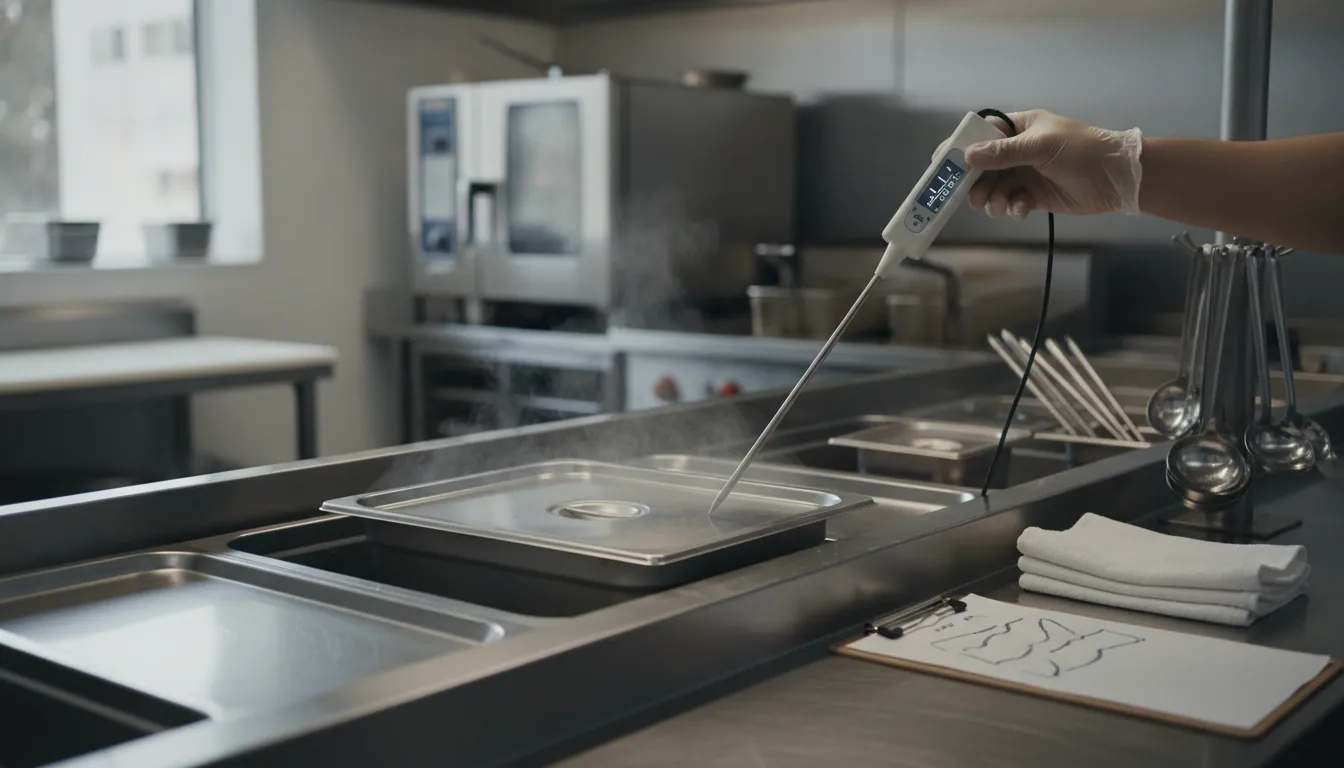
Use a calibrated and appropriate thermometer, clean and sanitize the probe as required by your food-safety procedure, and measure food where the reading is meaningful. A display on a refrigerator may show air temperature while the food inside is warmer or colder. For equipment problems, compare the control display with a reliable measurement and document the issue instead of changing a setpoint without authorization.
What corrective actions belong in a compliance log?
A blank corrective-action field is a warning sign. If a refrigerator reads above the applicable limit, the responsible employee should follow the restaurant’s written procedure. That may include rechecking with a calibrated thermometer, moving food to a functioning unit, evaluating how long it was out of control, discarding food when required, contacting a manager, or requesting service.
Document the action in plain language. “Fixed” is not enough. A stronger entry explains that food was moved to walk-in cooler 2, the unit was tagged for service, a manager was notified, and a second reading was taken at a stated time. If a reading returns to range, keep the first reading and the response. Do not erase an out-of-range result because a later check was normal.
North Carolina inspection instructions direct inspectors to document observations and corrective actions, including the temperature information observed. Your internal record should make the same sequence easy to understand. It also helps the service technician distinguish a one-time door-opening event from a repeated refrigeration failure.
How long should Yadkinville restaurants keep temperature logs?
Retention is one of the areas where a general article should not replace local direction. A restaurant’s required records can depend on its processes, approved plans, menu, and regulatory status. The record should be available to the person in charge and retained in a way that allows the restaurant to show what was monitored and how exceptions were handled.
For day-to-day control, organize records by date and shift. Keep paper forms protected from spills and make sure digital systems preserve the original time and unit information. Have a manager review the previous entries often enough to identify repeated temperature drift, slow recovery after door openings, or the same corrective action appearing repeatedly.
Ask Yadkin County Environmental Health to confirm which records your facility must retain and for how long. The county’s NC Food Code page provides local food-service information and directs operators to contact Environmental Health with questions. If your restaurant operates in another Triad county, confirm the applicable local process there as well.
How can Yadkinville restaurants make refrigeration logs more reliable?
Repeated high readings can come from an overloaded cabinet, a door that does not seal, blocked airflow, a dirty condenser, a failed fan, control trouble, or a refrigeration fault. Staff should not remove panels or attempt repairs outside their training. The useful next step is to preserve the readings, note the conditions around them, and have the equipment evaluated.
QRC HVAC & Refrigeration provides commercial refrigeration repair, preventive service, and support for North Carolina businesses. A restaurant in Yadkinville can use its records to show the service team which unit is affected, when the change began, how quickly the temperature recovers, and whether the problem occurs during a particular shift. That information can make diagnosis more efficient and help the restaurant plan a safer response.
For equipment planning or replacement, QRC also provides commercial refrigeration sales and custom design. A replacement decision should consider the restaurant’s menu, storage volume, door traffic, available space, and maintenance needs. Do not choose a unit only because its display shows a lower number. The system must suit the way the kitchen actually operates.
Frequently Asked Questions
Does every Yadkinville restaurant need the same temperature log?
No. The correct record set depends on the menu, equipment, processes, permit, and approved food-safety procedures. Most operations should consider receiving, cold holding, hot holding, cooking, cooling, reheating, and any time-control records that apply. Confirm facility-specific requirements with Yadkin County Environmental Health.
What temperature should refrigerated food be kept at in Yadkinville?
Yadkin County states that permitted food-service refrigeration must be capable of maintaining food at 41 degrees F or below. Food-specific rules and approved procedures can affect how a particular operation monitors its products, so keep the applicable standard with the log and confirm questions with the local regulatory authority.
What should staff write when a cooler is too warm?
Record the actual reading, date, time, unit, food affected, and corrective action. Depending on the procedure, the response may include a second measurement, moving food, evaluating exposure time, notifying a manager, tagging the unit for service, and documenting when a follow-up check confirms correction.
Can a digital temperature monitoring system replace paper logs?
A digital system can be useful when it preserves readable time-stamped records, identifies the unit or sensor, and documents alerts and responses. Whether it satisfies a specific facility’s requirements depends on the applicable permit, plan, and regulator. Confirm the format and retention process before replacing an established record system.
Who can help when refrigeration readings keep drifting?
First follow the restaurant’s food-safety response and contact the person in charge. For equipment diagnosis, QRC HVAC & Refrigeration provides commercial refrigeration repair and maintenance support. Keep the temperature history available so the technician can see the pattern rather than only one reading.