


How do integrated refrigeration systems save energy for multi-site retailers? They can reduce avoidable runtime and operating waste by connecting equipment data, controls, alarms, and maintenance decisions across the store portfolio. The value is not a universal percentage. It is a clearer view of where a system is working harder than it should, followed by measured corrections.
For a facilities team, integration means moving beyond isolated thermostats and service calls. Temperature trends, compressor and condenser behavior, defrost schedules, leak indicators, fault alarms, and work-order history can be reviewed together. That context helps teams prioritize the location, asset, or condition most likely to affect product protection and energy use.
The strongest results come from a disciplined cycle: establish a baseline, coordinate the system, respond to abnormal conditions, and verify performance afterward. Store format, weather, product load, equipment age, refrigerant circuit, commissioning quality, and maintenance practices all influence the outcome.
Talk with QRC about commercial refrigeration service and call (336) 281-5144.
How do integrated refrigeration systems save energy for multi-site retailers?
Refrigeration is a major energy load in many retail environments, especially where stores operate display cases, walk-ins, freezers, and other temperature-sensitive equipment throughout the day. Industry sources describe refrigeration as accounting for a substantial share of energy use, but those figures are not interchangeable. A grocery store, convenience store, specialty retailer, and distribution facility have different loads, schedules, equipment mixes, and weather conditions.
Integration helps because the facility team can evaluate those conditions as one operating picture rather than as disconnected service events. A temperature trend can be viewed beside compressor runtime. A recurring alarm can be compared with recent work orders. A high-load store can be compared with similar locations after accounting for weather and sales activity. This does not make the equipment efficient by itself. It makes inefficient operation easier to find and correct.
Energy improvement may come from several connected actions:
- Reducing conflicting setpoints or schedules that make equipment run longer than necessary.
- Identifying a leak, failing component, or control fault before it causes prolonged overwork.
- Prioritizing maintenance on assets showing abnormal temperatures, runtime, or repeat alarms.
- Using commissioning and post-service measurements to confirm that a change produced the intended result.
The business case should therefore be built around measured operating conditions, not a generic savings promise. A portfolio manager should ask which stores are consuming more energy than comparable sites, what changed, and whether product temperatures remained protected. That approach turns integration into a management tool for reducing waste while preserving reliability.
What does centralized monitoring change across a retail portfolio?
Without a shared view, a multi-site operation often relies on local observations. One store may notice a warm case. Another may report a noisy condenser. A third may continue operating with a recurring alarm because the condition has not yet caused a product loss. By the time these signals reach a central team, the portfolio may have accumulated avoidable energy use and urgent work.
A connected monitoring approach can organize those signals into a consistent workflow. The team can compare like-for-like assets, review alarm frequency, identify temperature drift, and see whether an issue is isolated or repeated across locations. That matters because the best response is not always the loudest alarm. A persistent but moderate deviation may deserve attention before a dramatic failure occurs.
Useful portfolio views may include:
- Store and asset temperature trends, including recovery after door openings or defrost cycles.
- Compressor, condenser, and fan runtime patterns that indicate abnormal demand.
- Alarm history, duration, recurrence, and whether a technician action cleared the condition.
- Comparison of similar stores after accounting for climate, hours, equipment, and merchandise load.
Centralized visibility also supports accountability. A facilities leader can assign a response, track the work order, and confirm that the trend returned to normal. The information can guide capital planning when a location shows repeated problems, but it should not be used to assume that every store needs the same upgrade.
Integration is most useful when the data leads to a practical decision. The controls architecture, sensors, network, alarm rules, and response process must be commissioned together. A dashboard that produces alerts without clear ownership can create noise instead of savings. The goal is a prioritized operating picture that helps the team act earlier and learn from results.
How do coordinated controls reduce unnecessary refrigeration runtime?
Refrigeration equipment is a system, not a collection of independent switches. Compressors, condensers, evaporator fans, case controls, defrost routines, doors, and temperature sensors all influence the load. When one part is adjusted without considering the others, the system may run longer, cycle poorly, or create a condition that another component must overcome.
Integration gives the controls strategy a chance to coordinate those relationships. A control sequence may stage capacity to match demand instead of running every available component at full output. A schedule may reflect store hours and expected load. A defrost routine may be reviewed against temperature recovery and product requirements. Setpoints can be checked for conflicts between a local controller and a supervisory strategy.
These are mechanisms, not automatic outcomes. A control change can create risk if sensors are inaccurate, equipment is incorrectly sized, or a setpoint does not protect the merchandise. Any adjustment should be tested under representative conditions, with the team watching temperature stability, runtime, alarms, and recovery. The right question is not simply whether a control is more aggressive. It is whether the sequence maintains the required conditions with less unnecessary work.
Facilities teams can evaluate coordinated controls by checking:
- Whether operating schedules match actual occupancy, delivery, and merchandising patterns.
- Whether temperature and pressure signals are reliable and located appropriately.
- Whether compressors and condensers stage smoothly as load changes.
- Whether defrost events complete without extended recovery or product risk.
- Whether alarms identify a genuine exception instead of a normal transition.
For a multi-site retailer, a standardized control philosophy can make training and troubleshooting easier. Standardization should not mean identical settings at every store. Local climate, equipment, refrigerant circuit, store hours, and load must remain part of the commissioning decision.
How do leak and fault alerts protect energy performance?
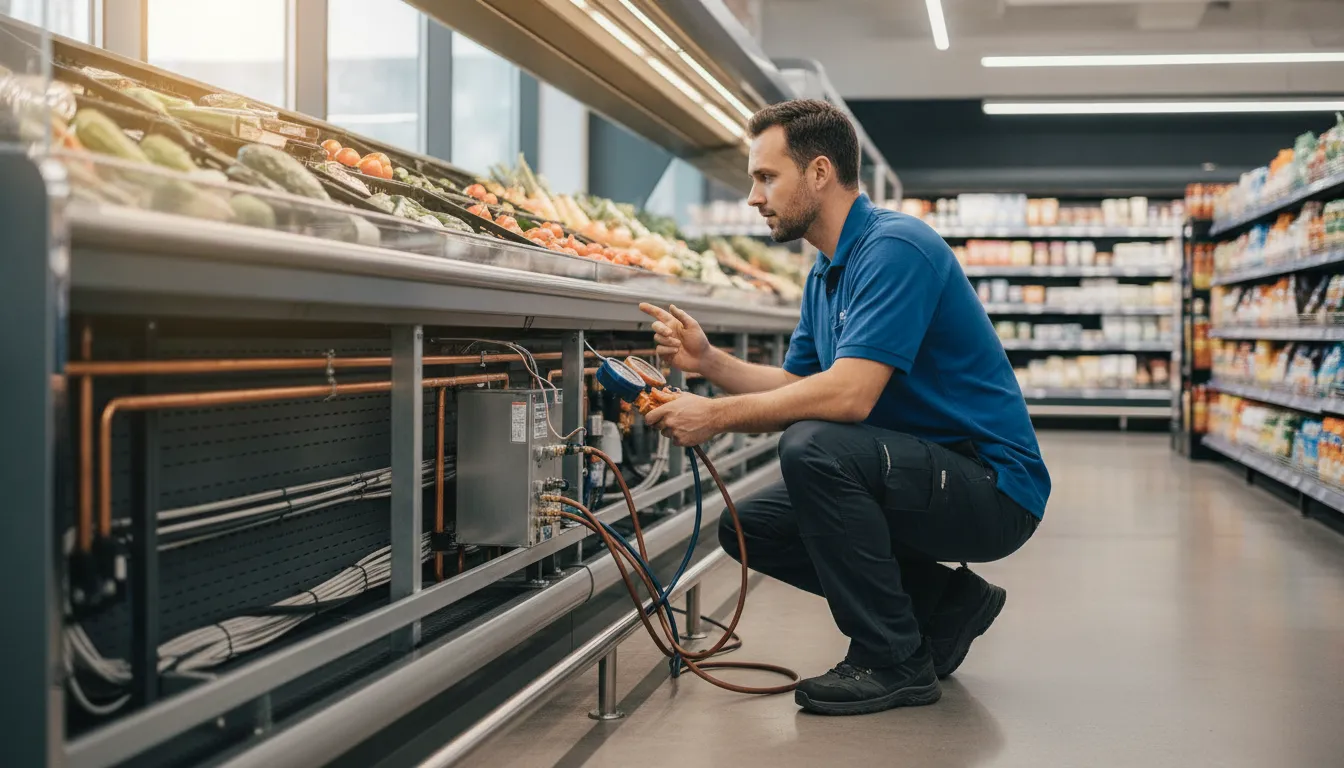
A refrigeration leak is more than a compliance or repair concern. As charge is lost, the system may struggle to maintain conditions and run longer while the facility team sees only symptoms, such as a warm case or repeated low-pressure alarm. A component fault can create a similar pattern. A fan, sensor, valve, controller, or condenser problem may increase runtime before the store experiences an obvious failure.
Integrated monitoring can connect the alert to context. The team can review when the condition began, whether temperatures changed, how runtime shifted, and whether the same asset has had prior work. That history helps separate a one-time transition from a recurring problem. It can also improve dispatch decisions, because the technician receives a clearer starting point instead of a vague report that a case is not holding temperature.
Leak management should follow applicable refrigerant requirements and the equipment manufacturer’s procedures. The Environmental Protection Agency’s Section 608 resources cover refrigerant handling and management for stationary refrigeration and air-conditioning equipment. EPA’s GreenChill program also addresses refrigerant emissions in supermarket refrigeration. Responsible service includes finding the cause, repairing it, verifying the system, and documenting the work rather than repeatedly adding refrigerant without resolving the underlying condition.
A useful alert process answers four questions:
- What changed, and when did the change begin?
- Which store, circuit, or asset is affected?
- What temperature, runtime, pressure, or alarm evidence supports the alert?
- Who owns the response, and how will normal operation be verified?
QRC HVAC & Refrigeration can support commercial operators with refrigeration service, repair, maintenance, and efficiency-focused assessment. The article’s point is not that an alert guarantees a particular energy reduction. It is that faster, better-informed intervention can protect both energy performance and product conditions.
For background on warning signs, see refrigerant leak detection and connect those symptoms to the specific commercial system.
Why does maintenance visibility matter for multi-site retailers?
Preventive maintenance is easier to manage when the team can see the condition of the portfolio. A work order should not stand alone. It is more useful when connected to the affected asset, prior repairs, alarm history, temperature behavior, parts, and the operating consequence of a failure. That context helps the team decide whether an issue calls for immediate repair, a planned maintenance window, a controls review, or replacement planning.
Visibility also helps identify repeat failures. If a store receives several visits for the same case, a repair-only approach may be masking a design, airflow, sensor, control, or loading issue. A portfolio view can reveal that a pattern appears at multiple sites, which may justify a standard inspection or training response. It can also show that one location is different and needs a site-specific correction.
Energy performance and maintenance reliability often overlap. Dirty heat-transfer surfaces, damaged door seals, restricted airflow, inaccurate sensors, and poorly tuned controls can all affect the work a system must do. The exact effect depends on equipment and conditions. So the team should use trend data and field verification rather than assume that every maintenance item produces the same result.
A practical maintenance-visibility program tracks:
- Asset identity, age, equipment type, refrigerant circuit, and criticality.
- Temperature trends, recurring alarms, runtime changes, and unresolved exceptions.
- Repair history, parts replaced, root-cause notes, and repeat-call frequency.
- Planned service windows, technician findings, commissioning checks, and closeout evidence.
QRC’s commercial refrigeration services include preventive maintenance and support for retail equipment such as display cases, walk-ins, freezers, and related systems. Operators can also use a refrigeration maintenance plan and a quarterly refrigeration checklist as starting points for a repeatable process.
How should retailers measure savings without overpromising?
A before-and-after utility comparison is a useful start, but it is not enough on its own. A store may use less energy because it had milder weather, lower sales, shorter hours, or a temporary closure. Another store may use more energy after an integration project because it added cases or extended operating hours. The measurement must explain the operating context.
| Measurement stage | What to document | Why it matters |
|---|---|---|
| Baseline | Utility data, store hours, weather, and merchandise load. | Establishes conditions before a change. |
| Baseline | Equipment inventory, temperatures, alarms, and runtime. | Shows the system state before a change. |
| Intervention | Controls changes, repairs, leak work, and commissioning steps. | Shows what could have influenced the result. |
| Intervention | Maintenance actions and dates. | Creates a clear timeline for review. |
| Verification | Normalized energy data, temperature stability, and runtime. | Tests whether performance improved. |
| Verification | Alarms, product protection, and repeat service calls. | Checks that savings did not shift risk elsewhere. |
For a portfolio, compare similar locations rather than averaging every store together. A large distribution facility should not be treated as a direct baseline for a small convenience store. Use consistent definitions for energy use, runtime, alarm duration, and temperature excursions. Keep a record of equipment additions, remodels, refrigerant work, and schedule changes.
Published industry sources report broad energy shares for commercial refrigeration, including ranges such as 40% to 60% in some retail and foodservice contexts. Those figures can explain why the category deserves attention, but they do not predict what a particular QRC customer or store portfolio will save. QRC’s guidance is to qualify generalized claims and measure the actual system.
A credible result is therefore more than a lower bill. It shows the conditions that changed, the operating performance that was preserved, and whether the team can repeat the improvement across comparable locations.
What should a multi-site refrigeration assessment include?
The assessment should begin with the portfolio, but it must finish at the equipment. A central report may show that one location has an unusual load or recurring alarm. A field review is needed to determine whether the cause is a sensor, control sequence, airflow issue, refrigerant problem, door condition, equipment capacity, or operating practice.
- Inventory the assets. Record store format, equipment type, age, refrigerant circuit, critical cases and walk-ins, controls, sensors, and business impact.
- Establish the baseline. Gather utility data, operating schedules, weather context, product load, temperature trends, alarms, runtime, and recent work orders.
- Review integration points. Check whether controllers, sensors, alarms, schedules, and supervisory systems exchange reliable information and have clear ownership.
- Investigate abnormal conditions. Review leak indicators, fault history, temperature drift, repeated calls, and equipment that runs outside expected patterns.
- Plan maintenance and corrections. Prioritize safety, product protection, reliability, and energy opportunities. Identify planned service windows and parts or access needs.
- Commission and verify. Test the sequence under representative load, confirm temperatures and alarms, and compare the result with the baseline.
- Standardize what works. Apply lessons to comparable stores, while preserving site-specific settings for climate, equipment, schedules, and merchandise.
QRC provides commercial refrigeration design, installation, repair, maintenance, and energy-efficiency audits and optimization. Its commercial service team supports North Carolina operators, but any savings outcome remains specific to the system assessed. A careful process protects the value of integration by connecting technology with field verification and accountable service.
For system planning, see QRC’s custom commercial refrigeration systems page.
Schedule a commercial refrigeration assessment with QRC and call (336) 281-5144.
Frequently Asked Questions
What does an integrated refrigeration system connect?
It can connect refrigeration equipment, temperature sensors, controllers, alarms, schedules, runtime data, and maintenance records. The exact scope depends on the existing equipment and controls architecture. Integration should be defined around the decisions the facilities team needs to make, not around a dashboard alone.
Do integrated systems guarantee energy savings?
No. Integration can make abnormal operation easier to identify and can support coordinated control and maintenance decisions, but results vary. Equipment age, store format, weather, product load, setpoints, commissioning, refrigerant condition, and operating schedules all affect energy use. Measure a documented baseline and verify the result.
What data should a multi-site retailer collect first?
Start with store hours, equipment inventory, utility data, temperature trends, alarm history, runtime, recent repairs, refrigerant work, and known product-protection events. Add weather and merchandise-load context when comparing locations. Consistent definitions make site-to-site comparisons more useful.
When should a retailer call a commercial refrigeration specialist?
Call when temperatures drift, alarms recur, a system runs unusually long, or a leak is suspected. Also call when a component fails repeatedly or the team cannot verify that a control change is safe. A specialist can connect the field condition to the equipment, controls, maintenance history, and required operating conditions.
Ready to Evaluate Commercial Refrigeration Performance?
QRC HVAC & Refrigeration helps North Carolina commercial operators plan, service, repair, and maintain refrigeration systems. A practical assessment can connect equipment condition, controls, alarms, maintenance history, and operating priorities without assuming a universal savings result.
Talk with QRC about commercial refrigeration service and call (336) 281-5144.