



If you are pricing residential geothermal HVAC Winston Salem homeowners usually start with the yard, not the brochure. A ground-source system can heat and cool a Triad house well. It works only when the lot, the soil, the ducts, and the state well rules all line up. We look at those limits before anyone talks about drilling.
The short answer is this. Geothermal can fit a Winston-Salem lot with trench or drill-rig room, a sound indoor system, and a licensed team for the well work. It is a poor fit when the yard is tight, trees and utilities block the rig, or the ducts still need major repairs. The federal 30 percent credit applied only through December 31, 2025. A 2026 install should not be planned around that credit.
Book an in-home heating and cooling review at (336) 281-5144.
Schedule a Winston-Salem home visit.
What Residential Geothermal HVAC Winston Salem Buyers Are Really Choosing
A geothermal heat pump, also called a ground-source heat pump, moves heat. It does not burn gas, and it is not a power plant. The U.S. Department of Energy explains that soil about 30 feet down stays near 50 to 59 degrees in much of the country. That ground is warmer than winter air and cooler than summer air. The loop can collect heat in January and reject heat in July.
We keep the equipment story short here, because a separate guide will cover how a geothermal heat pump is built. For a Winston-Salem buyer, the decision is local. You are choosing a buried collector, an indoor heat pump, and a way to move that heat through the rooms you already live in.
Three pieces have to work together:
- The ground loop, laid in trenches, dropped in boreholes, or sometimes placed in a pond.
- The indoor heat pump, which concentrates that heat and sends it into the house.
- The ducts, air handler, or radiant piping that actually delivers comfort room to room.
Air-source equipment, the heat pump most Triad homes already use, pulls heat from outdoor air. Geothermal pulls it from the ground. The indoor cabinet can look similar. The yard work does not. If your question is really about an ordinary heat pump, start with our heat pump services page instead of planning a loop.
Which Lots Can Hold Residential Geothermal HVAC in Winston-Salem
Lot shape decides more than the brand on the cabinet. We will not invent a minimum acreage. A long, narrow side yard can work. A wide yard full of septic lines, mature oaks, and a steep drop may not.
In closer neighborhoods such as Ardmore, Buena Vista, West End, and Washington Park, many lots are deep but tight beside the house. Horizontal trenches need open soil and a path for the excavator that does not tear out the driveway, the porch, or the neighbor’s fence. Vertical bores need less lawn, but the drill rig still needs a straight approach, overhead clearance, and room to stage pipe.
Farther out, toward Clemmons, Lewisville, Bermuda Run, and rural parts of Forsyth and Davie counties, yards are often larger. That helps a horizontal loop. It does not skip the other checks. We still look for wells, septic fields, buried power, irrigation, and the red Piedmont clay that can hide shallow rock. Rock does not forbid a loop. It changes how the trench or bore is built, and it belongs in the site plan, not in a guess from the curb.
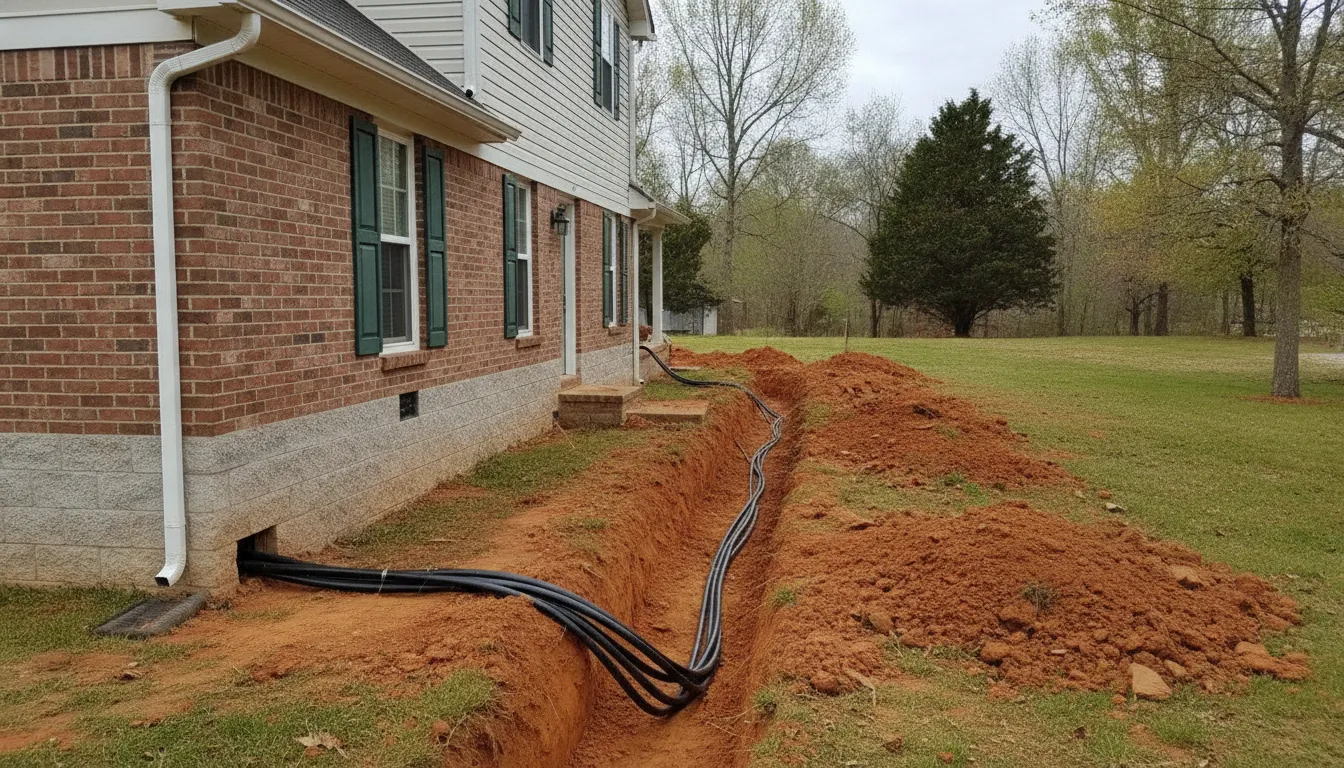
Bring these facts to the first visit so we are not guessing:
- A rough lot sketch, or the survey if you have one.
- Where the well, septic tank, and drain field sit, if the house is not on city water and sewer.
- Any known rock, springs, or standing water after heavy rain.
- HOA or historic-district rules that limit digging in the front yard.
Our Winston-Salem service area covers these residential neighborhoods. We do not treat residential geothermal as a statewide service. If the house is outside the Triad, say so on the first call.
Closed Loops, Open Loops, and the Rules North Carolina Actually Uses
North Carolina treats many geothermal wells as injection wells because they sit near groundwater people drink. The Division of Water Resources lists the common layouts on its geothermal heating and cooling page. The right layout is a site decision, not a slogan.
| Layout | How it moves heat | What NC DEQ requires | Where it tends to fit |
|---|---|---|---|
| Vertical closed loop | Fluid stays inside pipe in a grouted borehole | No state permit. File a well notice before drilling. Grout the full bore. Skip bentonite grout if chloride is 1,500 mg/L or higher. | Smaller Winston-Salem lots that a rig can reach |
| Horizontal closed loop | The same closed pipe, laid in trenches | No UIC permit. Still check county and city rules. | Open yards in Clemmons, Lewisville, and rural Forsyth |
| Open loop | Well water runs through the heat pump and returns to a well | File a water-return well application and get a permit. Supply-well grout and casing rules apply. Permits often run five years. | Only where water quality and return capacity are proven |
| Pond loop | Closed pipe exchanges heat with a pond or lake | Treated like a horizontal closed loop for UIC. Confirm local rules and water rights. | A real pond with enough depth, not a storm ditch |
Two details from that state page matter before you hire anyone. Only a certified well driller may construct the geothermal well. Only a licensed HVAC contractor may install the heat-exchange tubing in a well or borehole. That license comes from the State Board of Examiners of Plumbing, Heating and Fire Sprinkler Contractors. County and city offices can add their own rules on top of the state notice.
Closed loops come in two pipe styles. Direct-exchange systems circulate refrigerant in copper tubing and usually add cathodic protection so the copper does not corrode. Aqueous systems circulate potable water, sometimes with antifreeze, biocide, or a corrosion inhibitor, in HDPE or another material the North Carolina Mechanical Code allows. We do not pick that chemistry from a blog. The loop designer and the licensed installer own that spec.
We do not recommend “pump and dump” systems. Those wells pull groundwater and do not return it to the aquifer. The state says they fall outside the underground-injection rules. Wasting well water to heat a house is still a bad plan in a region that depends on those aquifers.
If you already own a water-source unit, maintenance is a different article. Use our water source heat pump checklist for service steps. This guide is about whether to build the loop in the first place.
What the House Has to Do Before the Loop Is Worth It
A perfect bore cannot fix a house that cannot move air. Before we would tie any indoor unit to a ground loop, we walk the same path we use for any replacement.
Our comfort advisor measures the home and runs a Manual J load calculation, the MJ8 report. That report uses the house itself, not the old nameplate. It sets cooling tons, heating output, and the airflow the ducts must carry. Then we sit down for the lifestyle side. We ask which rooms you use, how you set the thermostat, and what you want to spend to operate. We also ask whether quiet and indoor air quality are part of the job.
Geothermal adds scope that an air-source swap often skips. The project can include the loop, the indoor heat pump, a new air handler, line sets, a thermostat, duct changes, and electrical upgrades. Any one of those can move the job from a simple changeout to a home-improvement project. We do not publish a dollar band for that, because the yard and the house set the number. Our North Carolina heat pump installation cost guide explains the air-source cost factors. Our heat pump replacement cost calculator walks through how we build a conventional replacement visit. Neither page prices a ground loop.
Ask for the in-home review to cover all of this:
- Confirm the load, not the size of the unit sitting there now.
- Measure duct leakage, static pressure, and rooms that already run hot or cold.
- Check panel space and whether the heat pump needs a new circuit.
- Map loop access, setbacks, and who pulls the state notice or permit.
- Separate the drilling contract from the indoor HVAC contract so each license is clear.
- Price financing only after the scope is real. We have several financing options, including options for challenged credit, and we name them in the proposal, not in an ad.
Ducts and filtration are often the hidden half. If the loop is right but the air is not, we can talk about sealing, insulation, and filtration on our indoor air quality page. Fixing distribution first sometimes makes a high-efficiency air-source heat pump the smarter next step. That is a useful outcome, not a failed visit.
Incentives, Permits, and What We Will Not Promise
The IRS Residential Clean Energy Credit equals 30 percent of the cost of new qualifying clean energy property. Geothermal heat pumps were included for installs from 2022 through December 31, 2025. The same IRS page says the credit is not available for property placed in service after that date. It is nonrefundable, but unused credit can carry forward. Used equipment does not qualify. Landlords who do not live in the home cannot claim it. Homeowners file Form 5695. A tax pro, not an HVAC visit, should confirm whether a 2025 placement still applies to you.
Older ENERGY STAR summaries still describe a credit running for years past 2025. We do not use those pages to plan a 2026 Winston-Salem install. If a salesperson quotes a federal credit on a system that will be placed in service now, ask them to show the current IRS page.
State paperwork is separate from the tax form. Vertical closed loops need the well-construction notification before the driller starts. Open loops need the water-return permit, a site visit, and a later inspection that can include water samples. Horizontal trenches skip the state injection permit. They still need a call to Forsyth County, the City of Winston-Salem, or the town where the house sits. Digging without that check can turn a side yard project into a stop-work order.
We also will not promise a payback year or a percent off your Duke Energy bill. Those numbers depend on the loop length, the electric rate, the duct leakage, and how you set the thermostat. We can compare operating cost after we know the load. We cannot honestly do it from a keyword.
How We Help, and Who Should Drill
We should be plain about our role. QRC does not advertise geothermal drilling, and we do not install ground loops as a listed service. Certified well drillers build the wells. A properly licensed contractor installs the underground tubing. Across Winston-Salem and the rest of the Triad, we do the in-home load study and the duct and electrical review. We also install the indoor heat pump, air handler, thermostat, and related residential heating and cooling work when that equipment is the right fit.
That split protects you. A driller who is excellent at boreholes is not automatically the person who should size your ducts. An HVAC company that has never walked your attic should not guess the loop length. We would rather send you to a licensed driller, or tell you an air-source system fits better, than stretch a service we do not sell.
If you want a conventional system instead, start with our energy-saving heating options. Our heating contractors page is where a repair or replacement begins. Twice-yearly care for equipment we service is on our service maintenance programs page.
For a geothermal decision, call and ask for an in-home review. Have the lot sketch ready. We will tell you whether the yard and the house deserve a loop conversation, and we will say so before any trench is marked.
Talk with our heating team before you dig. Call (336) 281-5144.
Review heating options with QRC.
Frequently Asked Questions
Does residential geothermal HVAC work in Winston-Salem winters?
Yes, when the loop is sized for the house and the ducts can move the air. The Department of Energy describes ground temperature in a narrow band. The loop is not waiting on a mild day the way an air-source unit is. Cold snaps still change the indoor load. They do not, by themselves, rule the system out.
Do I need a state permit for a closed-loop system?
For a vertical closed loop, North Carolina does not require a UIC permit. The driller must still file a well-construction notice before construction, and the bore must be grouted full length. A horizontal closed loop does not need that state permit. Open loops do need a water-return permit. Your county or city may add rules for any of these.
Can every Winston-Salem yard take a horizontal loop?
No. Horizontal pipe needs open trench length that misses wells, septic, utilities, and large trees. Many in-town lots are better candidates for vertical bores, and some are better candidates for an air-source heat pump. We would rather measure the yard than assume.
Is the 30 percent federal tax credit still available in 2026?
The IRS says the credit covered qualifying geothermal heat pumps placed in service through December 31, 2025. It is not available for property placed in service after that date. Do not plan a new 2026 install around that credit. Ask a tax professional if you placed equipment in service before the deadline.
Will QRC drill the wells?
No. We do not drill geothermal wells or install the ground loop. Certified well drillers and licensed HVAC contractors do that work under North Carolina rules. We review the house and size the indoor system with a Manual J load calculation. We install or service the heat pump and ducts when that scope is ours.
Ready for a Winston-Salem Home Review?
Bring your lot questions to a real visit. We will walk the yard access, the ducts, and the electrical panel. Then we will tell you if a ground loop belongs in the plan, or if a conventional heat pump is the better fit. Call (336) 281-5144 or use our contact page to set a time. There is no substitute for seeing the house.