What temperature data logs should restaurants keep for compliance in Clemmons? The practical answer is a documented record for each time and temperature control point that applies to the menu and food safety plan: receiving, cold holding, hot holding, cooking, cooling, reheating, thermometer calibration, date marking, and time-based procedures. Each entry should show the actual reading, date, time, item or unit, employee initials, applicable limit, and response to an out-of-range result. North Carolina does not require every restaurant to use one universal form or one identical logging schedule, so the recordkeeping system should match the operation and be confirmed with the local regulatory authority.
What should a Clemmons restaurant temperature log record?
A useful log is a traceable record, not a sheet of prefilled numbers. Identify equipment by a consistent name, such as walk-in cooler 1, prep-line reach-in, freezer 2, hot-holding well 1, or receiving thermometer. If the entry is for food rather than ambient equipment temperature, name the product or batch. This detail helps a manager identify whether a problem is isolated to one unit, one delivery, or one process.
Include these fields in a paper form, spreadsheet, or digital monitoring system:
- Date and time: Record when the measurement actually occurred, not when the form was completed later.
- Food, batch, or equipment: Use a specific item or unit name rather than a general note such as “cooler checked.”
- Location: Note the walk-in, reach-in, prep line, kitchen, receiving area, or other point.
- Actual reading: Record the number shown by the calibrated thermometer or monitoring device, including the unit of measure.
- Limit or standard: Show which cold-holding, hot-holding, cooking, cooling, reheating, or time-control limit was used.
- Employee initials: Make the person taking the measurement identifiable.
- Corrective action: Document what happened when a limit was missed, including product disposition, recheck, adjustment, or service request.
- Review: Add manager or person-in-charge initials when the food safety plan or corrective-action procedure calls for review.
Do not fill in a target temperature before the check and treat it as a completed reading. A blank, a copied number, or a note that says “OK” does not give a restaurant manager the same evidence as an actual measurement connected to a specific food or unit.
How does North Carolina food-code compliance apply in Clemmons?
The North Carolina Food Code Manual is the most useful starting point for a restaurant in Clemmons. It explains the state’s adoption of the 2017 Food Code and covers time and temperature control, date marking, temperature-measuring devices, equipment, and specialized processes. The FDA’s Food Code 2022 is a model resource, but the FDA model is not a substitute for North Carolina’s adopted requirements or a direction from the local authority.
For local context, the Forsyth County Public Health Food and Lodging facility search lists food establishments and inspection information, including Clemmons locations. Confirm menu-specific or inspection questions with Forsyth County Environmental Health.
Menu, equipment, approved procedures, and specialized processes determine whether additional records are needed.
Which receiving and holding temperatures should restaurants log?
Receiving is the first opportunity to identify a temperature problem before food enters the kitchen. A receiving log can record the supplier or delivery, product or lot, delivery time, product temperature, condition of packaging, and whether the shipment was accepted, rejected, or placed on hold for a manager decision. The exact receiving procedure should match the restaurant’s food safety plan and the foods it receives.
For a daily cold and hot holding log, use a table that makes the operating limits easy to understand without implying that every menu item has the same requirement:
| Control point | What to record | Common North Carolina reference point |
|---|---|---|
| Cold holding | Food name, unit or location, actual product temperature, time, initials, and response | Many time/temperature control for safety foods are held at 41°F or below |
| Hot holding | Food name, service unit, actual product temperature, time, initials, and response | Many hot-held time/temperature control for safety foods are held at 135°F or above |
| Frozen storage | Freezer or product identification, reading, time, frost or alarm notes, and action | Use the restaurant’s equipment and food-safety specifications; frozen storage does not replace a product-temperature check when one is needed |
| Receiving | Supplier, item, delivery time, product temperature, packaging condition, and disposition | Use the approved receiving procedure for the menu and supplier program |
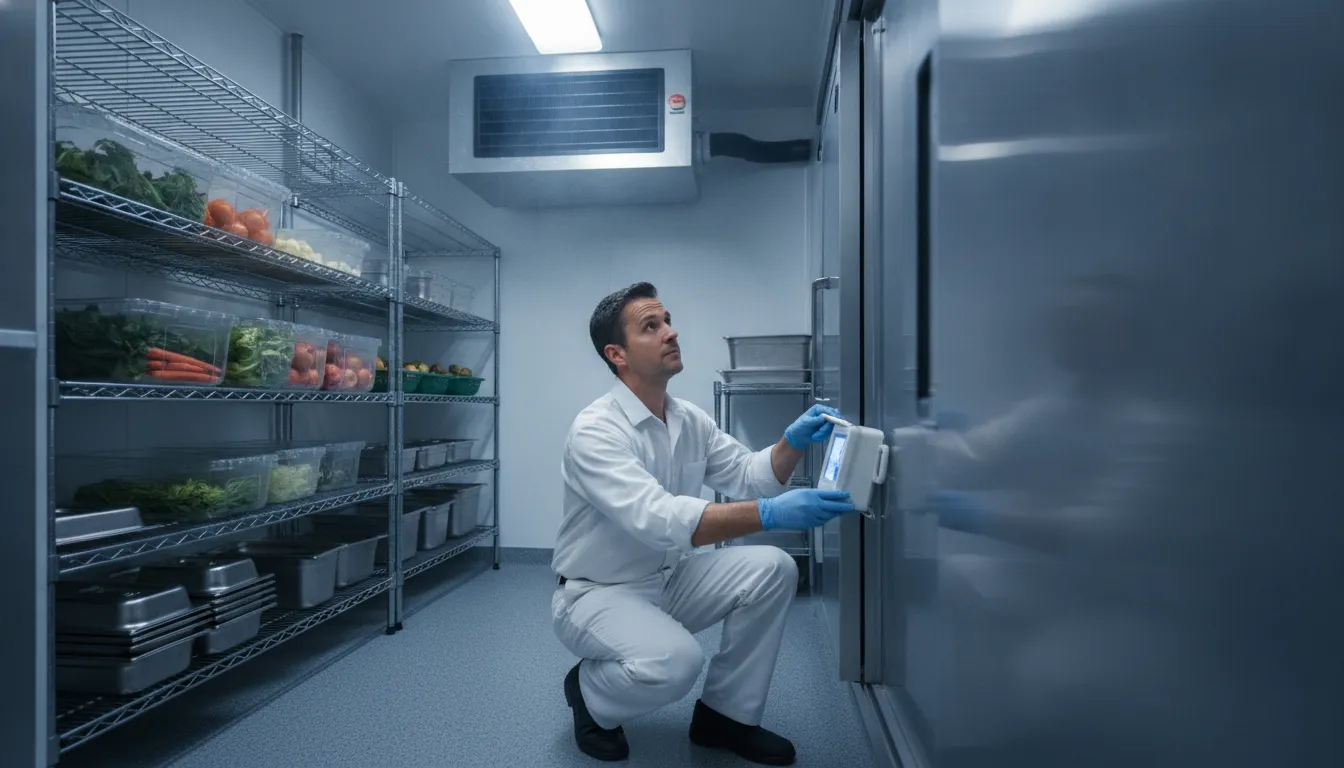
Measure food temperatures with a suitable, calibrated device when the procedure calls for a food reading. An air display on a walk-in cooler can show the condition near the sensor, but it may not show the warmest shelf, a recently loaded product, or a prep-table pan. Pair equipment readings with product checks where the food safety plan requires them.
Set a consistent schedule and train every person responsible for the check. The schedule should follow the restaurant’s written procedure rather than an assumed universal interval.
What should cooking, cooling, and reheating logs include?
Holding logs answer whether food is at a safe temperature now. Process logs answer whether the kitchen moved food through a time and temperature step safely. A cooling log, for example, should identify the food, the time cooling began, the temperature at each required checkpoint, the method used, and the time the food reached the final limit. This is more useful than writing one final number after the food is already in storage.
For many cooked time/temperature control for safety foods, the standard cooling framework is a reduction from 135°F to 70°F within two hours and to 41°F or below within a total of six hours. North Carolina provisions can include specific amendments or exceptions for food prepared from ingredients at ambient temperature, so the person in charge should use the state manual and the restaurant’s approved procedure rather than copy a generic chart.
Cooking and reheating entries should identify the product, the thickest or coldest point checked when applicable, the actual temperature, the time, and the employee. If the food did not reach the required limit, record the action taken. Reheating for hot holding has its own requirements, so do not use a cooling or hot-holding line as a substitute for the approved reheating step.
- Label the food or batch and note when the process starts.
- Measure at the checkpoints required by the written procedure.
- Record the actual temperatures and times as they occur.
- Document what happened if the food missed a time or temperature limit.
- Have the person in charge review unusual results and follow up on repeated failures.
Repeated slow cooling or warm prep-table readings can point to airflow, door seals, coils, controls, loading, or equipment capacity problems.
When do date-marking and time-control records matter?
Date marking connects a prepared food to its preparation or opening date and its discard date. The record may be a label on the container, a production sheet, a batch log, or a digital system, but employees should be able to identify the food and the date without guessing. Do not rely on a refrigerator temperature log to prove date marking; those are separate controls.
Time as a public health control also needs a clear system. Record the food, the time it leaves temperature control, the discard time, and the person responsible for the check. The North Carolina rule can differ from a generic four-hour poster in the details that apply to the operation. Confirm the procedure with the person in charge and local Environmental Health, especially if the restaurant uses a written plan or a nonstandard process.
Keep written procedures near the log or in the food safety binder. A digital log should let a manager retrieve entries, alerts, and responses during an inspection.
How should thermometer calibration and corrective-action logs work?
A temperature log is only as trustworthy as the device behind it. A calibration log should identify the thermometer, the method used, the date, the observed result, whether it was within the restaurant’s accuracy standard, and any adjustment or replacement. Train employees to remove a questionable device from service instead of continuing to use it because the number looks plausible.
A corrective-action entry should answer five questions:
- What was out of range, and what was the actual reading?
- Which food, batch, unit, or delivery was affected?
- What immediate decision was made about the food?
- What was checked or changed, such as moving food, closing a door, adjusting a control, or calling for service?
- What recheck showed that the issue was resolved, and who reviewed it?
Keep refrigeration service records with the corrective-action history when an equipment issue affects food temperatures. The service record is not a replacement for a food-safety log, but it can show the unit, symptoms, diagnosis, repair, temperature verification, and recommended follow-up. QRC HVAC & Refrigeration provides commercial refrigeration repair and restaurant refrigerator maintenance for businesses in Clemmons and the surrounding Piedmont Triad.
Repeated alarms, slow recovery after deliveries, warm spots, frost buildup, leaking door gaskets, or a compressor that runs continuously are reasons to investigate the equipment promptly. Do not simply change the temperature setpoint and erase the event. Preserve the reading, protect the food, and document the response.
What recordkeeping system works best for a Clemmons restaurant?
Paper forms work when they are legible, completed in real time, and easy to retrieve. Digital monitoring can create alerts, but it still needs a named employee response and a documented decision about affected food.
Give each unit a permanent name and use it on the log, alarm dashboard, service ticket, and maintenance record. Review logs as often as the written procedure requires. Look for readings near the limit, missing entries, copied values, long recovery periods, and repeat corrective actions.
For a restaurant in Clemmons, keep the state reference and the local inspection contact in the food safety binder. If an inspection question involves a menu-specific process, a record-retention period, an approved variance, or a new monitoring technology, ask Forsyth County Environmental Health for direction. A refrigeration contractor can diagnose equipment performance, but the regulatory authority determines how the restaurant’s food-safety documentation should be interpreted.
Use the simplest accurate system. The goal is to catch unsafe trends and show a clear chain from measurement to decision.
Frequently Asked Questions
Does every Clemmons restaurant have to use a temperature log?
North Carolina does not prescribe one identical log form and schedule for every restaurant. The needed records depend on the menu, processes, equipment, written food safety procedures, and applicable rules. Restaurants should document the controls they use and confirm process-specific questions with Forsyth County Environmental Health.
What temperature should a restaurant refrigerator hold?
Many time/temperature control for safety foods are held at 41°F or below under North Carolina’s food-protection framework. The restaurant should measure food and equipment according to its written procedures, use a suitable calibrated thermometer, and document the response if a reading is outside the applicable limit.
How long should a restaurant keep temperature records?
There is not one safe universal retention period for every record type and operation. Keep records for the period required by the restaurant’s written food safety procedures, applicable North Carolina requirements, and local direction. Ask Forsyth County Environmental Health if an inspection, process, or approved plan creates a specific question.
What should a restaurant do when a cooler temperature is too high?
Record the actual temperature and time, protect or move affected food according to the food safety plan, notify the person in charge, check the unit and product temperatures, and document the recheck. If the problem repeats or the unit cannot recover, arrange qualified commercial refrigeration service and keep the service record with the corrective action.
Can a digital temperature monitoring system replace a paper log?
A digital system can be part of the restaurant’s recordkeeping process if it captures readable time-stamped readings, identifies the unit, preserves alerts, and documents the employee response. It should still be accessible to the person in charge and available when records are requested. Confirm that the system fits the restaurant’s approved procedures.
Keep Your Restaurant Refrigeration Records Actionable
Temperature logs help your Clemmons restaurant spot risk early, but repeated excursions can signal a refrigeration problem. QRC HVAC & Refrigeration can help diagnose and maintain commercial refrigeration equipment. Call (336) 281-5144 or use the commercial refrigeration repair service page to request help.