When a walk-in refrigerator starts warming, cycling oddly, or collecting water, an organized response can help protect your operation and give a technician useful information. Commercial walk in refrigerator repair begins with noticing what changed, following your food-safety procedures, and describing the symptoms—not taking equipment apart. We serve commercial refrigeration customers in Charlotte and across North Carolina.
Call us to discuss walk-in refrigerator repair: (336) 281-5144
Which warning signs should you notice first?
A walk-in often gives clues before cooling stops altogether. One symptom alone rarely identifies the cause. Record what you observe and when it happens rather than guessing which component may have failed. A timeline can help us understand whether the issue is steady, intermittent, or connected to a change in use.
- Temperature rises or fluctuates. Note the display reading and time. If your team keeps a log, compare the current entry with earlier readings. Describe whether the change happened gradually or appeared between checks.
- The system runs longer than usual or starts and stops repeatedly. A change in workload, door use, airflow, or equipment operation can coincide with a different run pattern. Note whether the change followed a delivery, cleaning, busy service period, or a power interruption.
- New noise or vibration. Describe the sound, how often it occurs, and where it seems to come from. Do not reach around guards or moving equipment to locate it.
- Water or frost appears in an unusual place. Record the location and whether the condition returns. Avoid chipping ice with tools or pouring hot water into the unit.
- Airflow seems weak or uneven. Look for products or shelving blocking visible vents. Do not remove panels to investigate.
- The door does not close or seal normally. Check for an easy-to-move obstruction and look at the visible gasket for debris or damage. A door that will not stay closed needs prompt attention.
The room and the refrigeration system work together. Frequent door openings, heavy product loading, nearby heat, blocked clearances, and the way products are arranged can affect what staff observe. Those are useful details to report, but they do not confirm that a particular part has failed.
What can staff safely check before calling?
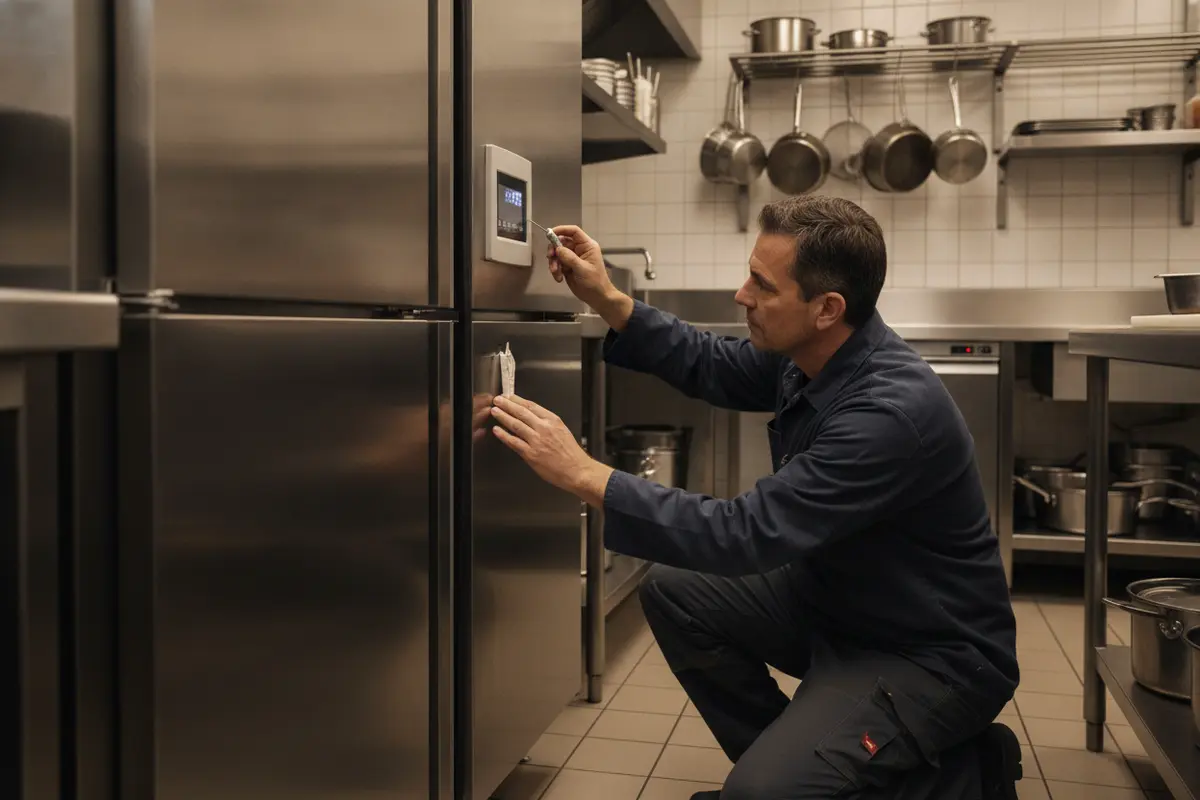
Start with observations that do not require tools, removing guards, or working around powered or moving parts. Follow your facility’s food-safety procedures as you assess the situation. If you see smoke, smell burning, hear a sudden severe mechanical noise, or notice another immediate hazard, keep people clear and follow your emergency and safety procedures.
- Confirm and record the symptom. Read the accessible display and write down the value and time. Compare it with the last routine entry if one is available. Note whether an alarm is present and copy its exact wording or code.
- Check the door without forcing it. Make sure an easily moved item is not blocking closure. Look at the visible seal for debris, gaps, or a tear. If the door is misaligned or difficult to operate, leave it alone and report that detail.
- Look for obvious airflow obstructions. If it is safe, move products away from visible vents and restore clear space around airflow paths. Avoid shifting heavy or unstable loads without a safe plan, and do not stack items against the ceiling or walls.
- Consider the room and recent activity. Note whether the kitchen is unusually warm, the door has been opened often, a delivery just arrived, or the unit was cleaned shortly before the symptom began.
- Review recent changes. Record prior service, a power interruption, a change in operating schedule, or new use of the space. Avoid repeated resets or setting changes unless your equipment instructions and facility procedure direct you to make them.
- Follow your product-protection plan. Use your business’s written procedures to decide how to monitor or protect stored products. Do not rely on smell or appearance alone to determine whether food is safe.
Do not open equipment panels, handle wiring, bypass controls, or attempt refrigerant work. These steps can create safety risks, damage equipment, and complicate diagnosis. If a control or alarm is confusing, record what it shows instead of experimenting with settings. For food-handling decisions, follow your facility plan and applicable requirements; the U.S. Food and Drug Administration’s food-safety resources are an authoritative starting point for general guidance.
Our commercial refrigeration service information explains the kind of equipment we work with. If your operation uses different cold-storage formats, our guide to walk-in and reach-in equipment considerations can help distinguish the equipment types without substituting for an assessment.
What information helps us assess a walk-in problem?
A clear first call helps us understand the equipment and the effect the problem has on your operation. If gathering details will not delay safety or product-protection steps, have the following information ready:
- Business and site location: Give the business name, street address, and the name of someone who can meet us or arrange access.
- Equipment identification: Say that the affected unit is a walk-in refrigerator. If you know whether it has a remote condensing unit or an integrated arrangement, mention it, but do not enter restricted spaces or climb to find out.
- Observed symptoms: Describe the warmer reading, noise, water, frost, frequent cycling, or door issue in plain language.
- Start time and pattern: Tell us when the issue was first noticed, whether it is continuous or intermittent, and whether it is getting worse.
- Readings and alarms: Share recorded temperatures, exact alarm text or codes, and when each was seen. A permitted photo of the display can help.
- Recent changes: Mention recent service, a delivery, cleaning, a power interruption, door damage, or a change in storage routine.
- Access and operating impact: Explain where the unit is, how a technician can reach it, any site rules, and whether the issue affects your only cold-storage area or normal service.
It is useful to distinguish direct observations from a suspected cause. “The display was higher at 2 p.m. after a busy delivery” gives us a factual timeline. “The compressor has failed” is a diagnosis that requires inspection. If several staff members noticed different things, record who saw each symptom and when.
If you have more than one walk-in or cold-storage area, identify the affected unit clearly. A location label such as “rear storage walk-in” can keep the conversation focused on the same equipment. Mention whether other units are operating normally; that comparison helps describe the scope but does not prove that the systems share a cause.
How do you distinguish a local issue from a service problem?
Some disruptions may follow a door left ajar or products blocking an airflow path. Others need a professional assessment. Look at the scope and pattern rather than naming a failed part. This table is a practical decision aid, not a repair diagnosis.
| What you observe | Safe first check | When to request service |
|---|---|---|
| Door partly open or blocked | Remove an easy-to-move obstruction and see whether the door closes normally. | If it will not close or seal, or the problem returns. |
| Warm reading after frequent door use | Limit unnecessary openings and record the next routine reading. | If the reading continues to rise, fails to recover as expected, or an alarm appears. |
| Visible vents blocked by products | Restore clear space around visible airflow paths when safe. | If airflow or temperature remains uneven afterward. |
| Water, frost, or unusual noise | Record location, timing, and recurrence; keep staff away from hazards. | If it is new, persistent, worsening, or accompanied by reduced cooling. |
| Repeated temperature change with no clear operating cause | Record readings and recent events without adjusting internal components. | Arrange an assessment so we can inspect the system and identify the cause. |
If the walk-in is warming and the cause is not obvious, it is sensible to contact a commercial refrigeration professional rather than wait for a complete failure. We handle commercial HVAC and refrigeration needs; our commercial services overview describes the wider scope of our work. For a repair discussion focused on the Charlotte area, see our walk-in refrigerator repair service page.
How should you protect the operation while waiting?
Keep the response focused on your business’s safety and food-handling procedures. Assign one person to maintain a simple log so staff are not working from conflicting reports. A useful entry includes the time, displayed reading, alarm status, door or loading activity, and any change in symptoms.
- Follow your internal food-safety plan and applicable requirements for monitoring or moving stored products.
- Limit door openings to necessary access, and remind staff not to leave the door propped open.
- Do not overload another cold-storage area or move products in a way that creates a handling hazard.
- Keep a clear path to the walk-in and accessible equipment locations, and tell staff where the technician may need to work.
- Keep the display, alarm information, and temperature log available for the person arranging service.
- Update us if the condition changes, especially if cooling is lost completely or a new safety concern appears.
If your own plan calls for moving products, consider whether the alternate space is suitable and has room before moving anything. Our article about mobile cold-storage options discusses one possible planning topic for businesses, but it does not determine whether a particular product is safe or whether an option is suitable for your site. For those decisions, use your facility’s food-safety process.
What affects the repair plan?
Every walk-in setup is different. Before recommending work, we need to understand the symptom history, unit configuration, visible condition, operating environment, and access to components. The technician may need to inspect and test the equipment before the cause is clear. A symptom list can guide the conversation, but it cannot confirm the failed component.
The plan can also depend on whether the concern is isolated or has affected other parts of the system, whether a needed part is available, and how the equipment is configured. Ask us to explain what has been confirmed, what remains uncertain, and why a particular next step is recommended. We do not want you to make a decision based only on a guess made over the phone.
For a recurring problem, organize your notes into three stages: what the walk-in was doing before the issue, what changed when the first symptom appeared, and what happened afterward. For example, note whether a reading rose gradually during a busy service period or changed suddenly when the kitchen was quiet. State whether the symptom happened once or returned on several shifts. These observations are more useful than an unsupported theory about the cause.
When a unit is older, has recurring trouble, or has a major failure, it may be reasonable to compare a repair with a longer-term equipment plan. There is no single age-based rule that decides the right choice. Ask us to explain the equipment condition, immediate need, and options in light of how your business uses the space. If the project concerns a freezer rather than a refrigerator repair, our information on planning a walk-in freezer installation quote covers a separate planning need.
Some businesses also operate ice machines or other refrigeration equipment. Keep each unit’s symptoms separate when you contact us, so the repair discussion remains clear. Our guide to commercial ice machine warning signs is about a different equipment type and should not be used to diagnose a walk-in refrigerator.
How can Charlotte businesses prepare for a service visit?
Before a visit, confirm the site contact, entrance, operating hours, and any access or safety rules. Walk-in equipment may be in a kitchen, storage area, or loading zone. Share access details in advance so we know where the unit is and how to reach the relevant equipment safely.
Keep a short timeline ready: when the symptom began, what changed, the latest reading, and what staff have already checked. If you have equipment records or prior service information, make them available. Do not remove access covers or stage a repair attempt to make the unit easier to inspect.
Tell us whether one walk-in or more than one system is affected. If other equipment is operating normally, identify it without assuming it has the same configuration. Our refrigeration service page is a useful starting point for understanding our commercial refrigeration work. Businesses with a broader building need can also review our commercial HVAC and refrigeration services.
We serve commercial refrigeration customers in Charlotte and across North Carolina. The specific work and scheduling depend on the equipment, site, and service need. If you are handling a separate urgent building-system issue, our commercial emergency HVAC guide describes what property owners can prepare; it is not a walk-in refrigerator diagnosis.
What should you ask after the inspection?
Once we have inspected the walk-in, ask for a plain-language explanation of what we observed and how it relates to the symptoms you reported. You do not need to know refrigeration terminology to understand the recommendation. A useful conversation connects the reported problem, inspection findings, and proposed next step.
- What did you confirm? Ask which conditions were observed and which are still possibilities.
- What work do you recommend, and why? Ask how it addresses the symptom and whether additional inspection or testing is needed.
- Are there operating or access considerations? Confirm whether staff should keep an area clear or coordinate access while work is underway.
- What should we monitor afterward? Ask which readings or changes are useful to record and when to contact us again.
- Is there another concern to plan for? If the assessment identifies a separate issue, ask how it affects the immediate repair plan and whether it should be discussed separately.
Write down the agreed next step and share it with staff who open the unit or monitor its temperature. If the symptoms change before work begins, update us rather than relying on the earlier description. Your business remains responsible for its food-handling and safety procedures, including decisions about stored products.
Talk with us about commercial refrigeration service: (336) 281-5144
Frequently Asked Questions
Should staff keep using a walk-in that is not holding its normal temperature?
Follow your business’s food-safety and operating procedures, record the observed conditions, and arrange an assessment if the temperature is not stable. Do not base food-safety decisions only on appearance or smell. Share the readings and timeline with the person responsible for the service call.
Can an alarm code identify the cause?
An alarm can be a useful clue, but it may not identify the underlying cause by itself. Record the exact message and provide it to us. Avoid repeated resets or setting changes unless your equipment instructions and facility procedure direct you to make them.
What if the walk-in is cooling again when the technician arrives?
Intermittent symptoms still matter. Keep your notes about readings, timing, sounds, alarms, and recent activity. A clear record helps us understand what happened even if the symptom is not present at the start of the visit.
Should we move products to another cold-storage area?
Follow your business’s food-safety procedures and use a safe, suitable space if your plan calls for moving products. Consider capacity and safe handling before moving anything. Ask the person responsible for food safety at your facility if you need a decision about specific products.
What details should we have ready when we call?
Have your location, a site contact, equipment type, observed symptoms, start time, readings or alarm messages, recent changes, access requirements, and operational impact ready. You do not need to know which component has failed to request an assessment.
Ready to discuss a walk-in refrigerator problem?
If a walk-in refrigerator is warming, making a new noise, or showing a recurring issue, we can discuss the equipment and next step with you. Have your site details, symptom timeline, and recent readings ready.
Call us about walk-in refrigerator repair: (336) 281-5144
We will use the information you provide to understand the request and discuss an appropriate service next step.