How long can a refrigerated trailer power outage in Greensboro leave the freight safe? There is no hour count that fits every trailer. A closed, pre-cooled, full load can drift slowly. A warm start, a thin load, or an open door can push product out of range much sooner. We treat the reading, the shipper rule, and the clock as the decision, not a guess from last summer.
Call us at (336) 281-5144 if a Greensboro trailer is already warming.
A Piedmont afternoon can sit in the 90s, and a dock behind a brick warehouse holds that heat. The unit only protects the box while it runs. Once site power, diesel, or the electric connection is gone, the box is just an insulated room. We can help you read the trend and get the unit running again. We cannot give a universal hold time from the phone.
What a refrigerated trailer power outage in Greensboro really allows
Safe hold time is the span before this load leaves its required range, not a number printed on the trailer. Insulation, starting temperature, cargo, and the weather all change it.
Start with the temperature the product must stay inside. Frozen freight, chilled meat, produce, and dairy do not share a limit. If the load was already near the edge when the power failed, the remaining window is short. If it was stable and the doors stayed shut, you may have more time, but you still do not have a promise.
Record the outage start, the setpoint, and the first box temperature you can trust. Then check again on a set interval. A slow climb can look fine for an hour and then speed up once the product and the air both warm. That curve, not a rule of thumb, tells you when to move the freight.
Our Thomasville hold-time guide walks through the same physics for a nearby stop. Use this page for a Greensboro dock, warehouse, or food plant that needs a local action plan while the unit is down.
What changes hold time at a Greensboro dock
The dock, the load, and the weather decide the drift more than the trailer brand. Write those facts down before you argue about hours.
A full trailer holds better than a half-empty one because cold product is part of the thermal mass. Empty floor space and warm return air let the box temperature move faster. A load that was still pulling down when the outage hit is not the same as a load that had already reached setpoint.
Door discipline matters as much as insulation. One long open door at a Greensboro receiving dock dumps the cold air you were counting on. A torn seal, a blocked chute, or a pallet parked in the airflow does the same thing more quietly. Sun on a dark trailer roof in July is a different problem from a cool night in January.
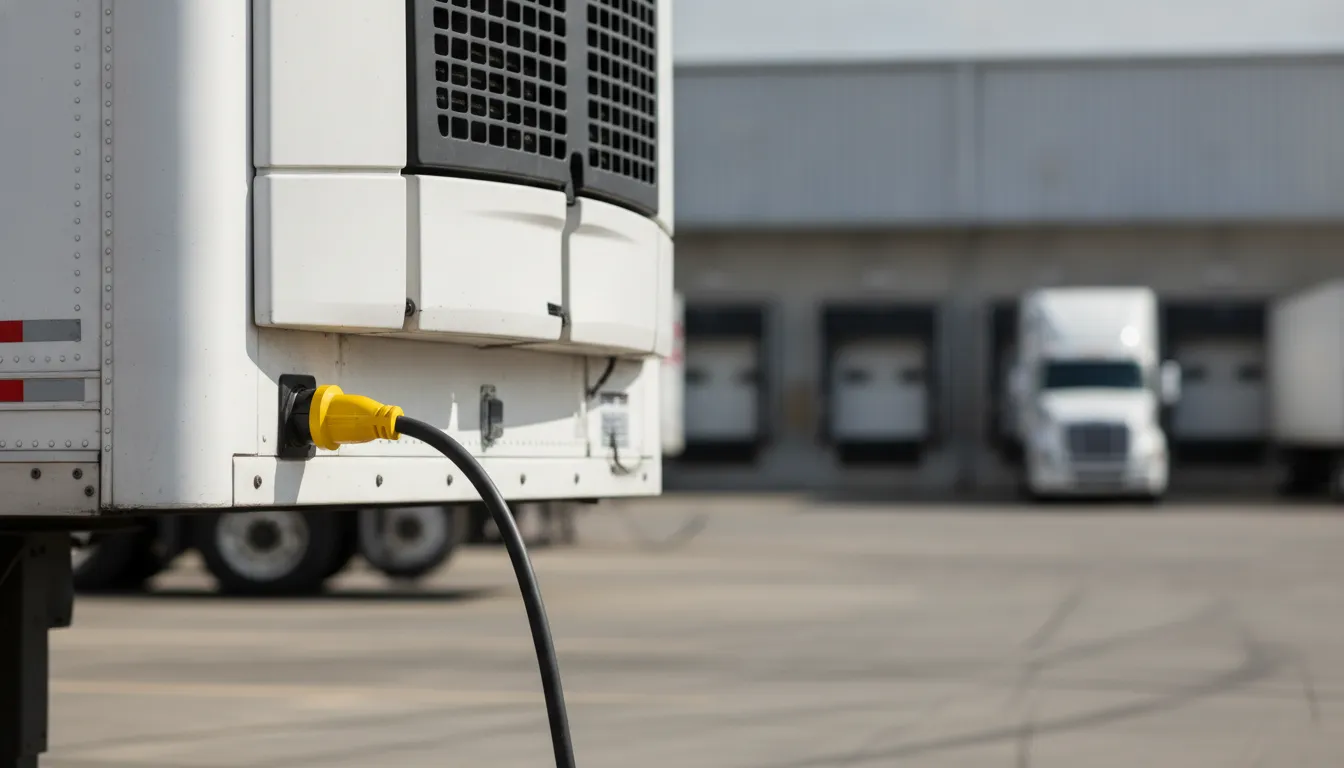
Standby power changes the story only if it is actually running. A diesel unit with fuel can keep cooling in a dark yard. An electric-standby unit needs a live, compatible receptacle. An engineless unit has no diesel backup. Our commercial refrigeration sales team can help you compare those setups later. During the outage, use the power source you already have.
| Condition. | What it does to hold time. | What we want you to do. |
|---|---|---|
| Full, pre-cooled, doors shut. | Often the slowest drift. | Log the start time and recheck on a schedule. |
| Partial load or warm product. | Temperature can move faster. | Treat the window as short and call the shipper. |
| Open door or bad seal. | Cold air leaves immediately. | Close up, then record the new reading. |
| Hot Piedmont afternoon. | Outside heat loads the box. | Shade is helpful, but the log still rules. |
| Working diesel or live standby. | The unit is cooling, not holding. | Confirm the mode, fuel, or plug before you relax. |
What to do in the first hour of an outage
Protect the product first, then find out why the unit stopped. Guessing a runtime wastes the minutes you still have.
- Close the doors. Tell the crew the trailer is in hold mode, not in loading mode.
- Write the time. Note when power or the unit failed, not when someone noticed the alarm.
- Read the box. Use the trailer probe or a calibrated thermometer in the air and, if the plan requires it, in the product.
- Check the power path. Look for fuel, a tripped breaker, a disconnected standby cable, or an alarm before you cycle the unit.
- Call the decision owner. The shipper, your food-safety lead, or the carrier says whether the load can wait.
- Call us if it will not restart. Share the model, the alarm, and whether the last run was diesel or electric.
Do not keep opening the door to “see how it looks.” Each look resets the hold you are trying to measure. If you must sample, do it once, write the number, and shut the door.
If the building is also dark, do not invent a cord from a generator that nobody sized. A wrong plug can damage the unit and still leave the freight warm. We would rather see a stopped unit with a clean log than a damaged one and no reading.
How to judge whether the cargo is still safe
The safe call comes from the required range, the time out of that range, and the shipper’s plan. A cold-feeling door is not a test.
For a home refrigerator, the FDA power-outage food page says to use a thermometer and to keep a closed refrigerator in mind for about four hours. That page is not a trailer rating. A refrigerated trailer is larger, loaded differently, and often governed by a customer spec that is tighter than a household rule. Use the FDA note as a reminder to measure. Use the shipper’s limit to accept or reject.
Compare three numbers: the required range, the temperature now, and how long it has been outside the range. Some plans allow a short excursion if the product never crossed a hard limit. Others require a hold, a dump, or a lab decision as soon as the line is crossed. We do not override that plan from the service truck.
Keep the log with the load. Write who read the temperature, what device they used, and what the unit display said if it still had power. That record is what quality and the receiver will ask for when the trailer finally moves.
If the product is already outside the range and the unit will not run, moving it can be the right next step. A nearby cooler, a second trailer that is running, or a receiver who can take it now may beat waiting on a repair. Our commercial refrigeration repair team can help you tell a quick restart from a job that will not finish before the load is lost.
Power choices that are not the same as hold time
Diesel, electric standby, and engineless electric units fail in different ways. None of them creates a guaranteed number of safe hours after cooling stops.
A diesel unit can keep cooling through a building outage if it has fuel and the engine runs. Check the tank before you assume that. A unit that ran all day may be low exactly when the grid drops. Noise and exhaust at a Greensboro door are real, but they are a later problem if the alternative is a warm load.
Electric standby only helps when the receptacle is live and the cable matches the unit. If the outage killed the dock power, standby is not a backup. If a generator is feeding that receptacle, someone qualified has to confirm voltage, phase, and capacity. We can look at the refrigeration side. An electrician owns the generator and the panel.
An engineless electric trailer needs batteries or site power. If both are down, you are in a pure hold. Plan the transfer sooner, because there is no engine to fall back on. Choosing that equipment is a separate buying decision. This article is about the hours after cooling has already stopped.
Greensboro mistakes that shorten the window
Most lost loads we hear about were still saveable when the first alarm sounded. The damage usually comes from the next choice.
- Quoting a universal hour count. “It always holds four hours” is how a hot load gets accepted. Measure this load.
- Opening the doors to cool the crew. The box is not a break room. Cold air does not come back when you shut the door.
- Trusting a dark display. If the unit has no power, the last setpoint on a blank screen is not a current temperature.
- Plugging into the wrong cord. A cord that fits is not proof of voltage or amperage. Stop and match the manual.
- Waiting on the utility before you call. Restoration time and repair time are different clocks. Start the service call while you still have a margin.
- Letting every driver change the setpoint. One lead should own the log, the mode, and the call to us.
Put the correction on the dispatch note for that dock. Name the person who may open the door, the thermometer location, and the office number. The next shift should not have to rediscover the plan in the dark.
When the same trailer fails every storm, the outage is exposing a maintenance problem. Dirty coils, a weak battery, a bad standby contactor, or a door that never sealed will show up on the worst day. Our commercial refrigeration maintenance visits are the time to find that, not the hour the freight is at risk.
A simple plan before the next storm
A written plan beats a memory of what worked in Thomasville or last July. Greensboro docks, yards, and food plants do not share one backup.
List every trailer that may sit at your site during a storm. For each one, record the model, the power modes, the fuel plan, and the receptacle if standby is real. Note where a calibrated thermometer lives and who is allowed to read it. Add the shipper contacts for the loads you carry most often.
Decide the backup before you need it. That might be diesel operation, a sized generator, a second running trailer, or a move into a cooler that is on backup power. “We will figure it out” is not a mode. If you want a second set of eyes on the equipment side, our commercial services team can walk the dock with you on a normal day.
Practice the log once. Time how long it takes to close up, read the box, and reach the decision owner. If that drill already eats half an hour, your real outage plan needs fewer steps, not more hope.
We serve Greensboro and the rest of the Triad from our Winston-Salem base. If you are unsure whether the unit, the dock power, or the building cooler should be the priority, call the office and we will help you sort the refrigeration problem from the electrical one.
Frequently Asked Questions
These are the questions we hear when a Greensboro trailer is dark and the freight is still inside. The useful answer is always tied to a reading.
Is there a safe number of hours for every refrigerated trailer?
No. Hold time changes with the starting temperature, the load, the doors, the seals, and the weather. A closed, pre-cooled, full trailer may drift slowly. A warm or open trailer may not. Log this load instead of reusing a number from another trip.
Does the four-hour refrigerator rule apply to a trailer?
No. The FDA four-hour note is household guidance for a closed refrigerator. Your shipper or food-safety plan sets the limit for this freight. Use a thermometer either way. Do not treat a home rule as a commercial release.
Will electric standby keep the trailer cold in a power outage?
Only if the standby source is still live. Dock power that died with the building does not help. A diesel engine with fuel can. An engineless unit cannot fall back on diesel. Confirm the mode before you count on it.
Should we open the doors to check the product often?
No. Open once for a planned reading, write it down, and close the doors. Repeated checks dump the cold air that was giving you time. If the plan needs product probes, assign one person and one trip.
When should we call QRC?
Call us when the unit will not restart, the alarm stays on, or the temperature is moving toward the limit and you need a technician in Greensboro. Have the model, the alarm text, the last power mode, and the current box temperature ready. Reach us through our contact page or at (336) 281-5144.
Talk with us about a Greensboro trailer outage. Call (336) 281-5144.
Get a Reading, Then Get Help
How long the freight stays safe is a measurement, not a slogan. Close the doors, log the time and temperature, and follow the shipper’s limit. If the unit will not run, call us at (336) 281-5144 or contact QRC HVAC & Refrigeration. We will help you protect the load while there is still time to act.