Commercial rooftop unit condensate in winter in North Carolina can raise questions when a business loses heat, sees water near equipment, or notices ice at an exposed drain. Cold weather can affect water left in a drain path, but a shutdown or cold room may have another cause. We recommend documenting what you can observe safely and arranging a qualified inspection when symptoms persist or water creates a risk.
Call (336) 281-5144 to discuss rooftop unit repair
How does condensate form in a rooftop unit?
Condensate is water that forms when moisture in the air collects on a cool surface. In cooling mode, warm indoor air passes over a cold coil, and moisture may collect on that coil. A drain pan catches the water and a condensate line carries it away. Some high-efficiency heating equipment also produces condensate while operating. The exact arrangement depends on equipment design, installation, and operating mode.
That distinction matters in winter. A rooftop unit that is heating may not produce condensate in the same manner as it does while cooling. Some equipment configurations may produce water during heating, but not every rooftop unit does. A puddle near a unit therefore does not prove that a condensate drain is blocked. Rain, melting frost, a plumbing issue, or another source could also be involved.
When a unit does have a drain pan and line, the water needs a clear route out. A restriction, damaged connection, poor drainage, or freezing in an exposed section may interrupt that route. If water backs up, a float switch or other safety control may stop operation on certain systems. Equipment varies, so a technician must verify the actual arrangement and control sequence rather than assume every unit works the same way.
Why can winter weather affect condensate drainage in North Carolina?
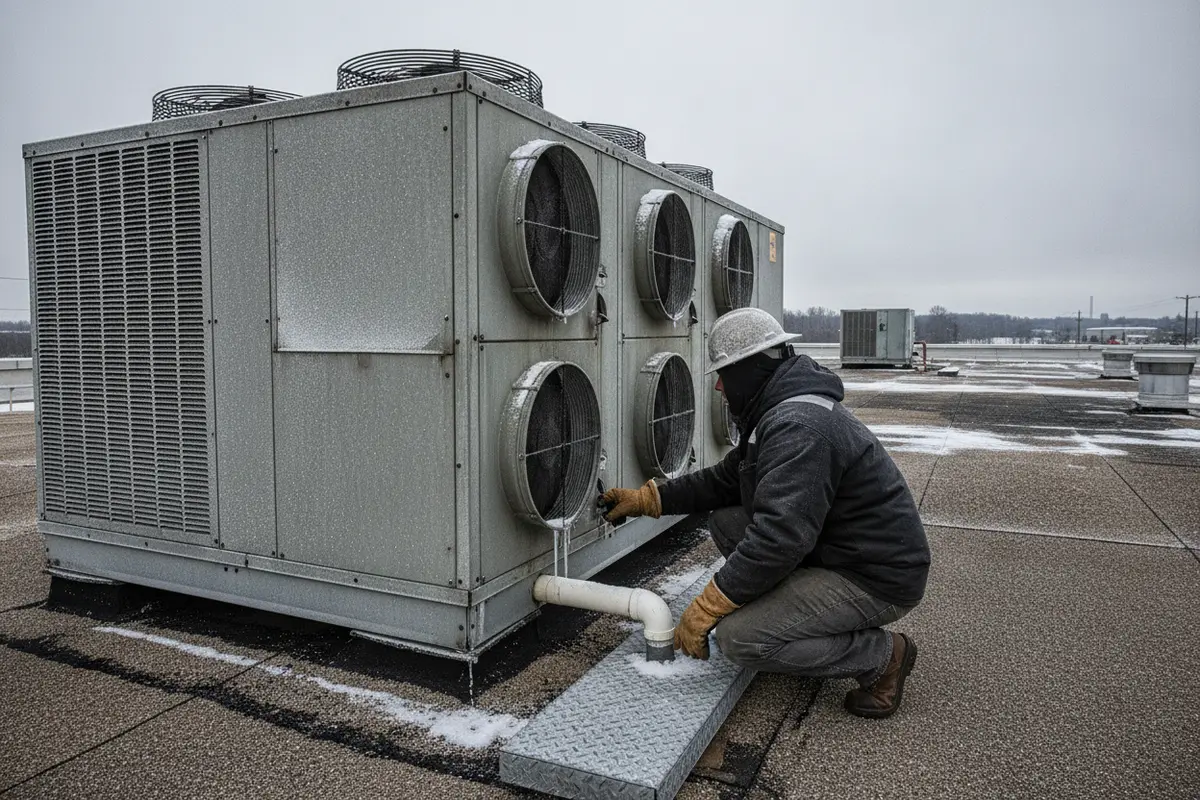
North Carolina winters can move between mild daytime conditions and freezing nights. Water that remains in a cold, exposed portion of a line may freeze when conditions allow. If a line is partly restricted, water may drain slowly or collect in a low area, leaving more time for cold exposure to matter. A thaw can make the symptom disappear temporarily, only for it to return during another cold period.
Exposure varies from one rooftop to another. Wind, shade, the line’s path, insulation condition, roof layout, and the location of the outlet all affect the conditions a technician will consider. Leaves or other debris at an outlet may be relevant too. These factors are possible contributors, not a diagnosis. We need to inspect the specific unit and its installation to establish what is happening.
Cold weather can also coincide with other faults. A control issue, electrical problem, airflow restriction, heating component failure, thermostat setting, or equipment capacity concern can produce a similar complaint: the space is cold or the unit is not running as expected. If several rooms are uncomfortable, if only one zone is affected, or if there is no visible water at all, those observations help narrow the service investigation without proving a cause.
What signs might point to a drainage concern?
Look for a pattern, not a single clue. From a safe and authorized location, staff may notice water where it is not normally present, an outlet that appears iced over, standing water near an accessible drain route, or a new ceiling stain. A unit may also stop, cycle off, or show a fault indication around the same time. A cold snap followed by a thaw and a repeat symptom is useful context.
- Water is visible near the unit or an observed drain route, or appears inside the building beneath the equipment.
- An exposed outlet appears blocked or iced over, when visible without climbing or approaching a roof edge.
- The unit stops, cycles repeatedly, or displays a warning or fault code.
- Occupants report a new leak, water stain, or change in temperature in a particular area.
- The symptom begins during freezing weather, changes as temperatures rise, or returns with another cold spell.
- A service record shows a similar issue on the same unit or area in a prior season.
Each sign can have more than one explanation. Water on a roof after precipitation, for instance, does not by itself show a drain failure. A fault code may point to a control condition but may need model-specific interpretation. Keep the location and timing precise. “Water near the north-side unit after an overnight freeze” is more useful to a technician than “the roof is wet.”
What should facility staff do first?
Start with people and property safety, then record the symptom. If there is active water close to electrical equipment, do not touch the equipment or enter the wet area. Follow your site’s safety and water-response procedures, restrict access where appropriate, and involve the people responsible for building maintenance. Roof access should be limited to authorized personnel following the facility’s safe-access rules.
- Note the time and conditions. Record when the issue started, the outdoor conditions if known, whether the symptom followed a freeze or thaw, and whether it is continuous or intermittent.
- Identify the affected area. List the rooms, zones, or operations affected. Note whether the unit appears off, runs but does not maintain temperature, or cycles on and off.
- Record controls and alarms. Write down the thermostat or building-control reading, displayed fault code, and any alarm message. Photograph a display only if this can be done safely and without opening equipment.
- Observe from an approved location. Note visible water or ice without climbing onto a roof, removing a panel, touching a drain, or approaching a hazard.
- Protect people and contents. Use the building’s procedures for wet floors, water intrusion, occupants, sensitive materials, and continuity of operations.
- Share the timeline with service personnel. Provide the unit label or location, recent service history if known, and what changed before the symptom began.
Do not pour hot water on a unit, use a flame or heat gun, or chip ice from a drain, coil, or cabinet. Do not bypass a condensate safety switch or repeatedly reset a unit that shuts down. A safety control may be responding to a condition that needs attention. Repeated resets can hide the sequence of events and may allow water to spread or another problem to worsen.
For general guidance about keeping walking and working surfaces safe, consult the U.S. Occupational Safety and Health Administration. The appropriate response at a particular site still depends on its procedures, conditions, and the equipment involved. Keep staff away from wet or icy roof areas and use the site’s authorized access and hazard controls.
How do drainage symptoms compare with other rooftop-unit issues?
This comparison is a way to organize observations before a service visit. The entries describe possible areas to investigate, not conclusions about a failed part. A technician needs to inspect and test the equipment to identify the cause.
| What staff observes | Possible area to investigate | Useful next step |
|---|---|---|
| Water near a drain route | Drain pan, line, outlet, or an unrelated water source | Record exactly where and when it appears; arrange inspection if it recurs or enters the building. |
| Ice at an exposed outlet | Water in the drain path, restricted flow, or exposure to cold air | Keep clear of roof hazards and report what is visible to service personnel. |
| Shutdown with a drainage-related warning | Condensate safety control or another control condition | Record the message; do not bypass the switch or repeatedly reset the unit. |
| Unit runs but spaces stay cold | Airflow, controls, heating components, or a zone-specific issue | Identify affected rooms and arrange professional diagnosis. |
| Interior leak without a visible roof drain symptom | Several possible sources, including piping or the building envelope | Protect the area and involve facility maintenance and HVAC service. |
| Problem changes after a thaw | An intermittent condition, possibly involving drainage or another cold-weather effect | Keep the timeline and request follow-up if the issue returns. |
How can you document the issue so a technician can act?
A short, consistent log is more valuable than a long account written after the problem has passed. If the building has multiple rooftop units, use the equipment label, building plan, or control-system identification to say which unit serves the affected space. Do not assume the closest unit on the roof serves the nearest room; duct routes and zoning may not follow that visual relationship.
For each observation, record the date and time, the room or area, the reading shown at the thermostat or control, whether the unit was operating, and any alarm or code. Add whether water was inside or outside, where it appeared, and whether the symptom followed precipitation, freezing weather, or a thaw. If you take a photo, capture the location from a safe vantage point and avoid entering a restricted area.
For example, a useful note might say: “At 7:15 a.m., the west office was below its usual setpoint. The control showed code ABC, and the unit identified as RTU-3 was not running. Staff saw no water inside. The issue began after an overnight freeze and was still present at 9 a.m.” Do not invent a code or interpret it without the equipment information; simply copy what the display actually shows.
For a second example, suppose one conference room is cold while the rest of the building remains comfortable. Note that the issue is limited to that room, whether its air delivery seems different, and whether the unit serving it has an alert. That pattern may direct attention beyond a roof drain. The service technician can use the information to inspect the appropriate system and determine what tests are needed.
Tell us about recent repairs, control changes, or maintenance if you know them. If an alarm cleared by itself, record that rather than omitting it. A temporary restart or thaw is part of the timeline, but it does not confirm that the original condition is resolved.
What should you tell the HVAC technician?
When arranging service, describe what happened in order. Say whether the unit is fully off or still running, when the building began to feel cold, whether the condition is isolated to one area, and whether there is water, ice, a warning, or a fault code. Give the equipment location or label and mention any recent service that may be relevant. If you do not know an answer, say so; guessing can send the investigation in the wrong direction.
Commercial buildings may have several systems serving different areas. Share which occupants, work areas, or temperature-sensitive operations are affected and whether the condition is changing. If water is entering the building, state where it is appearing and what immediate facility steps have already been taken. This helps us understand the scope and prepare for the conversation without asking staff to perform hazardous checks.
We provide commercial HVAC service for businesses. Our commercial HVAC and refrigeration services page describes the scope of our commercial work. For a heating issue in the Clemmons area, see our rooftop unit repair resource. Our HVAC service and repair guide offers additional context on preparing for service.
How can a facility reduce winter drainage surprises?
Preparation is most useful before an interruption. During planned service, a qualified technician can examine the unit’s drainage arrangement, look for obstruction or damage, and assess how the drain route is configured for that equipment. The appropriate work depends on the model, installation, and manufacturer guidance. A general checklist cannot replace an inspection of the actual system.
- Keep unit records together. Maintain accessible equipment labels, control information, service notes, and a history of recurring water, ice, alarms, and shutdowns.
- Report patterns early. Ask staff to note a repeat leak, unusual temperature change, or recurring alarm instead of waiting for a full loss of heat.
- Plan safe roof access. Confirm that only authorized, trained personnel use the approved access route and follow site procedures for weather and roof hazards.
- Discuss recurring cold-weather symptoms. Ask the technician to consider the drain path and relevant controls as part of a broader diagnosis, rather than presuming a single cause.
- Review response responsibilities. Make sure the people who receive building alarms know how to document the unit, protect affected areas, and contact the appropriate service provider.
Insulation or heat tracing should not be treated as a universal remedy. Whether either measure is appropriate depends on the equipment, conditions, design, and installation requirements. A qualified professional should identify the underlying issue and determine whether a change is suitable. Similarly, clearing a line or changing its route should be done only by qualified personnel following the applicable equipment guidance.
For broader continuity planning, our property owner’s guide to emergency HVAC service can help a team think through an interruption. If the concern involves commercial refrigeration as well as building heat, our commercial refrigeration services page explains that part of our work. We also provide information about walk-in and reach-in equipment choices for readers handling a separate refrigeration planning question.
When should you arrange commercial rooftop unit repair?
Arrange professional service when a unit repeatedly shuts down, a safety control trips, water enters the building, ice or a drainage symptom returns, or the system cannot maintain the expected indoor conditions. Contact service promptly if water is near equipment or if the building’s people, materials, or operations could be affected. Follow site emergency procedures while waiting and keep staff away from unsafe areas.
It can also make sense to request an inspection when the unit restarts after temperatures rise. A change in weather does not show that a drain path is clear or that the original cause has been corrected. A technician can inspect the configuration, test relevant controls, and determine whether a drainage issue or another fault explains the symptoms.
Some complaints call for immediate site safety action before any equipment diagnosis. If there is water near electrical components, active leakage over occupied space, or unsafe access conditions, follow your facility’s escalation procedures and keep people clear. Do not ask staff to climb to the roof or open panels to speed up a service call. Clear observations from a safe location are enough to begin the conversation.
We serve commercial customers with HVAC and refrigeration needs. Learn more about our commercial service work or review our emergency HVAC preparation guide as your team plans its response. Share the unit identification, alarm details, and timeline when you request assistance so we can discuss the problem with useful context.
Call (336) 281-5144 to arrange rooftop unit repair
Frequently Asked Questions
Can condensate freeze on a commercial rooftop unit?
Water in an exposed or restricted drain section can freeze when conditions are cold enough. Whether that is happening on a particular unit depends on its design, drain route, and conditions. Do not try to thaw equipment with a flame or improvised heat source; arrange an inspection if drainage or operation is affected.
Does water around a rooftop unit always mean the condensate line is blocked?
No. Water may come from another source, including weather-related water or a building issue. Note where and when it appears, and arrange an inspection if the water recurs, enters the building, or is accompanied by a shutdown or operating concern.
Should staff reset a unit that shuts off after a condensate warning?
Do not repeatedly reset the unit or bypass a safety switch. Record the warning and contact qualified service personnel, especially if water is present or the unit will not stay on. The control may be responding to a condition that needs diagnosis.
Can facility staff clear ice from a drain?
Only authorized, trained personnel should access rooftop equipment, and they should follow site procedures and equipment guidance. Staff should not climb onto a roof or chip ice from a drain or unit as a do-it-yourself response.
What if the unit heats again after a thaw?
Record when operation returned and whether water, ice, or an alarm was observed. The improvement is useful information, but it does not confirm that the original cause is gone. If the symptom returns or the system remains unreliable, arrange professional diagnosis.
Need Help With a Commercial Rooftop Unit?
When a rooftop unit loses heat or shows signs of a drainage problem, we can inspect the system and determine the cause. Call us at (336) 281-5144 to discuss the symptoms and arrange commercial HVAC service.