


A furnace problem rarely answers the repair-or-replace question by itself. A noisy startup, uneven rooms, or a sudden breakdown may come from a correctable issue, while repeated failures can point to a larger reliability concern. For a Yadkinville homeowner, the right choice depends on the equipment’s condition, service history, safety findings, comfort, and how long you expect to remain in the home.
When should you consider upgrading instead of repairing your furnace in Yadkinville? Consider an upgrade discussion when the furnace is aging, has recurring or extensive repair needs, no longer performs as expected, or raises safety concerns. Age is a useful clue, not an automatic replacement order. The EPA advises weighing age, condition, efficiency, energy costs, and repair costs together: ENERGY STAR’s repair-or-replace guide provides that framework.
Before focusing on a repair estimate or a new system, start with one practical question: what is the furnace actually telling you? A careful evaluation can separate a maintenance or airflow issue from a problem that warrants comparing repair and replacement options.
Talk with a furnace specialist in Yadkinville at (336) 281-5144.
What is the first question to ask about your furnace in Yadkinville?
Start by describing what changed. Is the furnace making a new or worsening noise? Are some rooms too hot or too cold? Uneven temperatures can come from equipment operation, duct problems, or inadequate insulation, so replacing the furnace may not solve the underlying comfort issue. A noisy heating system can also point to an equipment problem or an undersized duct system. These symptoms deserve diagnosis rather than an automatic upgrade recommendation. ENERGY STAR identifies uneven temperatures and noisy systems as issues that may require further evaluation.
Next, consider the furnace’s age in context. A 10-year-old furnace is not automatically at the end of its useful life, but its age may justify discussing an upgrade alongside the repair. A furnace over 15 years old deserves a particularly careful repair-versus-upgrade comparison. Age is a clue, not a verdict. A newer system with one isolated problem may be a sensible repair candidate. While an older system with recurring comfort or performance issues may make a replacement discussion more practical.
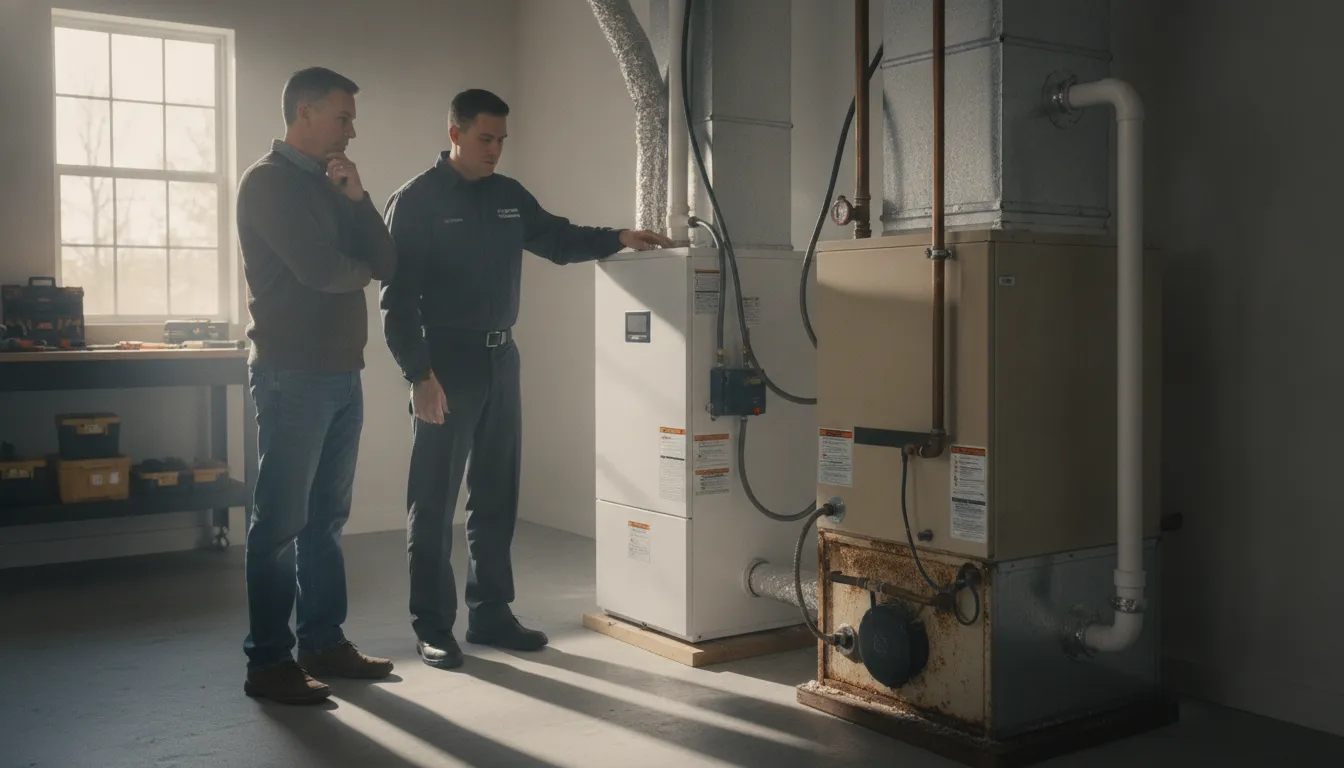
A repair can restore heat without being the best long-term value. If the repair addresses one failed component but the furnace continues to operate noisily or leaves rooms uncomfortable, the immediate fix may not resolve the broader problem. The right decision depends on what an inspection finds, not on a single symptom or a universal age rule. QRC HVAC & Refrigeration can evaluate the equipment and explain whether repair or replacement better fits the condition of the system.
Use this checklist before choosing repair or upgrade
- Record the furnace’s approximate age and any previous repairs.
- Note new noises, uneven room temperatures, or changes in heating performance.
- Ask whether the proposed repair addresses the root problem or only the immediate failure.
- For a furnace around 10 years old, request a repair and upgrade comparison rather than assuming either option.
- For a furnace over 15 years old, ask for a careful evaluation of condition, reliability, and likely next repairs.
For background on what technicians may inspect and repair, review this furnace repair services guide. It can help you prepare useful questions before discussing the next step for your Yadkinville home.
How does furnace age change the repair-versus-upgrade decision?
For a Yadkinville homeowner, the useful question is not simply. “How old is the furnace?” It is. “What is the furnace’s age telling me when I consider its condition, repair history. Performance. And safety?” The EPA’s repair-or-replace guide lists a furnace under 15 years old on the repair side of its comparison and a furnace over 15 years old on the replacement side. That guidance is a starting point, not a guarantee about any individual system. A well-maintained older furnace may continue to serve a home, while a younger system can still have a serious defect that changes the decision.
Start by gathering the service history. A good record supports continued repair, especially when the current problem is limited and the furnace is performing up to expectations. By contrast, extensive or costly repairs, repeat problems, excessive on-and-off cycling, and performance that falls short of expectations all strengthen the case for comparing replacement options. These indicators matter more when they appear together rather than in isolation.
| Broad age band | What to investigate | Possible direction |
|---|---|---|
| Under 15 years. | Check the current failure, repair scope, and service record. | Repair may be reasonable if the issue is isolated and the system remains dependable. |
| About 15 years or older. | Check repeat failures, cycling, comfort, efficiency, and condition. | Compare repair with an upgrade evaluation when several indicators appear. |
| Any age with recurring concerns. | Check the cause, airflow, ductwork, and safe operation. | Diagnose the underlying cause before choosing repair or replacement. |
The EPA guide advises considering an ENERGY STAR qualified replacement when two or more replacement indicators apply. Its broader framework includes age, overall condition, efficiency, energy costs, and repair costs. That does not mean a Yadkinville furnace must be replaced after reaching a particular birthday. It means multiple warning signs deserve a side-by-side decision rather than another isolated repair.
Also investigate the rest of the heating system before blaming the furnace. ENERGY STAR reports that sealing and insulating accessible ducts can improve heating and cooling efficiency by as much as 20 percent in some cases. Uneven airflow, duct leakage, or an undersized duct system can make a furnace appear inadequate when the distribution system needs attention. If an upgrade is appropriate, professional installation matters because the EPA says proper installation is necessary for equipment to operate at peak efficiency and deliver its expected benefits.
For a clearer planning discussion, review these furnace replacement cost factors, then have the existing equipment evaluated. The right answer depends on the evidence found at the home, not on age alone.
Which repair and safety signs point toward replacement?
Start with safety, not age or appearance. If a technician identifies a heat-exchanger problem, combustion concern, or another condition that makes continued operation unsafe, stop using the furnace and ask for professional guidance. Do not keep resetting the system or attempt to bypass a safety control. QRC HVAC & Refrigeration provides heat-exchanger inspection and repair, along with furnace troubleshooting and replacement evaluations.
- There is a safety finding. A suspected heat-exchanger defect, combustion issue, carbon-monoxide concern, unusual burning smell, or visible damage deserves prompt professional attention. If anyone experiences symptoms that could indicate carbon-monoxide exposure, leave the home and contact emergency services or the appropriate utility emergency line. A furnace should not be operated again until a qualified professional says it is safe.
- A major component has failed. A technician may find that the repair involves more than routine maintenance, such as a heat exchanger, control, motor, or another central operating component. Ask what caused the failure, whether other parts show related wear, and whether the repaired furnace can be expected to provide dependable heat. The answer should be based on an inspection, not a blanket rule.
- Repairs keep recurring. One reasonable repair on a furnace that otherwise performs well can be different from repeated breakdowns during successive heating seasons. Keep invoices and note which parts have failed. A pattern of repairs, especially alongside unreliable starts or frequent service calls, may justify comparing the next repair with a complete replacement.
- Rooms remain unevenly heated. Cold rooms do not automatically mean the furnace must be replaced. Ductwork, airflow, insulation, sizing, and equipment operation may all contribute. Have those possibilities checked before committing to new equipment. If the furnace is also noisy or struggles to maintain temperature after related issues are addressed, replacement may offer a more dependable path.
- The system is noisy or airflow is weak. ENERGY STAR notes that a noisy heating or cooling system may point to an undersized duct system or an equipment problem. Check the filter during heavy-use months, since a restricted filter can make the system work harder. If maintenance does not resolve the symptom, schedule a diagnostic visit rather than continuing to operate a failing system.
In Yadkinville and nearby Yadkin County communities. A professional evaluation can separate a correctable airflow or maintenance issue from a furnace that is no longer a practical repair candidate. QRC offers furnace repair, replacement, installation, maintenance, and emergency heating service. If the furnace is producing unsafe symptoms, stop using it and request emergency heating repair. For a non-emergency decision, arrange an inspection that addresses the safety findings, repair history, comfort complaints, and installation options.
Proper installation matters if replacement is recommended. The EPA ENERGY STAR repair-or-replace guide explains that only proper installation allows equipment to operate at peak efficiency and deliver its expected benefits. Read the ENERGY STAR repair-or-replace guidance and ask the technician to explain the findings in plain language before approving work.
When can repairing a furnace still be the better choice?
An older furnace is not automatically a failed furnace. A 10-year-old unit, for example, is not necessarily at the end of its useful life, although its age may justify discussing both repair and upgrade options. The more useful question is whether the current fault is a single, correctable issue or evidence of broader decline.
Repair is often worth considering when a technician can identify one isolated fault and the rest of the system is operating as expected. A furnace with a good maintenance record may have cleaner internal components, fewer unresolved airflow problems, and a clearer history of how it has performed through prior winters. That history gives a homeowner better context than age alone.
Signs that support a repair decision
- The problem is limited: The inspection identifies one repairable fault rather than several failing components or recurring breakdowns.
- Major components are sound: The heat exchanger, blower motor, inducer motor, controls, and other critical parts do not show findings that point to an immediate wider replacement concern.
- The repair history is favorable: The furnace has not been developing repeat problems, and a recent major repair may mean the present issue is minor by comparison.
- Comfort remains acceptable: The furnace heats the home consistently without persistent unusual noise, excessive cycling, or rooms that remain noticeably too cold.
- Expected remaining life is reasonable: The equipment’s installation quality, maintenance, sizing, operating conditions, and repair history all support continued service.
Maintenance can also affect whether a repair extends practical service life. ENERGY STAR notes that clean filters help prevent dust and dirt buildup that can contribute to expensive maintenance or early system failure. Checking the filter monthly during heavy-use months and changing it at least every three months, as recommended by ENERGY STAR, can support airflow and reduce unnecessary strain. A maintenance step cannot correct a failed component. But it can help distinguish a neglected airflow issue from a furnace that has reached the end of its dependable service.
Repair becomes less reassuring when the same symptoms return, safety concerns appear, or several major parts are deteriorating together. Heat-exchanger and combustion findings require qualified evaluation, not a guess based on the furnace’s age. For a Yadkinville homeowner, a professional inspection can clarify whether the repair addresses an isolated fault or only postpones a larger decision. QRC HVAC & Refrigeration provides furnace repair and replacement evaluation for that comparison.
The practical goal is not to keep an old furnace running at any cost. It is to choose the option that matches the equipment’s condition, safety, comfort performance, and likely remaining service life.
How should Yadkinville homeowners compare efficiency, comfort, and total cost?
Efficiency matters because heating and cooling account for a substantial share of household energy use. However, a higher-efficiency furnace cannot correct every comfort or operating problem. Uneven temperatures may come from duct problems, inadequate insulation, equipment operation, or incorrect sizing. A professional evaluation should separate a furnace issue from a house or ductwork issue before you decide that replacement is the answer.
For example, a dirty filter can restrict airflow and make the system work harder. ENERGY STAR recommends checking the filter monthly during heavy-use months and changing it at least every three months, depending on the home’s conditions. A yearly tune-up can also improve efficiency and comfort. These maintenance steps may be appropriate when the furnace is otherwise reliable and performing as expected.
Look beyond the efficiency rating
When comparing an upgrade, ask how the proposed equipment will affect the entire system. Is the furnace correctly sized for the home? Will the ductwork support the airflow? Does the installation include appropriate venting, controls, and commissioning? The EPA’s repair-or-replace guide explains that proper installation is necessary for equipment to operate at peak efficiency and provide its expected benefits: ENERGY STAR repair-or-replace guidance.
Comfort is equally practical. Frequent cycling, persistent noise, cold rooms, dry winter air, or repeated service calls can make a technically functional furnace frustrating to own. If a new system would address those concerns. Ask the technician to explain which improvement comes from the equipment and which depends on duct sealing, insulation, airflow correction, or controls. Do not assume a new furnace alone will solve a building-wide comfort problem.
Calculate total cost without guessing
Total cost includes more than the installation quote. Consider the proposed equipment, required modifications, disposal of the old unit, maintenance needs, expected repair exposure, and the value of dependable heat. Do not rely on a universal repair percentage or promised savings. A repair may be sensible when the furnace has a good service record and needs a limited fix. An upgrade deserves closer consideration when repairs are extensive, problems repeat, efficiency has declined, or the system no longer meets comfort and reliability expectations.
For a broader framework, review this guide to HVAC total cost in Yadkinville. QRC HVAC & Refrigeration also provides residential heating and cooling services for evaluating repair, maintenance, and replacement options. The right decision should reflect your home’s condition, your budget, and your plans, not a sales formula.
What happens during a professional furnace evaluation?
For a homeowner in Yadkinville, the goal is not to receive an automatic replacement recommendation. It is to understand the furnace’s actual condition and the risks of continuing to operate it. A thorough evaluation should give you enough information to make a decision based on evidence rather than urgency or guesswork.
- Identify the furnace and its operating setup. The technician should document whether the system is gas-fired, electric, or oil-fired, along with its model, capacity, installation details, and visible condition. This matters because the right diagnostic process and repair considerations depend on the equipment type. Installation quality, maintenance, sizing, operating hours, moisture, and repair history can all affect how a furnace performs over time.
- Review age and repair records. Bring invoices, service notes, and information about recurring problems if you have them. One moderate repair on a furnace with no significant history of trouble may still support repairing it. A pattern of repeat failures, however, deserves a broader comparison. The evaluation should identify which parts have failed and whether the proposed work is routine or materially more involved. A heat exchanger, control board, inducer motor, or blower motor can make a repair substantially more significant than standard maintenance.
- Inspect the heat exchanger and combustion safety. This is a critical on-site portion of the evaluation. The technician should examine the heat exchanger and combustion-related components, look for damage or unsafe operation, and explain any findings clearly. QRC HVAC & Refrigeration provides heat-exchanger inspection and repair. A virtual appointment may help with initial troubleshooting, but it does not replace an on-site safety inspection. If you start with remote guidance, use it only as a first step through a virtual HVAC diagnostic appointment.
- Assess comfort, airflow, and cycling. Ask the technician to consider uneven room temperatures, humidity concerns, unusual dust, and system noise. These symptoms can involve the furnace, ductwork, or equipment sizing, so replacing the furnace is not automatically the answer. Excessive on-and-off cycling also deserves investigation. If your furnace cycles too frequently, review the related guidance on furnace cycling too frequently while arranging a professional assessment.
- Review maintenance and explain the options. Maintenance records help show whether the system has received regular attention. ENERGY STAR recommends checking the filter monthly during heavy-use months and changing it at least every three months. A dirty filter can restrict airflow and make the furnace work harder. The technician should explain what maintenance can address, what repair would involve, and what replacement would change. That comparison should include condition, reliability, safety findings, and expected performance, not just the immediate symptom.
After the evaluation, you should have a written or clearly explained path forward: repair now, monitor a developing issue, or plan a replacement. The best recommendation is the one that fits the furnace’s documented condition and your home’s heating needs.
Get clear repair or upgrade guidance for your Yadkinville furnace at (336) 281-5144.
Frequently Asked Questions
FAQ summary: The repair-versus-upgrade decision depends on furnace age, condition, safety, repair history, comfort, efficiency, and the home’s needs. No single age or percentage rule replaces a qualified inspection.
When should I consider upgrading instead of repairing my furnace?
Consider an upgrade comparison when the furnace is in the older part of its service life. The proposed repair is extensive, safety cannot be confirmed, or repeated repairs are affecting reliability. A younger furnace with one well-understood failure may still be reasonable to repair.
Is a 13-year-old furnace considered old?
A 13-year-old furnace is mature equipment, but age alone does not require replacement. Review its repair history, condition, comfort, operating performance, and maintenance record. One manageable issue may support repair, while repeated failures or declining performance support a closer upgrade comparison.
Can a furnace over 15 years old still be repaired?
Yes. An older furnace can sometimes be repaired when the problem is limited, safe operation is confirmed, and the system has otherwise been dependable. Equipment older than 15 years is a reason to consider replacement, not an automatic replacement order. A professional inspection should guide the decision.
What are common signs that a furnace needs to be replaced?
Common signals include frequent breakdowns, rising repair needs, uneven heating, short cycling, persistent unusual noises, declining performance, and serious safety concerns. These symptoms can have other causes, so diagnose the system before choosing an upgrade.
When is a furnace problem an urgent safety issue?
Stop treating the issue as routine when you suspect a heat-exchanger or combustion problem, smell gas, or have a carbon-monoxide alarm. Turn off the equipment, leave the area if needed, and seek appropriate emergency help. A qualified HVAC technician can inspect the furnace and identify whether repair or replacement is the safer path.
Ready to Make a Clear Furnace Decision?
A professional evaluation can help you understand whether your furnace needs a focused repair or whether an upgrade better fits your home’s safety, comfort, and heating needs. QRC HVAC & Refrigeration can review the equipment and explain the next practical step for your Yadkinville home.
Schedule a furnace evaluation or call QRC HVAC & Refrigeration at (336) 281-5144.