


When should you consider upgrading instead of repairing your furnace in High Point? The answer depends on more than the age printed on a service record. A repair may be sensible when the fault is isolated and the furnace is otherwise safe. An upgrade deserves a closer comparison when breakdowns repeat, comfort declines, operating costs rise, or a technician finds a serious safety or installation concern.
Talk with QRC HVAC & Refrigeration about your High Point furnace options. Call (336) 281-5144.
Short answer: Compare an upgrade when a furnace is around 15 years old, needs recurring repairs, or has a repair approaching half the cost of a suitable replacement. Rising energy use, uneven rooms, repeated service calls, expired coverage, or unsafe operation add weight. These are screening points, not automatic verdicts.
High Point homes in Guilford County vary in age, floor plan, insulation, duct design, and fuel system. Replacing equipment without checking airflow or distribution can leave the original comfort complaint unresolved. Use the guidance below to organize a documented repair-versus-upgrade conversation before authorizing work.
When should you consider upgrading instead of repairing your furnace in High Point?
Consider upgrading instead of repairing your furnace in High Point when an older system has recurring failures, declining comfort, or a repair that no longer makes financial sense. A younger furnace with one clearly diagnosed problem may be a good repair candidate. Safety findings always require prompt professional evaluation before cost comparisons.
Start by confirming the furnace’s actual age. Look for the model and serial number on the equipment data plate, often inside the service panel or near the burner compartment. A home’s construction date does not prove the furnace’s age. Manufacturer records or a technician may be needed because serial number formats vary by brand.
ENERGY STAR heating and cooling guidance identifies furnaces older than 15 years as candidates for replacement consideration, especially when reliability and performance are declining. That is a starting point, not a rule requiring immediate replacement. A well-maintained older unit with one limited repair can still be evaluated on its condition.
Separate the age signal from the condition problem
Age changes the repair outlook because warranties may have ended and several components may be approaching the same stage of wear. It does not identify the failed part or tell you whether a repair will restore dependable heat. Ask the technician to name the failed component, explain the expected result, and identify other parts that show measurable wear.
Keep recent invoices together. Record the date, symptom, component, and cost for each visit. One igniter or sensor replacement is different from repeated failures involving a blower motor, control board, burner assembly, heat exchanger, or venting. A pattern of unrelated breakdowns during one heating season is a stronger upgrade signal than age alone.
- Repair may fit: The furnace is relatively young, the diagnosis is clear, and the repair restores safe, consistent operation.
- Compare an upgrade: The furnace is near or beyond 15 years old, repairs recur, coverage has ended, or multiple major parts are aging.
- Pause the cost decision: A suspected safety problem must be evaluated before the equipment is operated or extended.
QRC’s furnace replacement quote factors guide can help High Point homeowners understand why proposals differ. Equipment capacity, venting, efficiency selection, ductwork, permits, and installation conditions can all change the scope.
How does your furnace repair history change the decision?
A repair history shows whether the current issue is isolated or part of a pattern. One durable repair on a sound furnace may be reasonable. Several calls, temporary fixes, rising costs, or failures in major components justify a side-by-side upgrade assessment. The goal is dependable heat, not simply the lowest invoice today.
Look beyond the number of service calls. Ask whether each repair addressed an identified cause or only restored operation temporarily. A furnace can have several inexpensive maintenance items and still be a sound repair candidate. Another system may have fewer visits but need a costly control board, blower motor, heat exchanger, or venting correction.
Use a written repair history
Request a clear service record that separates the immediate repair from other observed conditions. It should identify the failed part, testing performed, repair warranty if applicable, expected result, and remaining concerns. This documentation lets you compare a repair with a replacement proposal without relying on memory during a stressful winter outage.
Also ask how the proposed repair affects the rest of the system. A replacement motor may restore airflow, but a blocked return or undersized duct can still create comfort problems. A new control board may solve a failure while leaving an aging heat exchanger or venting issue to evaluate. A thorough recommendation connects the part, the symptom, and the system’s broader condition.
| Repair may be the better path | Upgrade comparison deserves priority |
|---|---|
| Isolated, documented failure. | Recurring failures or temporary fixes. |
| Safe operation after repair. | Safety, heat exchanger, combustion, or venting concern. |
| Young or well-maintained equipment. | Older equipment with several aging major parts. |
| Repair restores comfort and airflow. | Repair will not address capacity or distribution problems. |
For a broader maintenance plan, review QRC’s residential service maintenance programs. Maintenance cannot make an unsafe furnace safe, but regular inspections and records can make future decisions less reactive.
Does the 50% repair-cost rule apply to a High Point furnace?
The 50% repair-cost rule is a comparison heuristic, not a required cutoff. If the proposed repair approaches half the cost of a suitable replacement, request both scopes in writing. Then weigh age, safety, repair history, warranty, efficiency, ductwork, installation requirements, and the chance of another failure rather than using the percentage alone.
The rule is useful because it prompts a homeowner to ask for a second number. It is not a technical diagnosis and should not pressure you into a rushed purchase. A repair that costs less than half of replacement may still be a poor choice if the furnace is unsafe or likely to fail again. A repair above that threshold may still be reasonable in a younger system when replacement scope is unusually complex.
Compare the total scope, not only the equipment price
Ask for an itemized comparison. The repair side should state the part, labor, testing, expected service life, and any warranty. The upgrade side should identify equipment capacity, efficiency rating, thermostat or controls, venting, condensate management, permits, startup testing, warranty terms, and any duct or return-air work.
High Point replacement proposals can vary because homes are not interchangeable. A split-level house, an older ranch, and a newer home may have different distribution and installation needs. An equipment-only price may omit airflow corrections that affect comfort. Conversely, a full replacement proposal should not assume that every duct or control needs to be changed without explaining why.
- Write down the repair cost and what failure it addresses.
- Request the comparable replacement scope, not just a model number.
- Ask what happens if another major component fails next season.
- Compare warranty, maintenance, comfort, capacity, and installation quality.
- Keep safety findings separate from optional efficiency improvements.
What does AFUE tell you about upgrading a furnace?
AFUE, or Annual Fuel Utilization Efficiency, estimates how much of a furnace’s annual fuel energy becomes heat under its rating procedure. A higher rating can support an efficiency comparison, but AFUE does not measure duct leakage, insulation, airflow, thermostat controls, or every comfort factor. Compare the complete installed system, not the rating alone.
AFUE is helpful when comparing an older furnace with a current replacement option. It can indicate how efficiently the equipment converts fuel into heat, but the rating is not a promise of a specific bill reduction in every High Point home. Actual performance also depends on sizing, run time, maintenance, duct condition, insulation, filter condition, and thermostat settings.
Ask what efficiency will change in your home
Request an explanation in practical terms. Ask how the proposed capacity fits the home, whether the duct system can deliver the intended airflow, and whether controls will change how the furnace cycles. An oversized unit may satisfy the thermostat quickly without providing even comfort. An undersized unit may run for long periods and still struggle during colder weather.
Efficiency should be considered with reliability and safety. A furnace that has a strong rating but poor airflow or an installation defect may not deliver the expected result. QRC’s residential heating and cooling service information provides a starting point for discussing the complete system rather than only a label.
Do not treat a higher AFUE rating as an automatic reason to replace a safe, well-performing furnace. Consider the remaining service outlook, your ownership plans, comfort priorities, fuel costs, installation scope, and available budget. A written comparison can show whether the efficiency benefit supports an upgrade now or simply informs a later replacement.
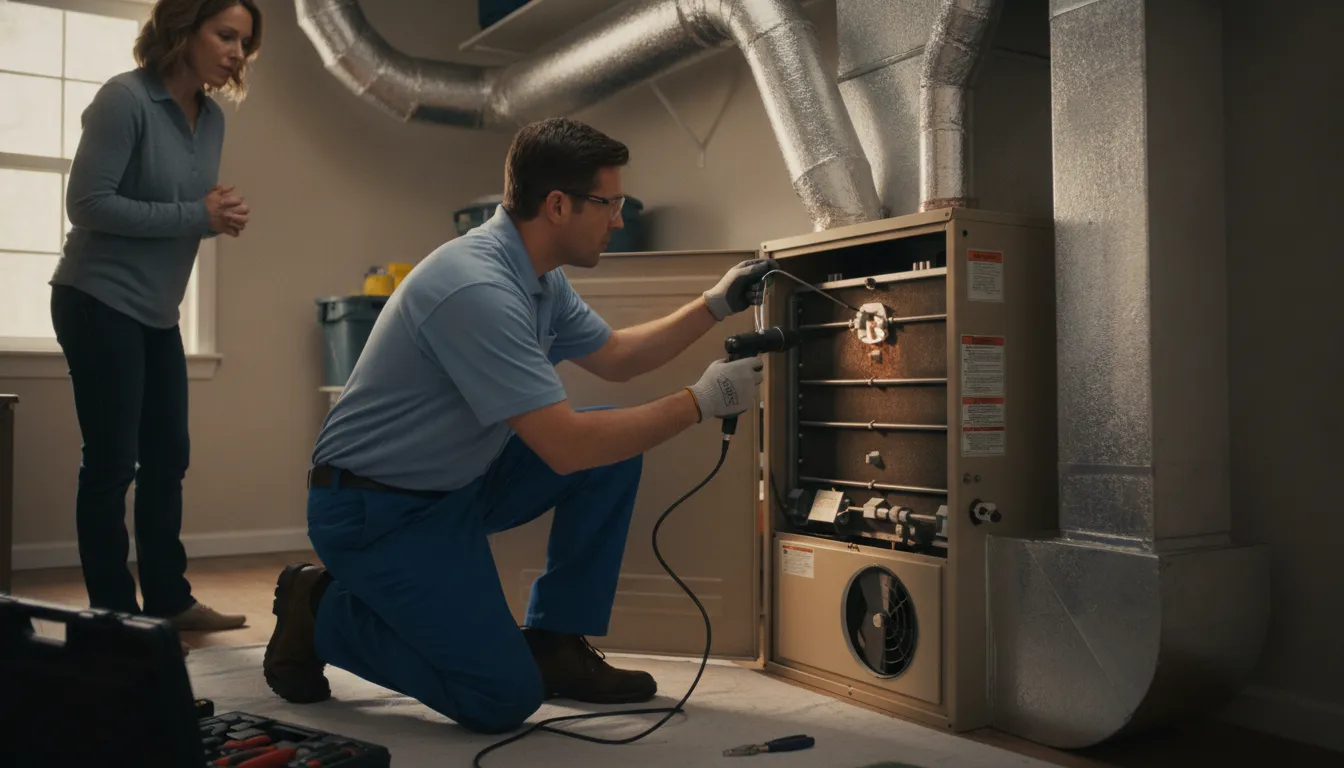
Are safety or comfort problems making replacement more urgent?
Safety concerns make a furnace issue urgent, but they do not automatically prove replacement is the only option. A suspected cracked heat exchanger, unsafe combustion, carbon monoxide concern, or venting problem requires prompt evaluation. If equipment is judged unsafe, do not operate it while comparing prices. Comfort problems require a wider system diagnosis.
Safety comes before cost. Fuel-burning equipment should be evaluated for combustion and venting, and homes should have working carbon monoxide detectors near sleeping areas. Carbon monoxide is invisible and odorless. If an alarm sounds or anyone has possible symptoms, leave the area and contact emergency services. Do not reset or operate equipment a qualified technician has judged unsafe.
What a safety evaluation should clarify
- Whether the furnace can be operated safely right now.
- What component or condition created the concern.
- Whether a durable, code-compliant repair is available.
- What testing is needed after repair or replacement.
- Whether venting, combustion air, or installation conditions need attention.
Comfort concerns are different from immediate hazards, but they still matter. A cold bedroom, frequent cycling, unusual blower noise, excess dust, or rising energy use can point to airflow, duct, insulation, filter, thermostat, control, or equipment problems. Replacing the furnace without identifying the cause can leave the original complaint in place.
Ask for the system to be assessed as a connected whole. The technician should review filters, supply and return ducts, thermostat operation, insulation conditions, furnace performance, and installation details. For High Point homeowners, an unsafe furnace may require immediate shutdown regardless of age. A safe but uncomfortable furnace requires diagnosis before replacement.
What should High Point homeowners ask before choosing repair or replacement?
Before choosing furnace repair or replacement in High Point, ask for a documented diagnosis and side-by-side comparison. Confirm the age, failed component, safety findings, repair scope, replacement efficiency, ductwork needs, warranty, installation requirements, and maintenance outlook. A local evaluation is more dependable than a generic rule because Triad homes differ in layout and condition.
Bring these questions to the appointment
- How old is the furnace, and how was that age confirmed?
- What failed, and what tests support the diagnosis?
- Will the repair address the underlying issue or only the immediate symptom?
- What other parts or installation conditions should be monitored?
- What are the repair and replacement costs when both scopes are itemized?
- What AFUE, capacity, controls, and warranty apply to replacement?
- Do the ducts, returns, insulation, filter, or thermostat need correction?
- What maintenance and testing will be required after either path?
Keep the answers with your service records. Clear documentation helps you plan a replacement before an emergency and explain the system’s history to a future homeowner or technician. If two recommendations differ, ask each contractor to identify the evidence supporting the proposed scope. You should be able to distinguish a safety requirement from an optional efficiency or comfort improvement.
QRC HVAC & Refrigeration serves homeowners in the Piedmont Triad, including High Point and surrounding Guilford County communities. To learn more about the residential heating service route, visit the High Point furnace service page or review the Tele-Tech appointment option when a virtual replacement discussion is appropriate.
Frequently Asked Questions
My furnace is 20 years old. Should I replace it?
A 20-year-old furnace deserves a replacement comparison, especially if repairs recur, comfort declines, or operating costs rise. ENERGY STAR identifies furnaces older than 15 years as replacement candidates, but age alone is not a diagnosis. Have a qualified technician verify condition, safety, repair scope, efficiency, and likely remaining service outlook.
Is the 50% repair-cost rule reliable?
The 50% rule is a comparison prompt, not an automatic verdict. If a repair approaches half the cost of a comparable replacement, request both options in writing. Then consider age, safety, warranty, efficiency, ductwork, installation requirements, and the likelihood of another breakdown. A documented diagnosis is more useful than the percentage alone.
How does AFUE help me compare furnace options?
AFUE estimates how much annual fuel energy becomes heat under the rating procedure. A 90% AFUE furnace converts about 90% of its fuel energy into heat under that procedure. AFUE does not measure duct losses, insulation, airflow, controls, or every comfort factor, so compare the complete installed system.
When does a safety issue make replacement more urgent?
A suspected cracked heat exchanger, unsafe venting, combustion problem, or carbon monoxide concern requires prompt professional evaluation. If an alarm sounds or anyone has possible symptoms, leave the area and contact emergency services. Do not operate equipment a qualified technician has judged unsafe. After safety is addressed, compare repair and replacement from documented findings.
What should a High Point homeowner ask during the evaluation?
Ask the technician to confirm the furnace age, identify the failed component, document safety findings, and explain whether the repair addresses the underlying problem. Request side-by-side scopes that include AFUE, capacity, ductwork, controls, warranty, installation requirements, and maintenance. A local evaluation is more reliable than a generic online rule.
Schedule a High Point Furnace Evaluation
Choosing between another repair and a furnace upgrade is easier when condition, safety, repair outlook, efficiency, ductwork, and installation scope are clear. QRC HVAC & Refrigeration can help organize those questions for your High Point home.
Schedule a High Point furnace evaluation with QRC HVAC & Refrigeration at (336) 281-5144.