


A walk-in failure during business hours can disrupt service and put stored product at risk. The best emergency response protocol is to protect people first, limit unnecessary door openings, document conditions, follow your food-safety plan, and contact qualified commercial refrigeration service promptly. A calm, factual record is more useful than an improvised repair attempt.
Contact QRC to discuss a commercial refrigeration concern | (336) 281-5144
What should you do first when a walk-in cooler fails?
Begin with people and immediate hazards, not equipment diagnosis. Keep employees and customers away from water on the floor, exposed or damaged equipment, smoke, or an unusual burning odor. If there is immediate danger, use your facility’s emergency procedures and contact the appropriate responders. Do not enter an unsafe area just to read a display or retrieve product.
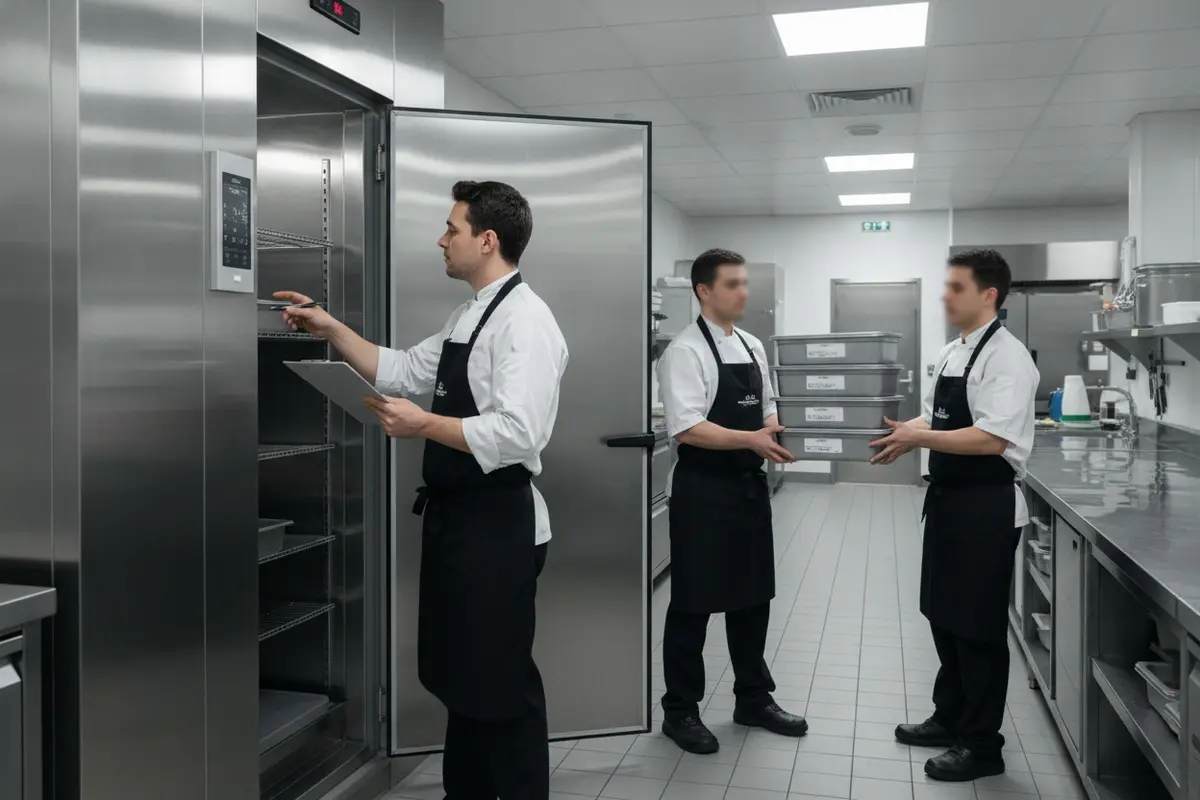
Next, assign one person to coordinate. That person can keep a timeline, relay updates, and limit repeated trips into the cooler. When several employees independently check the unit, the door may be opened more often and important details can get lost.
- Record when the problem was noticed. Note when the unit last seemed to operate normally, if known.
- Write down the display reading. Include the time and whether the reading appears to be rising, falling, or unchanged. Follow your established measurement procedure.
- Keep the door closed as much as practical. Coordinate access for necessary work or a planned product transfer.
- Observe from a safe position. Note a blank display, alarm, visible water, unusual sound, or other apparent change. Do not remove panels or handle wiring.
- Contact service. Explain the equipment type, symptoms, temperature information, and actions already taken.
These actions create a useful starting picture without asking staff to determine the mechanical cause. If there is no immediate hazard, avoid changing settings while you gather information.
How should you protect product while waiting?
Use your business’s food-safety procedures and applicable local requirements. Do not decide that food is safe because it still feels cool or because the interruption seems short. Track product temperatures through your established process, record decisions, and consult the person responsible for food safety or your regulatory authority when needed. Equipment service and product disposition are separate decisions.
If another suitable cold-storage location is available, plan a controlled transfer rather than moving everything in a rush. Keep containers covered and labeled, maintain an orderly route, and record what was moved and when. Check that backup storage has room and can maintain appropriate conditions; overloading it can create a second problem.
Separate product whose status needs review from items that remain under controlled conditions. Make decisions to hold, use, or discard product under your food-safety plan, not by guesswork. If the plan requires a manager or designated food-safety lead to approve disposition, involve that person early.
For example, if the display is rising but the door has remained closed, the team can record the reading and time, alert the designated lead, and prepare a suitable backup location while awaiting service guidance. If there is also a hazard such as smoke or water, staff safety takes priority over transferring contents. The correct sequence depends on conditions at the site.
Which checks can staff make safely?
Staff can gather observations without attempting repairs. From a safe position, check whether the door is fully closed and whether a container or other obstruction is preventing the seal from meeting the frame. Look at the controller or display for an alarm or error message. If workplace policy permits, take a photo so the exact wording is available later.
Listen from outside for whether the equipment seems to be running, and note visible changes such as ice or water. An observation is not a diagnosis: staff do not need to decide whether a sound or display means a particular component has failed. Share what was seen and heard with the service provider.
A breaker or control may look like an obvious explanation, but repeated resets can create risk or mask the underlying condition. Follow site procedures and leave equipment-level diagnosis to trained, authorized personnel. Do not open electrical compartments, bypass controls, remove guards, or use a flame or heat source to address ice. If an authorized person takes an action under an established procedure, document what was done and the result.
What information should you gather for the service call?
Clear details can reduce follow-up questions and help the service provider understand the situation. Gather what is readily available, but do not delay a call to find information that requires unsafe access.
- Business address and the best on-site contact.
- Whether the equipment is a walk-in cooler or freezer, and any make or model information visible without removing panels.
- When the problem began, when operation last seemed normal, and whether the change was sudden or gradual.
- Displayed temperature readings, times recorded, and the direction of the trend.
- Exact alarm or error wording, if present.
- Observed symptoms: blank display, unusual sound, persistent operation, visible ice or water, or another change.
- Recent circumstances that may help explain timing, such as a delivery, door left open, cleaning, or interruption in building power.
- Actions taken, product transferred, and whether the area is safe to access.
Describe observations rather than guessing at a technical cause. “The display changed from one recorded reading to another over a stated period” is more useful than an unsupported conclusion about a failed part. Keep the notes in one place so the person coordinating the response can give a consistent account.
How should you judge urgency?
Urgency depends on the equipment, temperature trend, stored product, site hazards, and available backup storage. A reading above your operating limit or a continued rise deserves prompt attention under your operating and food-safety plans. An alarm or recurring fluctuation also merits attention even if a later reading appears normal.
Use your business’s escalation plan to decide who must be notified and what operating changes are appropriate. Tell the service provider whether the unit is actively warming, whether backup storage is available, whether there is an immediate hazard, and how operations are affected. Avoid promising employees or customers a recovery time before the equipment has been assessed.
| Observation | Response priority | Useful information to report |
|---|---|---|
| Temperature is beyond the business’s operating limit or continues to rise | Limit door openings, document readings, follow product-protection procedures, and seek prompt service. | Readings, times, trend, product plan, and backup storage options. |
| Alarm or error message appears | Record or photograph the exact message; avoid changing settings without authorization. | Exact wording and when it appeared. |
| Water, smoke, burning odor, or another hazard | Keep people clear and follow the facility’s emergency procedures first. | What the hazard is and whether the area is safe to access. |
| Unit appears to run but does not hold expected conditions | Keep a timeline and avoid repeated checks or improvised adjustments. | Temperature history, observed sounds, and recent changes. |
| Display returns to a usual reading after an interruption | Continue monitoring under site procedures; a single reading does not establish stable operation. | Earlier readings, duration of interruption if known, and any recurrence. |
This table is a communication aid, not a replacement for your food-safety plan, emergency procedures, or professional assessment. The person responsible for operations should use the applicable requirements for the business and product.
How can staff coordinate a response without adding confusion?
A short role assignment helps during a busy shift. One person can coordinate the service call and timeline; another can communicate with the food-safety lead; and a manager can direct customer-facing changes if service is affected. In a small operation, one person may handle several roles, but recording who owns each decision still helps.
Use a simple incident log with columns for time, observation, action, and person responsible. For instance, an entry might say: “2:10 p.m.—display shows [recorded reading]—door kept closed; manager notified—initials.” The bracketed reading should be replaced with the actual observation; do not use a sample value as an operating threshold. This format separates what happened from what staff think it means.
Share updates at planned intervals or when a meaningful change occurs, such as a new alarm, a hazard, a transfer, or a marked change in readings. Avoid having multiple people make uncoordinated adjustments. If operations must change, explain the temporary procedure to staff so they do not keep opening the affected unit for routine access.
When moving product, label its destination and keep an inventory of what was transferred. This helps prevent items from being overlooked later and gives the designated food-safety decision-maker a clearer record. Keep walkways and exits clear, and do not block ventilation or access around the backup unit.
What should you avoid doing during a failure?
- Do not repeatedly open the door just to see whether conditions changed. Use a planned, documented check schedule.
- Do not bypass alarms or controls. An alarm may be the only visible indication that conditions need attention.
- Do not remove panels or attempt repairs unless you are trained and authorized for the work.
- Do not block airflow or access. Keep product away from vents and leave the equipment and work area accessible.
- Do not assume a restart fixed the problem. Continue monitoring under your procedures and report a recurrence.
- Do not promise a repair time or product outcome before the situation has been assessed by the appropriate people.
For a planned service discussion, our commercial HVAC and refrigeration services page describes our commercial work. You can also review our commercial refrigeration information and our guide to walk-in versus reach-in equipment for related context.
What can you expect when arranging commercial refrigeration service?
A technician needs a clear description of the equipment and conditions at the site. The assessment may include reviewing reported symptoms and alarm information, checking relevant components and controls, and determining what work is needed. The exact steps depend on the equipment and findings, so it is better not to assume a specific repair, cause, or completion time in advance.
Before the visit, identify a site contact who can provide access and share the incident log. If the equipment is in a restricted area, arrange safe access. Keep the surrounding work area clear, and let the service provider know about any known hazards or operational constraints. Avoid moving or changing equipment settings merely to make the area look orderly.
During the assessment, communicate new observations as they arise. If conditions change while service is being arranged, update the contact rather than relying on an earlier reading. After work is completed, ask what was found, what actions were taken, and what monitoring or follow-up the technician recommends. Record that information with the incident notes.
QRC provides commercial HVAC services in North Carolina. For commercial refrigeration questions, our refrigeration service information and custom walk-in cooler design guide provide related equipment context. Contact us with the symptoms and site details so we can discuss an appropriate next step.
How can you prepare for a future interruption?
A written response plan lets employees act without improvising. Keep the service contact information current and decide who can authorize a service request, who tracks readings, who communicates with staff, and who makes product decisions. Name an alternate for each role in case the usual lead is absent.
Identify in advance what backup storage could be suitable, who approves its use, and how product will be labeled and tracked during a transfer. Do not assume that any available cooler has sufficient space or capacity. Establish a route that does not block exits or create a cross-traffic hazard, and decide how the team will keep a record of moved items.
Include basic observations in staff orientation. Employees should know where the display is, how to record a reading under the site’s procedure, how to report an alarm, and which actions are off-limits. A short practice scenario can clarify who calls, who documents, and who communicates with the food-safety lead.
After any interruption, review the log with the appropriate manager. Note what went smoothly and what caused delay: unclear authority, missing contact information, an inaccessible display, or no prepared transfer plan. Update the written procedure based on the actual gap rather than adding unnecessary steps.
Routine attention to door closure, unobstructed access, staff reporting, and documented monitoring can make a future response more orderly. These practices do not prevent every mechanical failure, but they help staff notice changes and share accurate information.
How does a walk-in emergency affect daily operations?
A failed unit can interrupt more than storage. It may affect menu availability, delivery schedules, staffing, and customer communication. A manager should decide which operational changes are necessary using the business’s own procedures and product decisions, then communicate them clearly to staff. Do not ask employees to keep retrieving items from a unit that the response plan has placed on restricted access.
Keep a record of temporary changes, including which products are unavailable, what was transferred, and who approved the change. This reduces the chance that a later shift will assume normal service has resumed. If the business has multiple shifts, include a handoff note with the latest reading, unresolved hazards, contact status, and next scheduled check.
For example, a lunchtime interruption may continue into an evening shift. A handoff should state when the issue began, what observations have been logged, whether service has been contacted, which items were moved, and who is responsible for the next update. Avoid vague notes such as “cooler is acting up”; precise status lets the next manager continue the response without repeating checks.
How should you close out the incident?
Once the equipment has been assessed and the business has made its product decisions, keep the timeline, readings, service findings, and transfer record together. Note whether the unit held its expected conditions afterward under the monitoring process recommended by the responsible personnel. A quick return to a normal display is not by itself proof that the original issue cannot recur.
Review the event with the team while details are fresh. Was the alarm noticed promptly? Could staff find the contact list? Was backup storage suitable and available? Did two people unknowingly make the same call or adjustment? Keep the review focused on improving the procedure, not assigning blame.
Use recurring or unresolved symptoms as a reason to share the incident history during follow-up service discussions. A timeline can reveal whether a concern is isolated or recurring, while a clear account of prior work helps the next assessment start with better context.
For additional background, the Austin Community College Emergency Response Protocols explains how an institution structures response actions to help its community make informed safety decisions. Its campus protocol is not a refrigeration or food-safety standard, but it reinforces the general value of clear roles and planned actions when an emergency occurs.
For more information about our commercial services or commercial HVAC service, use the relevant service details to start a conversation with our team.
Talk with QRC about your walk-in system | (336) 281-5144
Frequently Asked Questions
Should staff unplug a walk-in cooler that is not cooling?
Not as a general response. Follow facility procedures and avoid equipment changes unless the responsible person is authorized to make them. Report the symptoms and seek qualified service guidance.
Should we move all product immediately?
Not automatically. Use your food-safety plan to decide what needs protection or transfer, and avoid overloading backup storage. Record readings, movements, and decisions as you go.
Can we keep using the cooler if the display returns to normal?
A normal reading at one moment does not establish that the issue is resolved. Continue monitoring under your procedures and arrange assessment if the problem recurs or the unit does not hold expected conditions.
What details matter most when calling?
Share the site location, equipment type, timeline, readings and trend, alarm messages, visible symptoms, and actions already taken. Do not delay the call to collect information you cannot safely access.
Who should decide whether food can still be used?
Use the business’s food-safety plan and involve the designated food-safety decision-maker or regulatory authority when appropriate. A refrigeration service assessment addresses equipment; it does not replace that product decision.
Ready to Discuss a Walk-In Cooler Problem?
If a walk-in cooler fails during business hours, keep the response organized: protect people, limit door openings, record conditions, follow your product-safety procedures, and contact qualified service. We can discuss the symptoms and an appropriate next step for your commercial refrigeration concern.
For related equipment planning, see our walk-in freezer installation quote guide and custom walk-in cooler design guide. You can also contact QRC to discuss service.
Keep the incident timeline and temperature records available so your team and service provider can make informed decisions.