Furnace filters air moving through your heating system by catching some airborne particles as the blower draws air through the return path. A clean, correctly sized filter that the equipment is designed to use supports normal operation; a loaded, poorly fitted, or unsuitable filter can add resistance. If you are comparing filters or wondering why airflow changed, start with the equipment instructions and the filter fit—not simply the highest rating on a package.
Talk with us about your heating system — (336) 281-5144
What does a furnace filter do?
A furnace filter sits in the return-air path. The blower pulls air from the home toward the heating equipment, the filter captures some particles, and the system sends conditioned air back through its supply registers. The filter is one part of the equipment’s air path and one part of indoor-air management. It does not capture every pollutant, and it cannot resolve a problem elsewhere in the system.
Filter products vary in dimensions, material, construction, and particle-capture performance. A number or efficiency rating printed on a package is not, by itself, a direction to use that product in every furnace. The equipment needs to be compatible with the filter and able to move air through it as designed. The U.S. Environmental Protection Agency’s Guide to Air Cleaners in the Home discusses HVAC filters alongside other air-cleaning approaches. The Department of Energy’s Building America Solution Center provides guidance on proper installation of furnace and air-handler filters, including fit and installation considerations.
For a homeowner, the practical goal is straightforward: use the specified filter, place it in the intended slot in the right direction, and follow the manufacturer’s inspection and replacement directions. If a filter appears to fit only when bent, leaves an obvious gap, or prevents the access panel from closing, pause rather than forcing it.
How can you choose a filter that supports airflow?
Start with the furnace or air-handler label and owner’s manual. Look for the specified dimensions and any instructions about filter material or performance. Compare those details with the existing filter, but do not assume that the old one is correct if it is loose, visibly warped, or difficult to remove. If the manual and label do not answer the question, ask the equipment manufacturer or an HVAC professional before changing to a denser or higher-efficiency product.
- Match the required dimensions: Use the size specified for the slot or cabinet. A smaller filter may leave gaps around the frame; an oversized one may buckle or fail to seat.
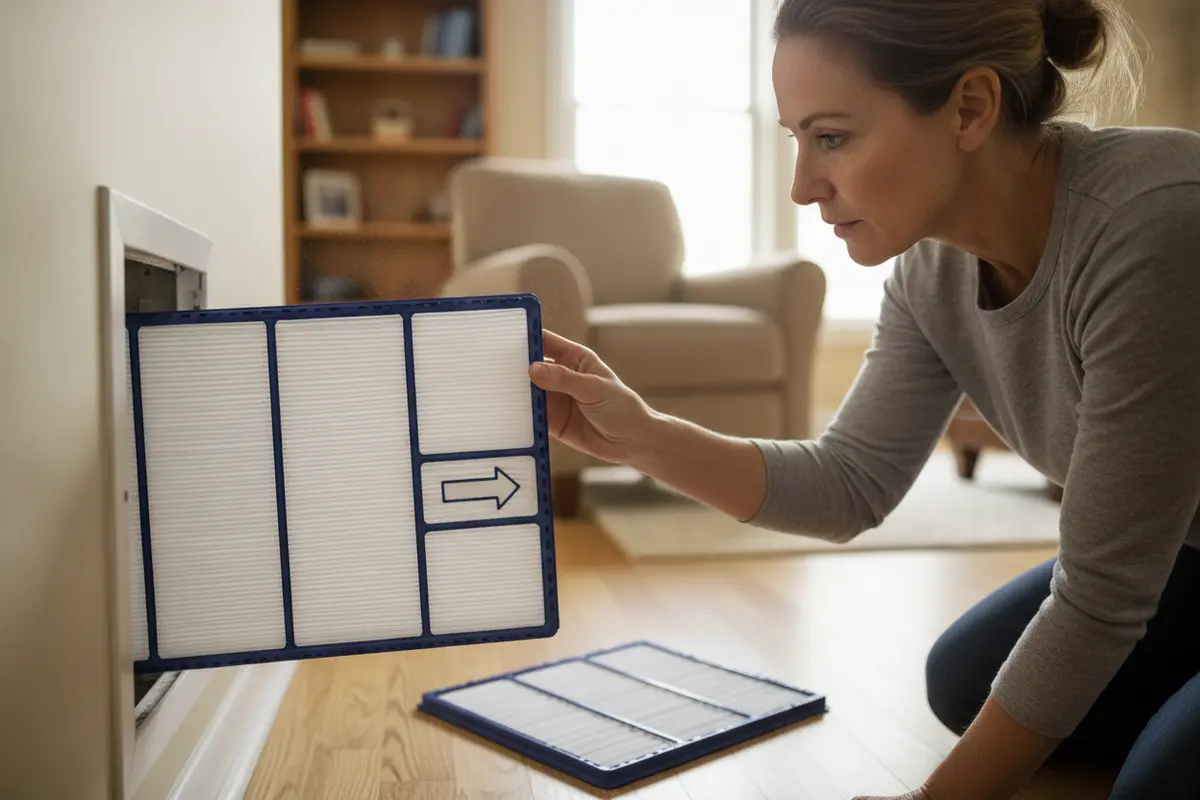
- Check the airflow arrow: The arrow marks airflow direction. It generally points toward the furnace or air handler, but follow any equipment-specific instruction if it differs.
- Confirm the permitted filter type: Follow the manual’s guidance. A higher number or denser feel does not automatically make a filter a better match for your system.
- Seat it completely: Place the frame in the designed track and close the access panel as intended. Do not force it into the opening or leave the panel ajar.
- Keep the packaging details: If you are unsure which product you used, retain the label or write down the size and type. Those details are more useful than describing a filter by color or appearance.
Think of selection as a fit-and-function decision, not a contest to choose the strongest-looking product. If your priority is capturing more particles, explain what you are trying to address and ask whether the equipment can support the options you are considering. The answer can depend on the system design, filter dimensions, and manufacturer’s permitted range. A qualified professional can consider compatibility without treating a higher rating as an automatic upgrade.
| Filter situation | What to verify | Practical next step |
|---|---|---|
| Standard replacement matching the manual | Dimensions, arrow direction, and instructions | Install flat in the designated slot |
| Higher-efficiency or denser product | Equipment compatibility and permitted filter types | Confirm before switching |
| Visible dust or buildup | Filter condition and replacement directions | Use the specified replacement and note the date |
| Filter is loose or will not fit | Required size and access arrangement | Verify the dimensions; do not force it |
How often should you inspect and replace a furnace filter?
There is no single replacement interval that applies to every home, filter, and heating schedule. Follow instructions from the equipment and filter manufacturers, then inspect the filter periodically so you can see how quickly it collects dust. Household conditions, system use, pets, nearby work that creates dust, and filter design can all affect how soon it needs attention. Treat the stated interval as guidance, not as a reason to ignore a visibly loaded filter.
A simple routine makes the task easier. When you install a filter, write the date on its frame or put a reminder on your calendar. At that reminder, inspect it and compare its condition with the manufacturer’s replacement directions. If it remains in good condition, follow the supplied guidance rather than replacing it arbitrarily. If it has collected substantial visible debris sooner than expected, replace it with the specified product and record the shorter interval. Repeatedly rapid buildup is useful information to share with a technician; it is not a reason to choose a different rating without checking compatibility.
For example, suppose you install a new filter at the start of a cold-weather period and find it visibly loaded sooner than expected. Write down the date, note whether the system has been running more often, and check whether work or unusual dust in the home could explain the change. Then follow the filter maker’s replacement guidance. If the same pattern continues, share those observations rather than guessing at a new filter type. The record helps distinguish an isolated dusty period from a recurring condition.
A careful replacement sequence
- Read the manual for any instruction about turning the system off before opening the homeowner-accessible filter area.
- Locate the intended filter slot. Do not remove unrelated service panels or reach into internal components.
- Note the old filter’s printed dimensions and arrow direction. Compare both with the equipment instructions.
- Remove the filter carefully so accumulated dust is not shaken into the equipment or room.
- Install the matching replacement with its arrow in the airflow direction, and ensure that it lies flat in its track.
- Close the access panel, record the installation date, and observe whether the system returns to its usual operation.
Do not reach into the blower or attempt equipment repairs during routine filter replacement. If the access is difficult, the old filter is damaged, or the opening does not match the replacement, stop and ask for guidance. Bending a frame, cutting a product to size, or leaving an access door open can create a separate problem instead of solving the original one.
What can a filter tell you about an airflow concern?
A heavily loaded filter can be one possible contributor to restricted airflow. Replacing it with a clean filter of the specified type is a sensible first check, but it does not prove that the filter caused the symptom. If airflow still seems weak, another issue in the system, return path, or ductwork may need evaluation. Do not remove the filter and run the furnace as a workaround; the filter helps keep particles from entering the equipment.
Observe what changed and when. Is the concern present at every supply register, or only in one room? Did it begin after a filter change, after furniture was moved, or without an obvious trigger? Does the system sound or operate differently than usual? These observations can help you describe the situation, but they do not identify a technical fault on their own.
- Confirm the specified filter size and arrow direction.
- Check whether return grilles or supply registers are covered by furniture, rugs, curtains, or stored items.
- Make sure the filter is seated and the access panel is closed.
- Note which rooms are affected and whether the concern is constant or comes and goes.
- If the issue remains, arrange professional diagnosis instead of opening equipment panels or changing system settings at random.
For related homeowner information, read our furnace repair guide, guide to heat pump repair issues, and guide to emergency heat use. These pages can help you describe a heating concern, but they do not replace an evaluation of your specific system.
Why might a new filter seem to change system operation?
A change noticed after installing a filter can have several explanations. The replacement may be the wrong dimensions, installed backward, or a type that the equipment is not designed to use. The filter may also reveal an existing concern that became noticeable at about the same time. A sound or comfort change alone cannot confirm the cause.
First compare the new filter with the equipment label and instructions. Check that the arrow points in the airflow direction, the frame is not crushed, the filter sits in its track, and the access door closes correctly. If those checks are in order but operation still seems unusual, do not keep experimenting with different ratings. The Department of Energy’s installation guidance explains why correct sizing and installation matter; gaps or poor fit can undermine the filter’s intended function.
Consider a homeowner who replaces a loose, undersized filter with a tightly fitting product that has a denser construction. The system sounds different, and a distant room still receives little air. There are at least two questions: whether the new filter is permitted for that equipment, and whether the room’s comfort concern has another cause. Returning to an approved, correctly sized filter may address a selection issue. If the room-to-room difference remains, it still deserves assessment rather than a string of product guesses.
Another example: a filter is replaced just before a cold spell, when the heating system runs more often. The homeowner notices more sound near a return grille and assumes the filter is responsible. The timing makes the filter worth checking, but it does not establish cause. Confirm the model-approved filter and installation first, then note whether the sound occurs during normal operation or alongside a change in comfort. If it persists, share the sequence of events with a technician.
How should you compare filter options?
When two packages appear similar, compare details that affect compatibility rather than relying on color, thickness, or marketing language. Check the exact size, filter type, and any performance information, then compare those details with the equipment manual. A thicker filter is not automatically more restrictive or less restrictive in every installation; the system and filter design matter. Do not assume that a product marketed for another furnace will work in yours.
If the product you normally use is unavailable, use the manual to identify acceptable alternatives or contact the manufacturer or an HVAC professional with the model information. Provide the furnace or air-handler model, the dimensions printed on the old filter, and the filter type. If the old product has no legible label, take a clear photo of its frame and the equipment label rather than guessing. Ask whether an alternative is approved and whether the system requires a particular filter cabinet. Do not modify the cabinet or add a second filter without qualified advice.
| Comparison point | Question to ask | Why it matters |
|---|---|---|
| Dimensions | Does it match the specified opening? | A proper fit helps avoid gaps and bending |
| Filter type or rating | Does the manual allow this option? | Suitability depends on equipment design |
| Alternative availability | Is another product approved? | Prevents choosing by appearance alone |
| Installed fit | Does it lie flat and let the panel close? | Correct placement supports intended operation |
| Replacement guidance | What condition or interval does the maker specify? | Helps set a sensible inspection routine |
Keep the comparison practical. If the filter’s printed size matches but the frame does not sit securely, verify the equipment’s specified dimensions and the way the slot is designed to hold the filter. If a candidate filter fits physically but has a different type or rating, physical fit alone does not establish compatibility. Confirm both rather than treating one correct detail as proof that everything is correct.
What should you check if one room feels different?
A filter serves the shared system, so a concern limited to one room may call for a broader look than simply changing the filter. Start with safe visual checks: confirm the room’s supply register is open and unobstructed, and check that return grilles elsewhere in the home are clear. A rug, furniture, or a closed door may affect how air circulates in a particular space. Do not dismantle registers or ductwork.
Compare the room with others under similar operating conditions. Note whether the difference occurs only during heating, whether it changes when doors are open, and whether the register has always felt different. Avoid closing multiple registers to force air toward one room. Changing system balance without understanding the design can create other comfort or operating concerns. If the room remains uncomfortable after basic obstruction checks and the filter is correct, ask for an evaluation of the system and airflow path.
For a broader overview of our residential heating and cooling information, visit our residential heating and cooling page. We serve residential HVAC customers in Winston-Salem and surrounding Triad communities. The useful next step depends on the equipment and what you observe, not on a one-size-fits-all filter recommendation.
How can you prepare for a useful HVAC conversation?
You do not need to diagnose the system before contacting us. A few accurate details help explain what you are experiencing and what you have already checked. Describe what changed, when it started, whether every room is affected, and whether inspecting or replacing the filter changed anything. If the concern is limited to particular registers, identify those rooms. Mention visible damage, unusual buildup, or difficulty getting the filter to fit.
- Have the equipment make and model available if it is easy to read safely.
- Note the filter’s printed dimensions, type, and installation date, if known.
- Describe whether the system is heating normally and whether the concern is constant or intermittent.
- Tell us whether the change followed a filter replacement or another event, without assuming that event caused it.
- Do not remove safety covers or attempt repairs to gather more information.
- Ask what inspection or next step is appropriate for the symptoms you described.
If you are unsure whether the situation needs prompt attention, our property owner’s guide to emergency HVAC service offers additional context. For service-area information, see our service-area page. If airflow remains poor after checking the filter and visible obstructions, an assessment is more useful than continued trial and error.
When you call, you can keep the explanation simple: “I changed the filter on this date; it is this size and type; the concern is happening in these rooms; and these are the checks I have made.” That gives us a starting point without requiring you to interpret equipment behavior. If the filter is difficult to reach or you are unsure how to identify its approved type, say so instead of removing other panels or trying a product that might not suit the system.
For more about our heating services and how to start a conversation, visit our heating service information. You can also explore our HVAC repair questions and answers and learn about QRC. We serve homes across the Winston-Salem area and surrounding Triad communities, so local service questions are best discussed with the details of your home and equipment in hand.
Ask us about a heating concern — (336) 281-5144
Frequently Asked Questions
Can a dirty furnace filter affect airflow?
It can contribute to restricted airflow, but it is not the only possible cause. Replace a dirty filter with the size and type specified for the system. If airflow remains weak afterward, arrange a professional assessment rather than bypassing the filter.
Can I use a higher-rated filter in my furnace?
Not automatically. A higher-efficiency or denser product may not suit every system. Check the equipment manual or confirm compatibility with an HVAC professional before switching filter types.
Which way should the arrow on my furnace filter point?
Point it in the direction of airflow, generally toward the furnace or air handler. Follow the equipment-specific instructions if they differ.
Should I run my furnace without a filter?
No. Do not remove the filter to try to improve airflow. It helps keep particles from entering the equipment. If the correct clean filter is installed and the concern continues, seek help with the underlying issue.
What if the replacement filter does not fit?
Do not force it or intentionally leave gaps. Check the required dimensions in the equipment documentation and ask for help if the correct size or filter type is unclear.
Ready to Get Help With Your Heating System?
If the correct clean filter is installed and airflow still seems off, contact us to discuss what you have observed and determine a practical next step for your Winston-Salem-area home.