If you manage a restaurant in High Point, temperature data logs should show more than a series of numbers. They should connect each reading to a food, piece of equipment, employee, time, safe limit, and corrective action. The practical answer to “What temperature data logs should restaurants keep for compliance in High Point?” is a documented system for receiving, cooking, cooling, holding, calibration, and equipment follow-up.
Talk with QRC about restaurant refrigeration maintenance at (941) 787-1511.
What temperature data logs should a High Point restaurant keep?
Short answer: Keep logs for receiving, cooking, cooling, cold holding, hot holding, thermometer calibration, and refrigeration alarms or corrective work when those activities apply to your menu and food safety plan. Each entry should identify the date, time, food or unit, actual reading, employee, limit, and action taken when a limit is missed.
That list is a strong operating baseline. But it is not a claim that every restaurant in North Carolina must use the same form or record temperature readings at the same interval. The right schedule depends on your menu, processes, equipment, risk category, approved procedures, and any HACCP (Hazard Analysis and Critical Control Point) plan or variance that applies to your operation.
Use one controlled log system, whether paper, spreadsheet, or a digital monitoring platform. The format matters less than whether the record is accurate, completed when the check occurs, easy to trace, and available to the person in charge and the regulatory authority when requested.
How does North Carolina food-code compliance apply in High Point?
Short answer: High Point restaurants inspected through Guilford County follow North Carolina food-protection rules. Those rules establish time and temperature controls, equipment and thermometer expectations, and documentation requirements for certain approved processes. The North Carolina Food Code Manual is the controlling reference. The FDA Food Code is a model and educational source, not a substitute for state or local direction.
Guilford County says its Food, Lodging, and Institutions team inspects restaurants and follows the North Carolina Rules Governing Food Protection and Sanitation of Food Establishments. The county’s public inspection search also includes High Point restaurants, making local inspection context useful when you build your recordkeeping process.
North Carolina adopted the 2017 Food Code and supplement by reference effective October 1, 2021. Read the current North Carolina Food Code Manual with your person in charge, certified food protection manager, or environmental health specialist. The code includes requirements for time and temperature control, date marking, food-temperature measuring devices, and specialized processes.
For context, the FDA Food Code 2022 describes a national model for retail and food-service safety. North Carolina’s adopted version and amendments control the state requirement. Do not copy a national checklist or a vendor’s suggested retention period without confirming that it fits your local rules and approved plan.
Which restaurant temperature logs are most useful?
Short answer: The most useful logs follow the points where temperature can change or where an inspector needs proof of control. For most full-service restaurants, that means receiving, cooking, cooling, cold holding, hot holding, thermometer calibration, and equipment alarms. A smaller operation may combine several checks, but it should not omit a process that affects food safety.
| Log | What it proves | Typical entries |
|---|---|---|
| Receiving | Cold or hot food arrived within the operation’s acceptance limits. | Supplier, product, date, time, temperature, lot or delivery note, acceptance or rejection. |
| Cooking | TCS (time/temperature control for safety) food reached the required final temperature for the process. | Food or batch, equipment, time, internal temperature, employee initials, corrective action. |
| Cooling | Cooked TCS food moved through the required cooling steps within the permitted time. | Food, start time, checkpoint temperatures, container or method, final result, action if out of control. |
| Cold holding | Refrigerated food stayed at the applicable safe limit while stored or displayed. | Unit, food, date, time, actual temperature, employee initials, disposition or repair ticket. |
| Hot holding | Hot TCS food stayed at or above the applicable hot-holding limit. | Food or pan, holding unit, date, time, temperature, employee initials, corrective action. |
| Calibration | Thermometers used for food checks are accurate enough to support decisions. | Device ID, date, method, observed result, adjustment or replacement, verifier. |
| Alarm and service | Temperature excursions were investigated instead of erased or ignored. | Unit, alarm, reading trend, product action, service request, technician findings, return-to-service check. |
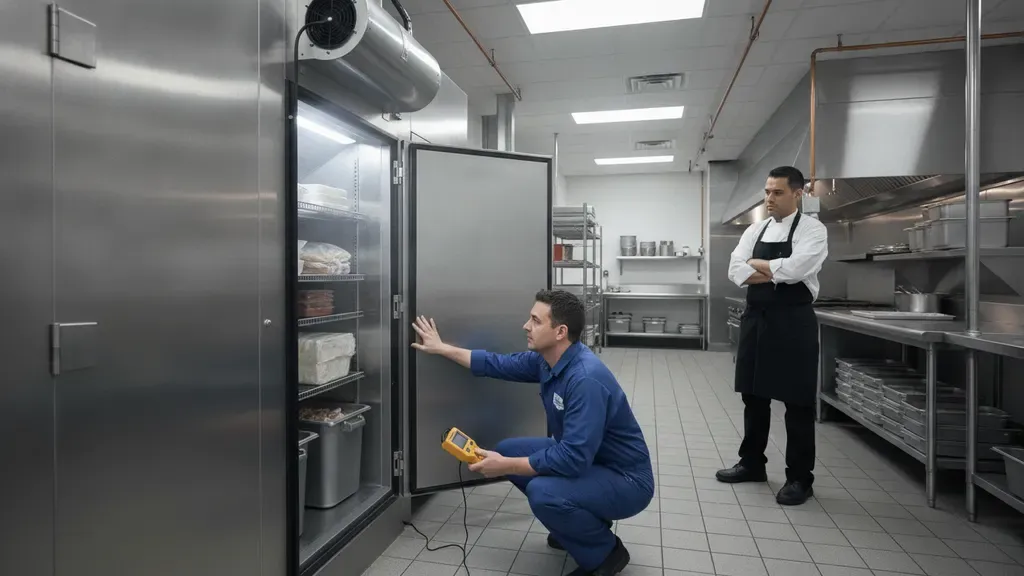
Keep the logs connected. If a walk-in cooler reads high, the cold-holding record should lead to a corrective-action entry, a product decision under your food safety plan, and an equipment follow-up record when needed. A temperature number without context cannot show what the restaurant did to protect food.
What fields belong on every temperature data log?
Short answer: Every temperature entry should be traceable to a specific event. At minimum, record the date, exact or planned check time, food or equipment location, actual temperature, safe limit or process target, employee initials, and corrective action. Add a manager review field when your plan requires verification.
A practical log template for a High Point restaurant should include these columns:
- Date and time: Use the time the check actually occurred. Avoid filling a full day’s log from memory.
- Food or equipment identifier: Name the product, batch, reach-in, walk-in, prep table, freezer, hot box, or line unit.
- Location: Identify the kitchen, bar, prep area, storage room, or other site when the restaurant has multiple areas.
- Actual reading: Record the measured number and unit, such as degrees Fahrenheit. Do not replace a reading with “OK.”
- Applicable limit: State the limit from the food code, approved plan, recipe, manufacturer instructions, or company procedure.
- Employee initials: Make the person who performed the check identifiable.
- Corrective action: Document the action, such as rechecking, moving food, rapid cooling, discarding food, adjusting a process, or calling for service.
- Manager verification: Add a review signature or digital approval when the plan assigns verification to a manager.
For digital systems, preserve the original timestamp and user identity. Avoid allowing employees to overwrite a failed reading without leaving an audit trail. For paper logs, correct an error with a single line, the corrected value, initials, and date rather than erasing the original entry.
How often should restaurants record temperatures?
Short answer: Record temperatures at the frequency stated in the restaurant’s food safety plan and operating procedures. Use more frequent checks during receiving, cooling, active service, equipment alarms, menu changes, or unstable conditions. North Carolina does not create one universal “every four hours” schedule for every restaurant and every process.
A useful schedule usually assigns responsibility by shift and process:
- Receiving: Check applicable deliveries before acceptance and record exceptions.
- Opening: Review refrigeration and hot-holding equipment before food is loaded or service begins.
- During preparation and service: Follow the plan for cooking, cooling, cold holding, and hot holding checks.
- Shift change: Use a handoff review so an emerging temperature trend is not missed.
- Closing: Confirm storage equipment, corrective actions, and unresolved service needs.
- After an alarm or repair: Recheck the unit and affected food according to the plan before returning it to normal use.
Do not treat an interval borrowed from a generic online form as legal advice. The frequency should match the process risk and the written procedure your restaurant actually follows. If your operation uses a specialized process or variance, the approved HACCP plan controls the monitoring method and record schedule.
What corrective actions should the logs document?
Short answer: A failed reading should create a clear chain from detection to resolution. Record the out-of-limit temperature, identify the affected food or equipment, protect or dispose of product as required by the plan, correct the process, notify the responsible manager, and verify the result. Never hide the failed reading by replacing it with a later normal value.
Examples of useful corrective-action notes include:
- Reach-in cooler: Measured 46 degrees F at 10:15 a.m. Food moved to a working unit and the manager was notified.
- Cooling checkpoint: Soup was divided into shallow pans and rechecked at the 30-minute interval in the plan.
- Walk-in alarm: The door seal was inspected. Product was protected, QRC service was requested, and the unit was rechecked after repair. For recurring failures, review QRC’s restaurant refrigerator repair service options.
- Probe check: The probe failed the ice-point check. It was removed from use, calibrated or replaced, and affected readings were repeated.
These notes are not a substitute for the restaurant’s approved food safety procedures. They show that employees recognized a problem and followed the designated response. When a refrigerator, freezer, prep table, or ice machine cannot maintain the required condition, do not bypass a safety control or open sealed refrigeration components. Isolate the risk and use a qualified commercial refrigeration technician.
How long should High Point restaurants keep temperature records?
Short answer: Keep routine logs for the retention period in your written food safety plan, company policy, permit conditions, or direction from the local regulatory authority. North Carolina does not establish one universal retention period for every routine temperature log. Records tied to a required HACCP plan or variance must be maintained and provided when requested.
This distinction prevents two common mistakes. First, a restaurant should not discard a record simply because a generic checklist online says the log is no longer useful. Second, it should not promise an inspector that one specific number of days applies to every process without checking the plan and local direction.
For an operation using an approved HACCP plan or variance, review the North Carolina HACCP and variance verification guidance. It explains that required records should demonstrate monitoring of critical control points, verification of effectiveness, and corrective action when a critical limit is not met. Store those records where the person in charge can retrieve them promptly.
Ask the Guilford County environmental health office or your assigned regulator to confirm the retention period for your specific High Point operation. This is especially important after a menu change, process change, approved variance, or inspection finding. Keep backups for digital records and protect paper records from moisture, heat, and loss.
When should a restaurant call a refrigeration professional?
Short answer: Call for commercial refrigeration service when logs show a repeated upward trend, alarms recur, a unit cannot hold its target, doors or gaskets fail, ice or water appears, or corrective actions do not restore stable temperatures. A technician can evaluate the equipment while your team protects food under its food safety plan.
Temperature logs help a technician diagnose the pattern. Include the unit identifier, readings before and after the issue, alarm codes, door or airflow observations, recent cleaning, and any product movement. This is more useful than reporting only that a cooler “is not cold.”
QRC HVAC & Refrigeration provides commercial refrigeration maintenance, repair, installation, and restaurant refrigerator service for businesses in High Point and the broader Triad. Its service scope includes restaurant refrigerators, walk-in coolers and freezers, ice machines, display cases, and related commercial refrigeration systems. The goal is not to replace your food safety plan. It is to help the equipment perform reliably enough for your team to follow that plan.
Schedule restaurant refrigerator maintenance with QRC at (941) 787-1511.
Frequently Asked Questions
Short answer: A compliant temperature-record system is specific, honest, and tied to the restaurant’s approved process. Keep records for the controls that apply to your menu and equipment, document corrective actions, and confirm local requirements with Guilford County or the regulator responsible for the establishment.
Does every High Point restaurant have to use the same temperature log form?
No. The form should fit the restaurant’s menu, equipment, processes, food safety plan, and any HACCP or variance requirements. The entries must still be accurate, traceable, and available when required.
What temperatures should a restaurant record?
Record the temperatures your process requires, including receiving, cooking, cooling, cold holding, hot holding, and equipment checks. A common North Carolina baseline is 41 degrees F or below for cold TCS food and 135 degrees F or above for hot holding. But process-specific code provisions and approved plans also apply.
Is a temperature check every four hours always required?
Not as one universal schedule for every restaurant and process. Follow the written food safety plan and local direction. Receiving, cooling, active service, alarms, equipment problems, or high-risk processes may require checks that are more frequent or use a different method.
How long should a restaurant keep its temperature logs?
Keep them for the period specified by the restaurant’s food safety plan, policy, permit conditions, or regulatory direction. There is not one universal North Carolina retention period for every routine log. Required HACCP or variance records must be maintained and provided when requested.
What should staff do when a cooler temperature is out of range?
Record the actual reading and time, protect or evaluate the affected food under the restaurant’s plan, notify the responsible manager, document the corrective action, and recheck the equipment. If the unit cannot recover or the issue repeats, request qualified commercial refrigeration service.
Keep Your Restaurant Refrigeration Ready for Service
Accurate logs help your team see problems early, but reliable equipment still needs professional inspection and maintenance. Learn more about QRC HVAC & Refrigeration service or contact QRC at (941) 787-1511 to discuss your High Point restaurant’s equipment.