


A heat pump can serve your home for years, but the quality of the installation depends on much more than placing equipment outside and connecting a few lines. Greensboro homeowners should look for a contractor who can explain the system choice, evaluate the home, and define the work clearly before installation begins.
The right heat pump installer Greensboro homeowners choose should use professional sizing and system selection, follow manufacturer instructions and applicable codes. And explain how the proposed equipment fits the home’s heating, cooling, duct, and electrical needs. QRC HVAC & Refrigeration provides residential heat pump installation and replacement, including ducted and ductless systems, with in-person guidance for homeowners evaluating their options.
That evaluation starts with qualifications, not a quick equipment recommendation. Knowing what training, documentation, and installation practices to ask about can help you distinguish a complete project scope from a proposal that leaves important details unclear.
What Does a Qualified Heat Pump Installer in Greensboro Do Differently?
For Greensboro homeowners, the first distinction is who performs the work. Heat pumps should be installed by licensed, trained professionals who understand electrical connections, refrigerant circuits, airflow, drainage, and the requirements of the selected equipment. The U.S. Department of Energy’s installation guidance also emphasizes following manufacturer specifications, installation instructions, building codes, and regulations.
Ask whether the installer receives training from the equipment manufacturer or participates in a preferred installer program. This matters because heat pump systems have specific requirements for setup, controls, refrigerant lines, and commissioning. A contractor should be able to explain which parts of the installation are based on the manufacturer’s instructions rather than relying on a one-size-fits-all routine.
Refrigerant credentials are part of the qualification
EPA Section 608 certification is a federal credential for technicians who work with regulated refrigerants. QRC HVAC & Refrigeration’s knowledge base states that its technicians are EPA 608 certified for refrigerant handling. That qualification is one useful question to include when comparing installers, especially when a project involves opening or connecting a refrigerant circuit.
Look for a complete process, not just equipment selection
A qualified contractor should discuss the home’s needs, the system configuration, installation requirements, and ongoing service rather than focusing only on a model number. QRC provides residential HVAC service in Greensboro as part of its Winston-Salem metro coverage, including heat pump installation and replacement. Homeowners can use this conversation to understand what the proposed work includes and which qualifications support it before choosing a contractor.
How Does a Proper Heat Pump Site Assessment Work?
A proper heat pump site assessment measures the home’s heating and cooling loads, reviews the ductwork and airflow, and matches equipment capacity to the home’s actual needs. It should also account for homeowner priorities, comfort concerns, and the practical conditions that affect installation.
The assessment should begin with the house, not a preselected equipment size. A qualified heat pump installer in Greensboro evaluates the factors that drive heat loss and heat gain. Such as the home’s layout, insulation, windows, orientation, and existing heating and cooling performance. The goal is to determine both heating and cooling loads before recommending equipment.
The U.S. Department of Energy Building Science Education and Consulting resource explains that contractors should use recognized sizing standards after determining those loads. ACCA Manual J is one method contractors can use for residential load calculations. This matters because a rule-of-thumb estimate can result in an oversized system, which may increase cost, waste energy, and cycle on and off too frequently. See the BSESC guidance on properly sizing HVAC systems for the underlying sizing principles.
A complete visit also examines the distribution system. For a centrally ducted heat pump, the contractor should review duct condition, available airflow, registers, returns, and blower capacity. Equipment and ducts should be selected to match the calculated loads, and the blower must support the required cubic feet per minute range. If the existing ductwork is restrictive, leaky, or poorly configured, simply replacing the outdoor unit may not solve comfort problems.
Homeowner priorities belong in the assessment as well. Discuss rooms that run hot or cold, noise concerns, operating preferences, future remodeling, and whether certain areas need separate control. Those details help the installer compare practical options instead of treating every Greensboro home as the same project.
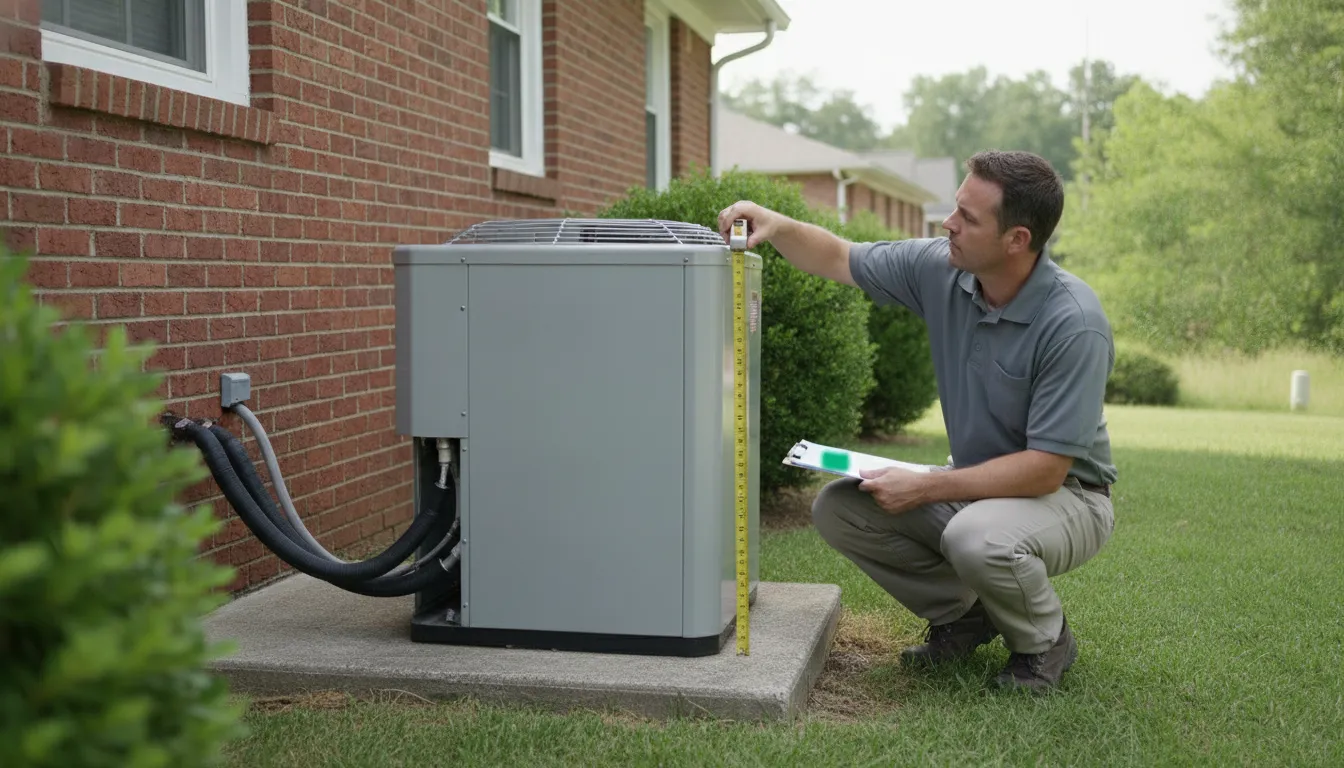
Photo credit: Vernon Air Conditioning, Plumbing & Electrical Services via Wikimedia Commons, CC BY 4.0.
.jpg)
Before accepting a proposal, ask what was measured, which sizing method was used, and what work is included beyond equipment delivery. This makes it easier to compare contractor installation proposals based on scope and suitability, not just the equipment label.
Which Heat Pump Configuration Fits Your Greensboro Home?
Greensboro homes do not all distribute air in the same way. Some have usable central ductwork, while others have additions, finished spaces, or room layouts that make a single air-distribution approach less practical. The system type should follow the home’s needs rather than a preset package.
- Ductless: A ductless air-source heat pump uses indoor units, often called heads, connected to an outdoor unit. It can suit homes without ductwork or spaces where extending ducts would be disruptive. The number and placement of indoor units should be matched to the home’s layout and heating and cooling loads.
- Compact-ducted: A compact-ducted system uses a concealed air handler with shorter duct runs. It may be useful when a homeowner wants a less visible indoor installation while still serving selected rooms or zones. Available space and the proposed duct path need careful review.
- Centrally ducted: A centrally ducted heat pump uses a central air handler and connected duct system to serve much of the home. This can be a logical option when existing ducts are suitable, properly sized, and in acceptable condition. The installer should evaluate the ducts rather than assume they can support new equipment.
QRC HVAC & Refrigeration services both ducted and ductless heat pump systems and provides professional sizing and system selection for ductless mini-splits. Homeowners comparing options can also learn more about variable-speed heat pump technology and review mini-split system configurations.
Ask the heat pump installer to explain how each configuration will serve your rooms. Where indoor equipment will be placed, and what changes to ductwork or electrical connections may be required. That conversation helps you compare practical system designs without assuming one configuration is best for every Greensboro home.
What Should a Heat Pump Installation Proposal Include?
A proposal is more useful when it describes the scope of the project instead of listing equipment alone. The selected heat pump, ducts, and blower capacity should match the home’s calculated heating and cooling loads. The U.S. Department of Energy’s Building Science Education guidance notes that equipment, including ducts. Should be selected based on those loads and that the blower must meet the required airflow range. Ask what information was used to select the system and whether the proposal accounts for the home’s existing ductwork.
| Scope item | Homeowner question | Why it matters |
|---|---|---|
| Equipment and airflow | Does the system and blower match the calculated loads and duct capacity? | A mismatch can affect comfort, airflow, and system operation. |
| Refrigerant line set | Are the planned line-set length and height changes within the manufacturer’s limits? | Line-set routing must follow the equipment instructions for the selected system. |
| Installation and verification | What installation work and performance checks are included? | Installation practices have a major impact on heat pump efficiency and performance. |
Line-set routing deserves specific attention. The proposal should identify where the refrigerant lines will run, how the installer will handle their length and elevation changes, and what protection is included. These details help you compare proposals on the actual work involved, not just the equipment label. For more guidance, see how to compare contractor installation proposals.
It can also help to review this guide to heat pump installation scope. That resource addresses factors that influence project scope, while this article focuses on evaluating a local installer and the completeness of the proposal. A clear scope gives you a better basis for discussing questions with a qualified heat pump installer Greensboro homeowners can meet in person.
Why Do Heat Pump Installation Details Matter After Equipment Is Chosen?
Once a Greensboro homeowner and installer agree on equipment, the quality of the installation still matters. Refrigerant lines connect the indoor and outdoor portions of the system, so their routing, length, height changes, and protection must follow the manufacturer’s requirements. The BSESC Guide To Installing Air-Source Heat explains that both pipes in the line set should be insulated over their full length. This helps reduce condensation and energy loss.
Outdoor sections need protection from the conditions they face. The guide recommends a rigid cover over outdoor line-set insulation to help prevent physical damage. Where insulation remains exposed, UV-resistant tape or other mechanical protection may also be needed. Without suitable protection, insulation can deteriorate, leaving the line set less effective than it was on installation day.
The point where the line set enters the home deserves the same attention. A professional should make that penetration rodent-proof, seal it with an appropriate insulating sealant, and restore any insulation disturbed during the work. These details help preserve the home’s enclosure instead of leaving an unsealed opening around new equipment.
Installation practice can affect the heat pump’s efficiency and performance, not just its appearance. That is why a qualified heat pump installer Greensboro homeowners can evaluate should be prepared to explain how the line set will be routed, protected, and sealed. These are reasonable scope questions, not requests for a homeowner to perform refrigerant or electrical work. A trained professional can also verify the finished system and address installation details that are difficult to judge from the equipment label alone.
In practical terms, a careful installation treats the home, the line set, and the equipment as one system. Asking how penetrations will be sealed and how outdoor insulation will be protected can reveal whether the proposal accounts for the complete job. Rather than only the box being installed.
What Questions Should You Ask a Greensboro Heat Pump Installer?
Use these questions to compare contractors on the quality and completeness of their process, not just on the equipment name.
- Are the technicians licensed and trained to install heat pumps? Heat pumps should be installed by licensed, trained professionals. Ask which team will perform the work and what experience they have with your type of home and system.
- How will you determine the correct system size? Ask whether the proposal is based on a documented assessment of your home’s heating and cooling loads rather than a rule of thumb. ACCA Manual J is one recognized method contractors can use for residential load calculations. The U.S. Department of Energy’s Building Science Education and Solutions Center explains why accurate load determination should come before equipment selection: proper HVAC sizing starts with calculated loads.
- Will the equipment, ducts, and blower match those calculated loads? A complete answer should address existing ductwork, airflow, and whether the blower capacity fits the required air volume. This helps reduce the risk of an oversized system that cycles too frequently or delivers uneven comfort. Our comfort advisors will do an “engineering analysis” of the home to calculate all aspects of air flow and demand.
- Which installation instructions and local codes will you follow? Ask how the team will document compliance with manufacturer instructions, applicable building codes, and regulations. Also ask who handles required inspections or permits when they apply.
- Do you serve my Greensboro home for residential work? QRC provides residential HVAC service in Greensboro as part of coverage centered within about 30 miles of Winston-Salem. That residential footprint is local, not statewide. Confirm your address and project scope during an in-person assessment so the installer can explain what the home requires.
Clear, specific answers are a better sign than broad assurances. A qualified installer should be willing to explain the reasoning behind the system recommendation and the work included.
How Can QRC Help With Heat Pump Installation in Greensboro?
QRC serves residential customers in Greensboro as part of its service area centered around Winston-Salem. That local fit matters when a heat pump project involves more than selecting equipment. During an in-person assessment, the team can discuss the home’s layout, existing system, ductwork or indoor units, and the practical scope of an installation or replacement.
QRC provides professional sizing and system selection for ductless mini-splits, along with service for ducted and ductless heat pumps. Whether the project involves a complete replacement, a new system, or a repair. The goal is to match the equipment and installation approach to the home rather than assume one configuration works for every Greensboro property.
After installation, QRC also provides preventative maintenance and repair. We recommend twice-yearly preventative heat pump maintenance, giving homeowners a regular opportunity to address wear. Operating concerns, and seasonal readiness before a small issue becomes more disruptive.
Learn more about QRC’s residential heating and cooling service, or review the options with us via phone at any time. For an in-person discussion of your home’s system and installation scope, call QRC at (336) 281-5144.
Frequently Asked Questions
How do I choose a qualified heat pump installer in Greensboro?
Look for a contractor who can explain system sizing, equipment options, installation scope, and ongoing maintenance in plain language. Ask about relevant training, licensing, manufacturer instructions, and experience with the type of system your home needs. QRC HVAC & Refrigeration provides residential heat pump installation, replacement, repair, and maintenance, including ducted and ductless systems.
What should happen during a heat pump installation assessment?
A professional assessment should consider the home’s heating and cooling requirements, existing equipment, ductwork where applicable, electrical needs, and the proposed system configuration. The installer should explain why the selected equipment fits the home instead of recommending the same setup for every property. An in-person assessment also gives you an opportunity to ask what the installation includes.
How much should heat pump installation cost?
There is no reliable single price for every Greensboro home. Project scope can vary with equipment type, system size, ductwork, electrical work, access, and whether the project is an installation or replacement. Request a written proposal that separates equipment, labor, included modifications, commissioning, and maintenance recommendations so you can compare the work being proposed rather than only the bottom-line figure.
Does QRC install both ducted and ductless heat pumps?
Yes. QRC services both ducted and ductless heat pump systems. During an in-person discussion, the team can review your home’s layout, existing distribution, comfort concerns. And preferred configuration before outlining an appropriate installation or replacement scope for your Greensboro property.
Ready to Plan Your Heat Pump Installation in Greensboro?
A professional, in-person discussion can help you understand the installation scope, equipment options, and questions to ask before work begins. QRC HVAC & Refrigeration can help Greensboro homeowners evaluate the right next step for a ducted or ductless heat pump system. Call (336) 281-5144 or visit QRC’s residential heating and cooling service page to get started.