Indoor air quality monitors can help you notice changes in your home, but they do not measure everything you breathe or explain the cause of a reading. For Winston-Salem homeowners, an indoor air quality monitor is most useful when you know which sensors it has, place it as directed, and compare readings with what was happening in the room. Treat it as a way to observe patterns—not as a diagnosis or a substitute for addressing a source.
Talk with us about a home comfort concern — call (336) 281-5144
What can an indoor air quality monitor measure?
There is no single sensor that measures every aspect of indoor air. A consumer monitor may track one pollutant or condition, or combine several sensors in one device. Read the specifications before buying. The general label “air quality monitor” does not tell you which substances the unit detects.
- Particulate matter: Some monitors report particles by size, such as PM2.5. Cooking, smoke, and some outdoor sources can affect particle readings. Check the sizes and units the device reports.
- Carbon dioxide (CO2): CO2 readings can change with the number of people in a room and how it is ventilated. A CO2 sensor is not a carbon monoxide detector, and one does not replace the other.
- Volatile organic compounds (VOCs): This is a broad group of gases that can come from some products and materials. Many consumer devices display a combined or relative VOC index. That does not mean they identify a particular compound.
- Temperature and relative humidity: These readings describe room conditions and can help you spot changes over time. They cannot locate a leak, identify a mold source, or diagnose a building issue.
- Carbon monoxide (CO): Do not assume a general-purpose air monitor includes a safety alarm. Use a properly installed carbon monoxide alarm designed and listed for that purpose, and follow its instructions.
Before purchase, compare the exact sensor list, measurement units, stated limitations, and any alarm function. If the manufacturer does not say that the device measures a substance, do not assume it does. A broader overview of indoor air quality and control can provide additional context on managing indoor conditions.
Are indoor air quality monitors accurate?
Accuracy depends on the sensor, the substance being measured, calibration, maintenance, and the conditions around the device. Different products may use different methods and may report different units or scales. Two readings from different models are not necessarily direct comparisons, even if both show a number for particles or VOCs.
A consumer device can still be useful for noticing a repeatable change. For example, if a particle reading tends to rise while you cook and then falls afterward, that pattern may prompt you to use kitchen exhaust or reconsider how you ventilate the space. The monitor cannot establish the exact source by itself, and a single high or low number is not a full health assessment.
Read the manual for operating conditions, maintenance, calibration guidance, and the device’s limitations. If you see an unexpected reading, check that the monitor is in a suitable location and working as directed. Repeat the observation under ordinary conditions before deciding whether the pattern persists. Do not make a major health or building decision based only on a consumer monitor.
How should you choose a monitor?
Start with the question you want the device to help you explore. If your concern is particles during cooking, a model that measures particles may be more relevant than a device with many features but no clear information about its particle sensor. If you want to observe CO2, verify that the device measures CO2 directly rather than estimating it from another sensor.
| Feature | What it may help you observe | What to check before buying |
|---|---|---|
| Particle sensor | Changes in airborne particles, including patterns around cooking or smoke | Particle sizes, units, sensor limitations, and care instructions |
| CO2 sensor | Changes in occupied rooms that may relate to occupancy and ventilation | Whether CO2 is measured directly and how the model presents results |
| VOC sensor | Relative changes in certain gases in the room | Whether the display identifies compounds or shows a broad index |
| Temperature and humidity | Room conditions and changes over time | Operating range, accuracy information, and placement guidance |
| CO alarm | Carbon monoxide detection only if specifically designed for that purpose | Use a separate, appropriate CO alarm; do not rely on an unrelated monitor |
Also consider whether the display is easy to understand, how alerts work, whether readings are stored, what power the device needs, and whether sensors require replacement or calibration. A simple model that measures the concern you have and that you will use consistently may be more practical than a feature-heavy one that is difficult to interpret.
Write down your reason for buying before comparing models. “I want to see whether cooking changes particle readings” is a more useful starting point than “I want the best air monitor.” It helps you check whether a device’s actual sensors and reporting functions match your purpose.
Where should you place an indoor air quality monitor?
Follow the manufacturer’s placement instructions first. In general, choose a location that represents the room you want to observe, with air able to move around the device. Keep it away from open windows, exterior doors, supply vents, cooking appliances, bathrooms, direct sunlight, and obvious sources of steam unless the manual gives different instructions. Nearby influences can make readings less representative of ordinary room conditions.
Do not hide the monitor behind furniture or set it directly on a humidifier. If you want to compare rooms, use the same device in comparable positions and allow the settling time specified in its instructions. Avoid comparing a reading from beside a kitchen range with one from a quiet bedroom corner and treating the difference as a reliable room-to-room result.
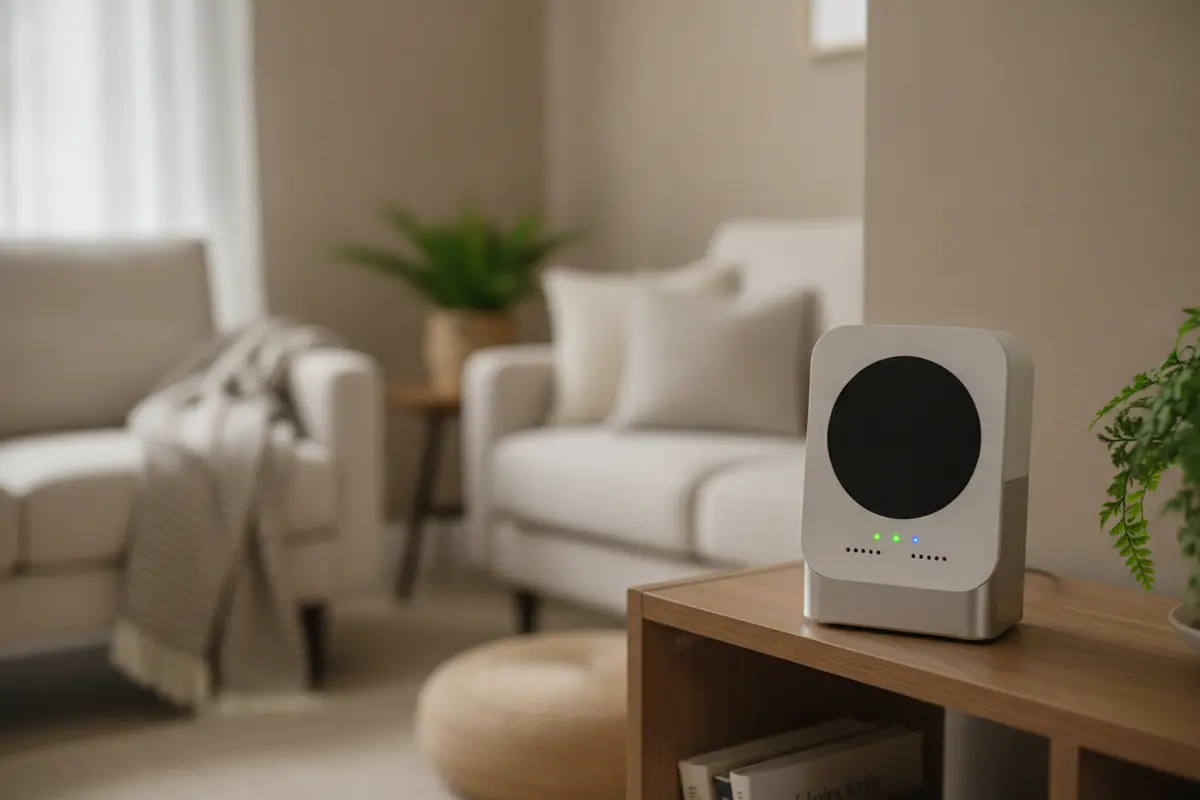
Keep a brief record of where the monitor was placed and what was happening when the reading changed. Note the room, time, occupants, open windows, cooking, cleaning, and other activities. That context makes a reading easier to understand than a number viewed by itself.
How can you make sense of changing readings?
Look for patterns that repeat under similar conditions instead of reacting to every brief fluctuation. Use the same device, room, approximate placement, and type of activity when comparing readings. A simple log can include the date and time, the displayed value and unit, what was happening, and how long the change lasted. Follow the manufacturer’s advice about averaging or settling time.
- Check the monitor. Confirm it is powered, unobstructed, operating within its stated conditions, and maintained as directed.
- Check the timing and surroundings. Think about occupancy, open windows, cooking, cleaning products, and other recent activities that may coincide with a change.
- Repeat the observation. Compare like conditions rather than unrelated moments. If the same pattern does not recur, record that too.
- Consider a safe, obvious source. For example, avoid smoking indoors and use kitchen exhaust while cooking when available. Do not take apart equipment or handle an unknown substance to test a theory.
- Get appropriate help if a concern persists. A monitor cannot identify every cause. Choose a qualified professional or relevant safety resource suited to the issue.
Imagine that a particle reading rises during dinner on several evenings but remains lower at other times. Record the cooking method, whether exhaust was used, and how long the reading takes to return toward its usual level. That repeated pattern offers a more useful clue than one isolated spike, although it still does not prove exactly what particles are present.
A different pattern calls for a different response. If a humidity reading changes after a shower, that is not the same observation as a persistent damp area or visible leak. The monitor records a room condition; it does not locate the source of moisture. For persistent moisture, investigate the building concern rather than expecting an HVAC monitor to diagnose it.
What should you do after an unusual reading?
First, identify exactly what changed. Check the display label and unit, then confirm in the manual what that sensor measures and how its alerts work. A colored status light or combined score may summarize several inputs; it does not necessarily name a pollutant. Do not compare it with a number from another brand unless the devices report the same measure on a comparable basis.
Next, check the monitor’s location and operating status. Look for a blocked inlet, a recent move, a low battery, or a maintenance reminder. If the device appears to be working normally, record the reading and what was happening nearby. Follow the manufacturer’s settling guidance before deciding whether the change continues.
- For a brief change: Note the time and activity, then observe whether the value returns toward its usual pattern.
- For a repeated change: Compare similar occasions and consider whether a practical source or activity coincides with it.
- For a persistent or unexplained concern: Seek guidance suited to the issue. A general air monitor cannot determine the cause by itself.
- For a safety alarm or immediate danger: Follow the alarm’s instructions. If a carbon monoxide alarm sounds or you suspect an immediate hazard, leave the area and contact emergency services or the appropriate safety authority.
For example, a short-lived particle increase after frying food is different from a repeated increase when no obvious activity is taking place. In either case, keep a simple record rather than guessing at a cause. If the reading does not settle or the concern recurs, share the model, reading, location, and timing with an appropriate professional. Do not treat an air monitor as a substitute for a dedicated safety alarm or as permission to remain in a space when an alarm directs you to leave.
What practical steps can improve indoor conditions?
Source control, ventilation, and filtration are useful starting points, but the right combination depends on the source, outdoor conditions, home layout, and equipment. A monitor can help you observe whether conditions change after a practical step. It cannot guarantee that a particular action has removed every pollutant.
- Reduce sources where possible. Avoid smoking indoors, use kitchen exhaust while cooking when available, and follow product labels when using cleaners and other household products.
- Ventilate appropriately. Outdoor air can dilute some indoor pollutants, but outdoor conditions matter. Consider smoke, pollen, and other local conditions before opening windows.
- Use a compatible HVAC filter. Follow the equipment and filter instructions for size, fit, and replacement. A filter that does not fit or is not suitable for the system can cause problems; do not choose one based only on a high rating.
- Pay attention to moisture. Use exhaust fans in damp areas when available, and address leaks or persistent condensation. A humidity reading alone does not identify where moisture is coming from.
- Maintain airflow equipment. Keep the heating and cooling system in good working order. It supports comfort and air movement, but it does not remove every pollutant or fix every indoor source.
Try one reasonable change at a time when practical, then observe under similar conditions. If you change the filter, open windows, and alter several other things at once, you may not know which change affected the reading. Record what you did, when you did it, and whether the pattern changed. Do not disable equipment or override its instructions to experiment.
If a concern seems connected to heating or cooling operation, our air conditioning service information explains our residential HVAC service context. You can also review our guide to home air-conditioning efficiency for related system-use considerations. Those resources are not a substitute for identifying a specific pollutant or arranging specialized testing where needed.
When should you ask an HVAC professional?
Consider contacting an HVAC professional when a comfort or airflow concern continues, rooms feel uneven, the system operates unusually, or you are unsure whether a filter or ventilation change is suitable for your equipment. An HVAC evaluation can focus on the system and airflow. It does not automatically include laboratory analysis, identify every possible pollutant, or diagnose a medical condition.
When you reach out, describe the rooms affected, when the issue began, the comfort or airflow changes, and what your monitor measures. Share the device model if available, where you placed it, the units displayed, and a few notes about readings and household activities. That information helps us understand what you have observed without treating the monitor as proof of a cause.
We work on residential heating and cooling concerns in the Winston-Salem area and surrounding Triad communities. For additional context, see our QRC HVAC and refrigeration services overview, our guide to heating and cooling in smaller homes, and our article on unusual air-conditioning odors. These pages address different HVAC questions; they do not claim that a monitor can test for or identify the source of an indoor air concern.
For example, if one room feels stuffy while another is comfortable, note when it happens and whether the system is running. If the monitor also tracks CO2, note the number of people in the room and how long they have been there. Share both observations, but do not interpret the CO2 value as a carbon monoxide warning. We can discuss whether the comfort or system symptoms warrant an HVAC evaluation.
Contact us to discuss a home comfort concern — call (336) 281-5144
Frequently Asked Questions
Do I need an indoor air quality monitor in every room?
Not necessarily. One device, placed according to its instructions, can help you observe conditions in the room where it sits, but it does not represent every room. Use another monitor only if you have a clear reason to track an additional space, and remember that different models may not be directly comparable.
Can an air quality monitor detect mold?
A typical consumer monitor does not identify mold or confirm that a home has a mold problem. Particle or humidity readings may provide context, but they do not establish a source. Address visible moisture and seek appropriate building or health guidance for a persistent concern.
Does a high CO2 reading mean the air is dangerous?
Not by itself. CO2 readings can vary with occupancy and ventilation, and a consumer reading needs context and should be interpreted using the device’s guidance. CO2 measurement is not carbon monoxide detection. Use a proper CO alarm for carbon monoxide protection and follow its instructions.
Can an HVAC filter remove every indoor pollutant?
No. Filters differ in what they capture, and some indoor air concerns are not particles that pass through an HVAC system. Use a compatible filter, maintain the equipment as directed, and consider sources and ventilation as appropriate.
What should I tell QRC if I call about an air quality concern?
Tell us which rooms are affected, when the concern began, what comfort or airflow changes you notice, and what your monitor measures. Include the device model, placement, timing of readings, and activities happening in the home. This gives us a clear starting point to discuss whether an HVAC evaluation may help.
Ready to discuss a home comfort concern?
A monitor can help you notice patterns, but understanding what may influence them takes context. If a persistent concern involves your heating or cooling system, contact us to discuss what you have observed and whether an HVAC evaluation is a practical next step.