A power outage can turn a dependable walk-in cooler or freezer into a business interruption before anyone has time to improvise. Restaurants, food-service operations, retailers, and other North Carolina businesses need a written plan that assigns responsibility, protects temperature-sensitive inventory, and names the site limits before the lights go out.
A commercial cold storage backup plan for North Carolina businesses should name who checks each unit and how temperatures are documented. It should also name which products move first, and when to call for help or use temporary storage. Refrigerated time/temperature control for safety food must be held at 41 F or below. Keep a calibrated thermometer and written emergency steps in the plan. Follow your health department on food disposition and when to stop operating.
Good preparation starts with decisions tailored to your facility rather than a one-size-fits-all promise. The next step is to define the people, equipment, temperature checks, power limits, and contingency options your operation can realistically manage.
Talk with our team about commercial refrigeration support
Call (336) 281-5144 to review the plan for your coolers and freezers.
What a commercial cold storage backup plan in North Carolina has to decide.
A commercial cold storage backup plan in North Carolina should be written before an outage, when the people responsible for food safety and operations can make clear decisions without working around a failing system. At a Greensboro restaurant, that may mean coordinating a walk-in cooler check with kitchen leadership. At a Winston-Salem distributor, it may require a plan for several cooler zones, loading activity, and product movement. The details differ, but the decisions should be specific enough that staff know what to do next.
We recommend putting four points in writing:
- Who is in charge: Name the person who starts the response, assigns checks, records temperatures, contacts refrigeration support, and decides when the facility must stop operating. Include a backup contact for nights, weekends, and staff changes.
- Which products move first: Identify the products and storage areas that receive priority if capacity, power, or access is limited. The plan should explain who can authorize movement and how staff protect product identity while relocating it.
- How temperatures will be read: Specify where readings are taken, how often they are logged, and which calibrated thermometer staff use. NCDHHS advises food establishments to check refrigerated time/temperature control for safety food with a calibrated thermometer and to keep a written emergency plan. Refrigerated TCS food must be held at 41 F or below. See the NCDHHS power-loss guidance and follow your local health department.
- Where product can go if the box cannot recover: List approved temporary options, decision-makers, access instructions, and the conditions that trigger a move. That could include another suitable on-site unit or temporary refrigeration, but availability and site fit must be confirmed rather than assumed. If a repair is not possible, NCDHHS identifies ice, time as a public health control, and a risk-control plan as temporary approaches, with follow-up on the repair.
This is different from guessing how long a closed box will stay cold. Our article on trailer hold time during a power outage addresses that separate question. A written plan instead establishes authority, priorities, measurement, and the next storage option. It should also tell staff when conditions are unsafe and when to stop operating, rather than relying on an informal estimate during the outage.
Sort product by risk before you sort it by dollar value
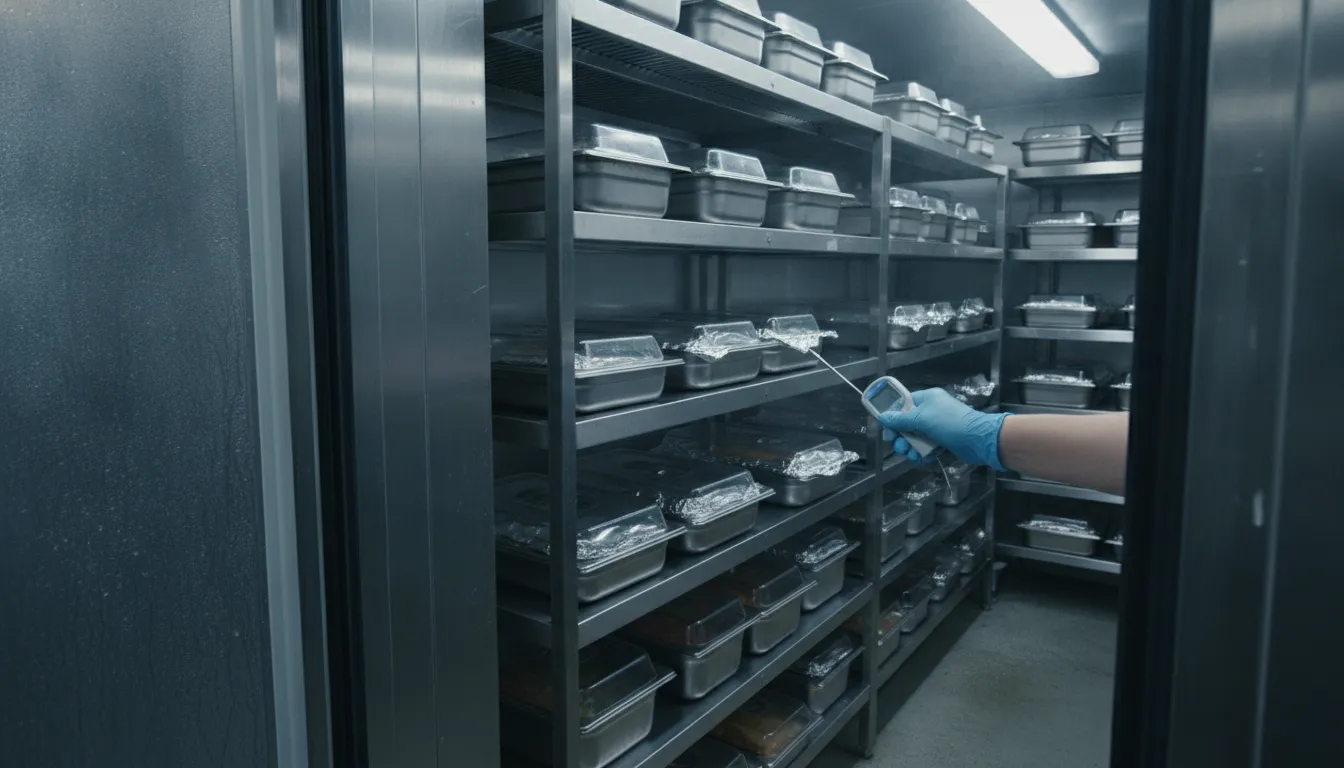
When a walk-in loses reliable cooling, we do not begin with the highest-cost case. We begin with the food most vulnerable to temperature abuse and the food that creates the greatest safety risk if its history is uncertain. That gives the team a practical order for moving product, checking conditions, and documenting decisions.
For refrigerated time/temperature control for safety food, North Carolina requires cold holding at 41 F or below. See North Carolina’s 41 F cold-holding rule as part of your written plan. We recommend recording the product temperature, the time of each check, and the temporary location rather than relying on memory.
| Product group | Why it moves first or last | What to record |
|---|---|---|
| Ready-to-eat TCS food | Move first because it may be served without a later cooking step and needs tight temperature control. | Temperature, check time, temporary location, and identifying details for the container or batch. |
| Raw proteins | Prioritize next, while preventing leaks or cross-contamination during transfer. | Temperature, time, location, and whether packaging remained intact. |
| Dairy | Move after the highest-risk foods, keeping it cold and separating damaged or questionable packages. | Temperature, time, location, and package condition. |
| Hardy produce and sealed frozen goods | These generally come later in the triage order, but staff should still document condition and temperature when applicable. | Temperature when applicable, time, location, and signs of thawing or damage. |
The NCDHHS emergency cold-holding chart supports emergency planning. It is not a universal discard schedule. Decisions depend on how warm food became and how long it stayed there. The same NCDHHS power-loss page tells establishments to discard TCS food that has been above 41 F for more than 4 hours. Use that rule with your health department and written plan, not as a substitute for either one.
FDA guidance for households offers a useful contrast, not a commercial guarantee. A closed home refrigerator may stay cold for about four hours, while a full home freezer may hold for about 48 hours, according to FDA food safety guidance for power outages. Those figures do not establish a safe holding time for a commercial walk-in. Food-safety decisions stay tied to measured conditions, documented time, and your approved plan.
Match backup power and temporary boxes to the building
A backup plan is only useful when it matches the refrigeration equipment, the building, and the people responsible for the response. We can help you identify what needs to stay cold and whether the equipment can restart and hold after power returns. We do not design electrical service. A licensed electrician owns the generator connection, distribution, and other electrical work.
- List the refrigeration circuits that matter most. Identify each walk-in cooler, walk-in freezer, display case, compressor, condenser, control, and other circuit that must operate. A generator plan should name the refrigeration circuits it can actually carry, not simply assume that the entire building can run normally.
- Assign the people who will act. Decide who starts or checks the generator, who verifies the refrigeration equipment, who monitors product temperatures, and who can stop operations if conditions become unsafe. Keep a calibrated thermometer with that assignment so refrigerated TCS food can be checked against the 41 F holding line.
- Review fuel, exhaust, and connection safety. Confirm the fuel responsibility and inspection process before an outage. The generator location must keep exhaust away from occupied areas and provide a safe electrical connection. We can discuss whether refrigeration equipment can restart and hold, while the licensed electrician determines how the building is connected safely.
- Check the site before choosing temporary capacity. Look at dock or lot access, power at the parking spot, the door path for product, and who approves moving food or equipment. Depending on the site and the emergency, we can talk through when a refrigerated trailer rental makes sense or mobile walk-in freezers for emergency storage. Fit and availability need to be confirmed for the specific building. We do not treat a trailer as a guaranteed number of cold hours.
- Set the call list and review triggers. Keep contacts for the facility lead, electrician, refrigeration provider, equipment decision-maker, and health department with the plan. Include the point at which the business pauses operations or moves product. For broader planning or a site review, our North Carolina commercial refrigeration services can be part of the conversation. We use the building, equipment, and access conditions to choose a practical next step rather than promise a one-size-fits-all backup.
Temporary refrigeration can support emergency storage, but it does not remove the need for temperature checks, safe handling decisions, or a qualified electrical review. Walk the plan with your operations team before an outage so responsibilities and site limits are already clear.
Write the call script before the cooler fails
A useful plan includes a short call script that anyone on the team can use. Keep it with the emergency contacts, not only in one manager’s inbox. When you call us, start with the site address and the best person to meet a technician. Then identify the equipment: a walk-in cooler, a walk-in freezer, or a reach-in line.
Next, note when the problem started and the current product temperature. If you have a calibrated thermometer, record the reading and the time it was taken. Tell us whether the doors have stayed shut, whether anyone moved product, and whether the unit is showing an alarm or fault code. A brief alarm history can help us understand what the equipment was doing before the call.
Include the operational decisions already made. Tell us whether a generator is part of the plan, whether temporary refrigeration is being considered, and who is responsible for food-safety decisions. Do not assume a generator or temporary box will fit every site. Electrical limits, access, equipment capacity, and the condition of the product all matter. Follow your health department’s emergency plan while the equipment is being assessed.
This preparation is different from responding to a walk-in failure during business hours. That page covers the live failure. This page is the plan written ahead of time. If you need commercial refrigeration support, share the script and your temperature notes so we can discuss the next step. Keeping up with commercial refrigeration maintenance can also help the team spot concerns before an outage becomes an emergency. Our walk-in freezer repair guide is a separate reference for ice, door, and temperature symptoms once a freezer is already in trouble.
If the outage shows that the equipment needs a major repair or replacement, we can review multiple financing options, including options for challenged credit. The scope may include more than the box itself, so we look at the site and the work required before discussing a path forward. We do not quote a price from a phone description.
Practice the plan on a normal week, not during a storm
A backup plan that stays in a binder is not much help when a cooler stops holding temperature. We recommend a short quarterly drill for kitchens, warehouses, and other commercial cold-storage sites in Winston-Salem or Greensboro. Run it during a normal operating week, when the team can notice gaps without also managing a storm, a delivery rush, or a full loss of power.
Start with the instruments staff will actually use. Read two probe thermometers against the box display and record the results, including the time and the equipment checked. If the readings do not agree, assign someone to investigate the thermometers and the refrigeration system before an emergency. Your food-safety procedures still control what happens to the food.
Next, ask the people named in the plan to confirm their roles. A quick drill should answer these questions:
- Is the decision-maker list current, including an after-hours contact?
- Who checks temperatures, documents conditions, and contacts service?
- Who decides what can be moved, held, or taken out of service under your approved procedures?
- Does the alarm reach a person after hours, and does that person know what to do next?
Walk the physical route as well. Have someone trace the path a pallet would take from the cooler or freezer to the intended trailer spot. Look for locked doors, narrow turns, loading conflicts, blocked access, and missing keys. A plan that depends on a temporary unit should be checked against the actual layout, not an assumption made in an office.
We can help turn those observations into a repeatable routine. Use our quarterly refrigeration maintenance checklist alongside walk-in cooler preventive maintenance. Maintenance lowers the chance of failure, but it is not a promise the system will never break. For a site-specific review, contact our Winston-Salem team.
Schedule a cold-storage planning conversation
Call (336) 281-5144 before the next outage, not after product is already warm.
Frequently Asked Questions
Can one written backup plan cover every walk-in?
No. We build the plan around the specific box, stored products, monitoring points, power setup, access, staffing, and escalation contacts. The plan should identify who checks temperatures, who documents decisions, and when operations stop. For North Carolina food establishments, refrigerated time/temperature control for safety food must be held at 41 F or below, and NCDHHS recommends a written emergency plan and a calibrated thermometer during a power loss. Follow your health department’s direction for disposition decisions.
Do household refrigerator times apply to a commercial walk-in?
No. FDA household guidance says a closed refrigerator keeps food cold for about four hours. A full home freezer may hold about 48 hours. That is household guidance, not a guarantee for a commercial walk-in or a refrigerated trailer. Commercial decisions depend on the equipment, the load, the readings, and door openings. Document the actual readings and follow your regulator’s emergency plan.
When is a generator not enough for cold storage?
A generator may not solve the problem when the refrigeration equipment has a separate mechanical failure, the electrical connection is not suitable, fuel or transfer arrangements are unavailable, or the site cannot operate safely. It also does not replace temperature monitoring or food-safety decisions. If the box cannot maintain 41 F, assess the refrigeration system and the site’s contingency options instead of treating restored power as proof that the food is safe.
Is a refrigerated trailer always the right backup?
No. A trailer may not fit the site’s access, capacity, loading, product separation, power, or sanitation needs, and availability has to be confirmed. A mobile walk-in or another temporary measure may fit better, while some facilities need repair or a documented risk-control plan. For questions about refrigerated-trailer hold time during an outage, see our Thomasville trailer hold-time guide rather than assuming one answer fits every site.
Talk through the plan before the next outage
We can review the backup plan and the refrigeration equipment it depends on, so the team has a clearer next step when conditions change. Call us at (336) 281-5144, or start with our commercial refrigeration support page. We will focus the conversation on your facility and the equipment that keeps stored products protected. A phone call and an on-site look are the right next step. This article is not a substitute for that visit or for your health department’s direction.